





 Portuguese
  English
  Spanish
  4 min of reading
  1 comment


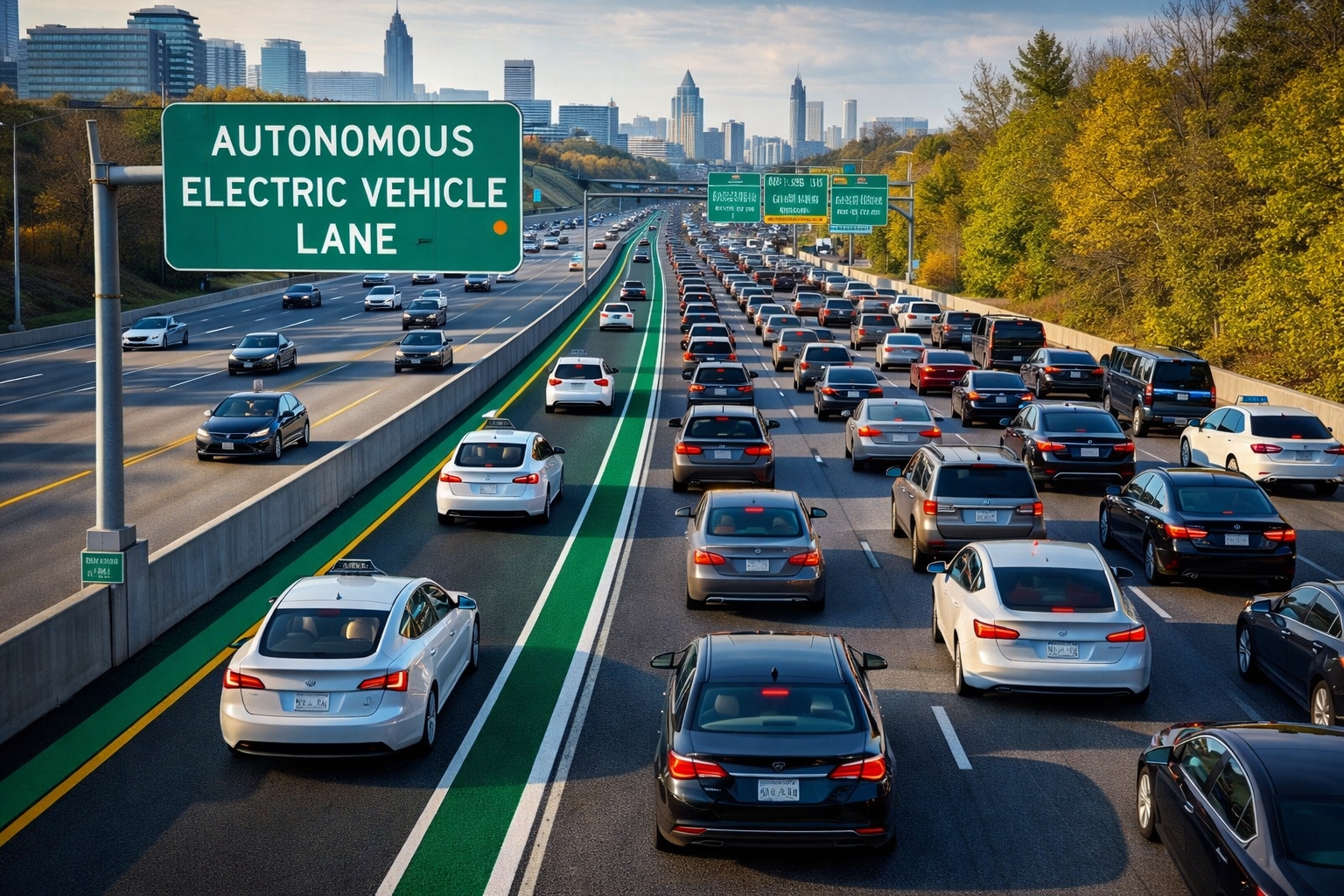

U.S. Company Launches Public Automated Transport Test in Atlanta with Electric Driverless Cars on Exclusive Track, Promising to Move Many People Per Hour at Bus Fare Prices.
Move 10 thousand people per hour within a lane just 2 meters wide. This is the promise that has just come to fruition in Atlanta and has put engineers, public managers, and investors on alert.
The project began to be implemented in the southern part of the city and is expected to open for free testing in December 2026. The proposal is straightforward: to create a new layer of urban transport without competing for space with the already saturated traffic.
If the numbers are confirmed, the impact could reach everyone from transport operators to construction companies specializing in large railway works.
-
Friends have been building a small “town” for 30 years to grow old together, with compact houses, a common area, nature surrounding it, and a collective life project designed for friendship, coexistence, and simplicity.

-
This small town in Germany created its own currency 24 years ago, today it circulates millions per year, is accepted in over 300 stores, and the German government allowed all of this to happen under one condition.

-
Curitiba is shrinking and is expected to lose 97,000 residents by 2050, while inland cities in Paraná such as Sarandi, Araucária, and Toledo are experiencing accelerated growth that is changing the entire state’s map.

-
Tourists were poisoned on Everest in a million-dollar fraud scheme involving helicopters that diverted over $19 million and shocked international authorities.


The Urban Bottleneck That Costs Billions and Opened Space for an Unconventional Solution
Large cities face congestion that drains productivity and raises logistical costs. Adding more vehicles to the same streets does not solve the problem. According to experts, it may even make it worse.
Glydways’ bet comes from a simple rationale: create entirely new capacity, without competing with what already exists.
Instead of using open roads, the system operates in dedicated corridors, specifically built for electric autonomous vehicles. No sharing space with conventional cars or buses.
The pilot connects the ATL SkyTrain to the Georgia International Convention Center and the Gateway Center Arena, over a stretch of 0.8 kilometers. It may seem short, but it serves as a strategic testing ground.
The Engineering Behind the Electric Pods That Operate Without Driver and Traffic Lights
The system uses small electric passenger vehicles that travel on exclusive lanes, coordinated by software with artificial intelligence.
The user requests the ride via an app and goes straight to their destination, with no intermediate stops. The flow is continuous, organized, and independent of traditional traffic.
The striking figure is the operational density. The company claims that the full model can achieve 10 thousand passengers per hour in a single corridor with 2 meters width.
Translating the scale, it means concentrating the flow equivalent to a light rail system within a space narrower than many urban bike lanes. The promise is bold.
The Quiet Competition Between Traditional Tracks and the New Compact Infrastructure
Urban railway projects typically require high investments and long construction timelines. Estimates indicate that conventional systems can cost hundreds of millions of dollars.
The company’s proposal aims to reduce implementation time and structural expenses. No official figure has been released for the pilot’s cost in Atlanta.
The economic model relies on three pillars: driverless operation, electric propulsion, and reduced maintenance in a controlled environment. The declared goal is to operate without subsidies, with fares at a level similar to those of buses, although no amounts have been announced yet.
If this equation works, traditional operators may face competitive pressure. Otherwise, the system will join the list of experiences that did not scale.
The Test in Atlanta That Could Open Doors for Airports and Suburban Corridors
The location was not chosen randomly. The route connects convention centers and a sports arena to an existing system, within a predictable and controlled environment.
The Metropolitan Atlanta Rapid Transit Authority is conducting a feasibility study to assess performance and decide on potential expansion in the metropolitan area.
If approved, the model could provide airport connections, suburban routes, and high-traffic areas where implementing traditional tracks is often considered too expensive.
The company has also made agreements with authorities in Dubai and Abu Dhabi and is holding talks in places like Tokyo, Florida, California, and New York. The test in Atlanta serves as a global showcase.
The Real Test Is Not Technical, It’s Financial
Autonomous vehicles in dedicated corridors do not represent a novel engineering challenge. The decisive factor lies in large-scale economic sustainability.
Operating twenty-four hours a day, keeping fares affordable, and sustaining maintenance with revenue will require strict efficiency.
December 2026 will mark the beginning of this public evaluation. From then on, managers and investors will have concrete data to decide whether the model represents a new standard of mobility or just a limited experiment.
The project draws attention because it touches on one of the most sensitive sectors of modern cities: transportation. Solving congestion without expanding roads and without large railway works is a promise that affects public budgets and urban planning.
And you, do you believe that compact and automated systems can compete with subways and light rail systems in large cities? Share your opinion in the comments.










Não é universal!