





 Portuguese
  English
  Spanish
  7 min of reading
  16 comments


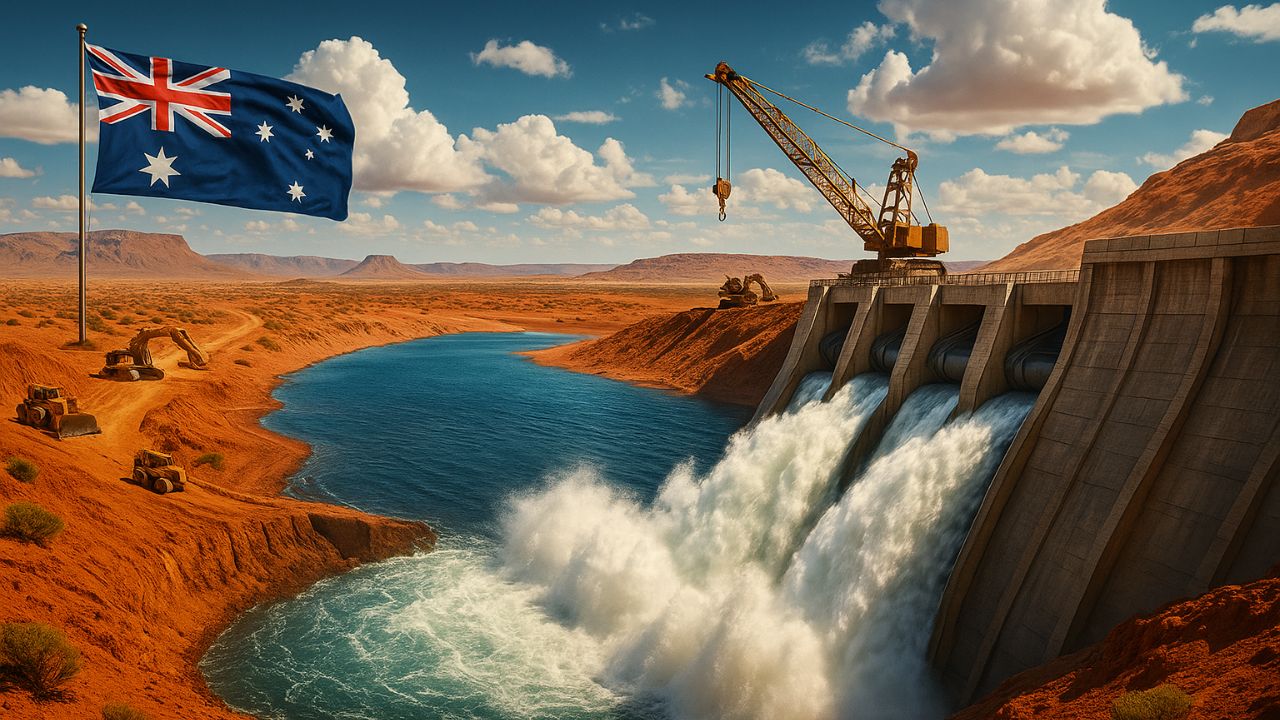


Megaengineering Project Plans A Giant Sea In The Australian Desert, With Desalination Plants, Pipelines, And Solar Energy To Transform Climate, Ecosystems, And Inland Cities
The idea of building a giant sea in the desert of Australia emerged as a response to an extreme challenge: a country of continental dimensions, with a large part of its territory dry, sparsely populated, and under increasing pressure from more severe droughts. More than just an infrastructure project, it was conceived as a way to change the climate of the inland, create new productive areas, and reduce the vulnerability of regions facing water collapse.
Over the course of nearly a century, engineers and governments have discussed different versions of this plan, ranging from diverting rivers to pumping water from the ocean hundreds of kilometers away.
The proposal for a giant sea in the Australian desert was estimated to cost around 200 billion dollars, covering an area larger than the sum of Mato Grosso do Sul and Bahia, capable of changing the environmental and economic landscape of the country.
-
The section of Serra da Rocinha on BR-285 is now open in Timbé do Sul: 50 m tensioned curtains and top-down technique stabilize the slope, with a stairway duct controlling the water.
-
Scientists use sawdust mixed with clay to create a lighter brick, promising efficient thermal insulation and impressing by transforming waste into a solution for construction.

-
With a DNA shape, this bridge in Singapore draws attention in modern architecture and surprises tourists by transforming a simple crossing into an unforgettable visual experience in the urban heart.
-
Giant underwater pipeline begins to take shape with a R$ 134.7 million project at the Port of Santos: the 1.7 km structure uses 12-meter and 700 mm pipes to supply water to 450,000 people in Guarujá.

A Giant Country With An Almost Empty Interior
Australia is similar in size to the United States, but the population distribution is extremely uneven. About 80 percent of the country is sparsely populated, with vast areas of desert and extreme climate in the interior.
The population is concentrated in a relatively narrow strip along the coast, where cities such as Sydney, Brisbane, and Perth are located.
In the center of the country, the so-called Outback is one of the largest population voids in the world. There are areas the size of the state of Amazonas with fewer inhabitants than a single densely populated neighborhood in large Brazilian capitals.
In the Outback, summer temperatures easily exceed 45 degrees, winter can see temperatures drop below zero, and rain can take years to fall.
The soil, in many places, is so dry and salty that it resembles the most arid backlands. Basic services, such as health and communication, are scarce.
In some isolated regions, a single bottle of water can cost the equivalent of a full meal at a diner. Historically, European colonizers avoided this hostile interior and established their cities on the coast, reinforcing the contrast between a relatively fertile coastline and a barren, emptied center.
The First Dream Of A Giant Sea In The Desert
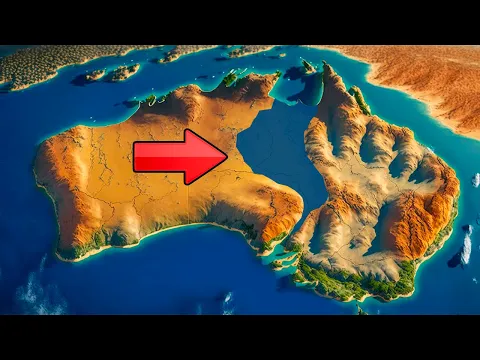

In the 1930s, engineer John Bradfield, known as one of the great names in Australian engineering and responsible for the Sydney Harbour Bridge, presented a plan that seemed like science fiction.
The proposal was to create a giant sea in the desert by redirecting waters from tropical floods in the northern part of the country, especially from Queensland, to the basin of Lake Eyre, a large natural depression approximately 15 meters below sea level.
To achieve this, Bradfield designed a network of dams, pumps, and channels stretching over 2,300 kilometers. The idea was similar to a super-scale canal but with a different goal: instead of connecting oceans, it aimed to transform a desert into a vast permanent lake.
This inland sea would help cool the regional climate, generate hydroelectric power, and allow for large-scale agriculture.
From time to time, Lake Eyre does fill with monsoon rains and temporarily transforms into a wet environment brimming with life. Bradfield’s plan sought to make this phenomenon constant, creating a new ecosystem in the center of the country.
In terms of ambition, the giant sea project in the Australian desert resembled the largest water transfers in the world, but on an even bolder scale.
However, the project never got off the ground. High costs, technical complexity, and environmental concerns derailed the proposal. The failure of the Aral Sea in the former Soviet Union, where river diversion for irrigation caused the sea to shrink by about 90 percent, served as a warning about the risks of altering natural systems on a large scale.
In 1970, the idea was officially shelved, although the concept of an inland sea has been discussed at various times since.
Historic Drought And Fires That Rekindle The Mega-Idea
Since 2017, eastern Australia has been facing the worst drought in four centuries. Medium-sized cities, such as Tamworth, with tens of thousands of residents, began relying on army water trucks for drinking water. In smaller municipalities, families received daily water limits that barely covered the minimum for cooking and basic sanitation.
In the countryside, the situation was even more severe. Without water to maintain livestock, many producers had to cull their own cattle. In three years, the country lost about a third of its cattle herd, and properties began to be abandoned after generations of the same family on the land.
Subsequently, the summer of 2019 to 2020 was marked by large-scale fires, resulting in billions of animals dead, smoke visible for thousands of kilometers, and severe impacts on forests and coral reefs.
Dams built over decades, with investments in the range of tens of billions of dollars, became empty. Desalination plants helped major cities, but did not reach the interior.
In this scenario of prolonged drought, intense fires, and collapse of traditional water systems, the proposal for a giant sea in the desert gained renewed attention as a potential structural response to Australia’s water and climate crisis.
Giant Sea In The Desert 2.0: How The New Project Would Work
The recent version of the project, described as a kind of inland sea 2.0, updates the old dream with modern technologies. Instead of relying solely on rivers and tropical floods, the proposal is to pump water from the ocean over more than 600 kilometers into the interior, supported by three main pillars:
- desalination plants distributed along the coast
- large solar plants to supply energy to the system
- a network of pipelines and pumping stations to transport large volumes of water
The goal remains to form a giant sea in the desert in the region of the lake basin, creating a permanent water body in the heart of the country.
Saltwater would help reduce evaporation, and the large-scale water surface could influence wind and moisture circulation.
Models indicate a potential increase in rainfall of up to 15 percent within a radius of about 100 kilometers, with the possibility of new urban centers emerging.
The estimated cost for implementing the system exceeds 200 billion dollars, a figure higher than some of the largest space programs in history.
The proposal for a giant sea in the Australian desert is regarded, even by its proponents, as one of the largest megaengineering projects ever planned, with a construction timeline spanning decades.
Climate, Ecosystems, And Culture: What Could Change

If built, the inland sea would profoundly alter the environment of one of the driest regions of Australia. Increased humidity and rainfall could recreate landscapes, favor distinct vegetation, and open up space for agriculture in areas now considered impractical. At the same time, the advance of salinity is one of the main points of concern.
Saltwater, if not controlled, could sterilize the soil around the lake, hinder cultivation, and create conditions similar to those of other extremely saline bodies of water.
There are scenarios in which, a few years after the formation of the sea, the combination of evaporation and salt concentration would lead to an environment of difficult ecological balance.
Another central factor is the impact on local communities and indigenous peoples. The lake area is considered sacred to the Arabana people, who associate the site with ancestors and spiritual traditions.
For these groups, flooding the area to create a giant sea in the desert would equate to transforming a sacred territory into infrastructure, raising complex social and cultural questions.
From an economic standpoint, critics argue that the same resources could fund thousands of smaller desalination plants, rainwater harvesting programs, water recycling, and drought-adapted agriculture, yielding more distributed and predictable results.
Supporters of the project, on the other hand, maintain that piecemeal interventions would not be sufficient in light of the magnitude of the climate crisis and advocate for a leap in scale.
Megaengineering Or Distributed Solutions: The Debate Remains Open
At this moment, the giant sea in the desert project remains under study, with assessments of environmental impact, costs, social risks, and long-term returns.
There is no consensus among experts, local communities, and public policy makers about the best path forward.
The construction, if approved, would only begin in the coming years and extend over decades, requiring ongoing political and financial commitments.
For some, the initiative represents a bet on the radical transformation of the geography and climate of an entire region. For others, it poses a high risk at a time when flexible, decentralized solutions tailored to different territories gain momentum worldwide.
The debate surrounding the giant sea in the Australian desert encapsulates a central question of the 21st century: to what extent should megaengineering be used to try to correct or compensate for the effects of large-scale climate change.
And you, what do you think? Should Australia move forward with the plan to create a giant sea in the desert or prioritize smaller, distributed solutions to tackle drought and the water crisis?









Debe implementar el proyecto
Siiii!!!!!!!
Mi opinión es todo lo contrario; con 200 millones se podría crear una planta des salinisadora jigante y construirse varias piscinas gigantes con agua des salinizada creando bomberos de agua desde el océano y partecde esa agua des salinidad puede tratarse y cortarse para uso humano reforsando Grandemente el suministro de agua potable y otra parte de esa agua sin tratar se puede usar en parcelas grande de terreno en el desierto con sistema de riegos por goteo para tener un me jor uso del recurso líquido, y esa seria una solución más barata y más viable que viene a mitigar el suministro de agua algunas poblaciones más lejanas a la capital, lo segundo: este sistema vendria a sacarle mucho provecho al desierto con la agricultura por medio de sistema de riegos y a convertir parte del desierto en zonas productivas económicamente hablando y creando una fuente de producción de alimentos, provocando baja en algunos productos que quizas se tengan que importar para el consumo humano y por último esto podría ser también rentable y productivo en la producción de energía hidroeléctrica, que también podría ser benefactor para el estado y para la misma población, es un bonito proyecto, es mucho más barato, puede ser gran parte de sus costos de manutención autosustenible y abriría espacio a la agricultura, la ganadería, revivirla los suelos con el riego a goteo y se le sacaría muchísimo provecho alas aguas del océano y al suelo reseco y seretico sin desaprovechar ni mal gastar el recurso líquido como es el agua., esta es mi opinión Gracias por permitirme opinar.