





 Portuguese
  English
  Spanish
  6 min of reading
  3 comments


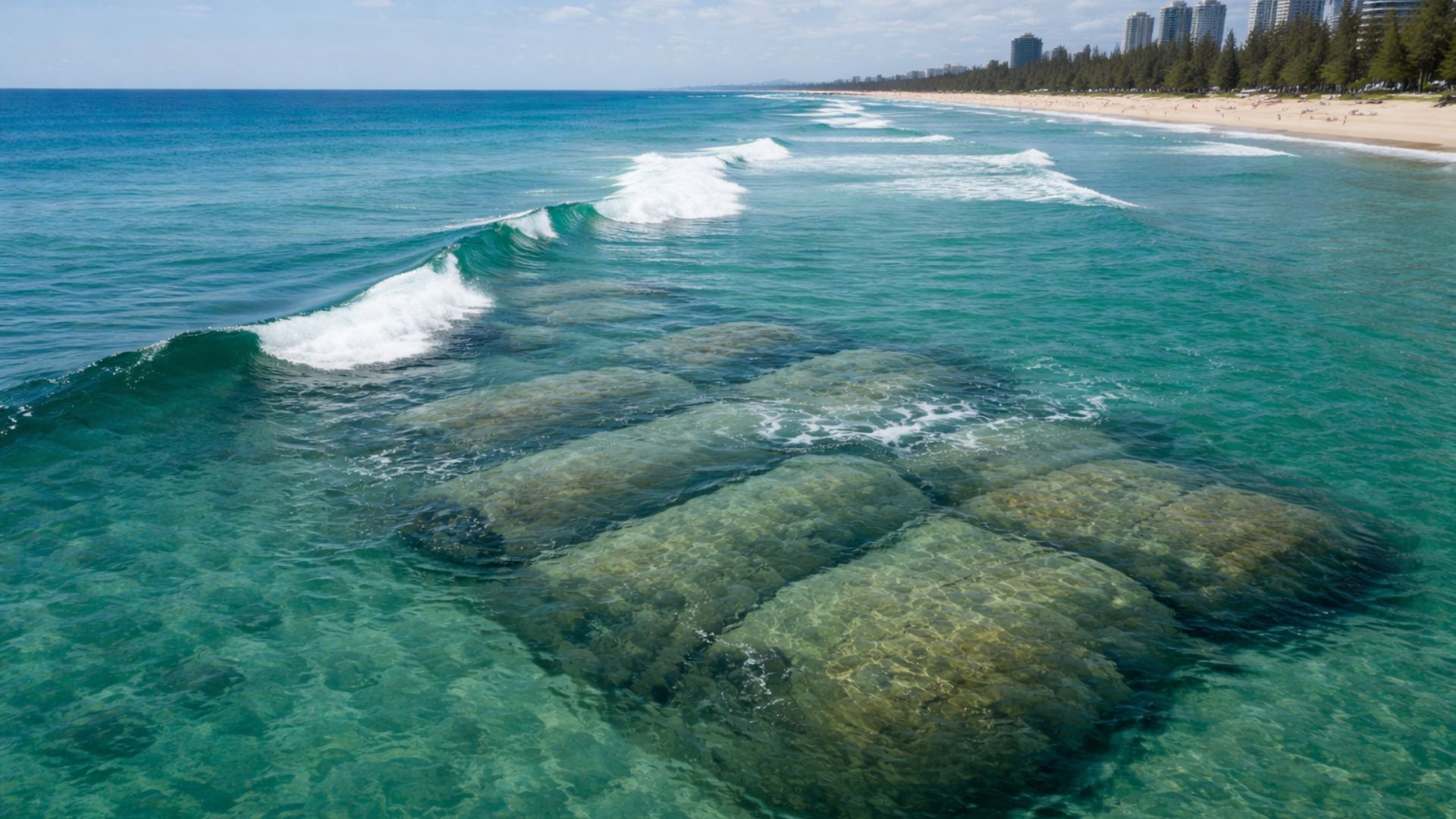


Underwater Structures on Gold Coast Use Geotextile Megabags Filled With Sand to Change Wave Behavior and Protect a Vulnerable Stretch of Beach in a Discreet Offshore Intervention That Also Became Known for Attempting to Influence Wave Quality for Surfing, Merging Coastal Engineering and Recreation.
A structure that doesn’t seem like a construction when viewed from the beach, but functions as coastal defense when the sea thickens, was installed along the Gold Coast in Australia, using an unintuitive method: large geotextile bags filled with sand, positioned on the seabed to form a submerged artificial reef.
The installation, known as Narrowneck Reef, was designed to reduce the force of waves reaching the beach in an area with a history of erosion, combining coastal engineering with a side effect that caught attention outside the technical field: the attempt to improve wave quality for surfing.
Submerged Artificial Reefs and Coastal Protection
What makes the project unusual is not only the fact that it is out of sight, but the material chosen.
-
Oldest tree on the planet reappears after 130 years of searches: Wattieza, 385 million years old, was 10 meters tall and had no leaves or seeds; Gilboa fossils in New York solved the mystery in 2007.

-
A 48-square-meter house assembled in hours with 4,000 bricks made of recycled plastic that does not absorb moisture, has natural thermal insulation, and costs less than 90,000 reais in a complete kit.

-
Luciano Hang revealed that Havan’s air fleet has already accumulated more than 20,000 landings, 10,000 flight hours, and 6 million kilometers traveled, and he says that without the planes, the company would never have grown so quickly.

-
A historical discovery in the Andes Mountains reveals a gold deposit valued at 770 billion reais hidden over 4,000 meters above sea level on the border between Chile and Argentina, and the whole world is watching.


Instead of concrete blocks or metal structures, the reef was constructed with “geobags,” geotextile bags filled with sand which, when placed on the seabed, form volumes capable of interfering with wave behavior.
In practice, the set acts as a submerged barrier that weakens part of the energy that would reach the beach with full force, helping to reduce the impact of storm surges and larger waves on a stretch described by local management as narrow and susceptible to sand loss.

Why Use Geotextile With Sand Instead of Concrete
The choice for a submerged reef also addresses a recurring dilemma in tourist regions: protecting the coast without transforming the landscape into a wall.
Visible structures, such as traditional breakwaters and walls, can alter beach use, generate unwanted effects in neighboring stretches, and create conflicts with recreational activities.
In the model adopted at Narrowneck, the intervention remains offshore and submerged, with the aim of influencing wave and sediment dynamics without imposing a rigid and permanent barrier along the coastline.
Erosion at Narrowneck and Monitoring on the Gold Coast
According to the City of Gold Coast, the Narrowneck area has a history of severe erosion, and the artificial reef was built offshore with geotextile to reduce the power of the waves breaking on the beach.
The same source states that the structure was installed in the late 1990s as part of a coastal protection effort and, years later, underwent a renewal with new geotextile bags to extend its lifespan.
The central point presented by the administration is that monitoring indicates an increase in the beach’s resilience against the impacts of storms and large swells, precisely the type of event that tends to accelerate sand loss in vulnerable stretches.
How the Structure Affects Waves and Sediments
The mechanism of action of a submerged reef begins before breaking.
When encountering a rise on the seabed, the wave changes shape and loses part of its momentum, redistributing energy and altering local current patterns.
In a coast with a history of erosion, small differences in this balance can be decisive, as the available sand is constantly moved by waves and currents.
When the incident energy is attenuated, the environment tends to become less aggressive for the sandy stretch, which helps the beach withstand periods of stronger seas with less accumulated damage.
Geobags: “Resistant Skin” and Sand Body

The geobags enter this equation as an engineering solution that uses the very natural material of the coastal system, sand, as the main body of the structure.
The geotextile acts as “resistant skin”, containing the sand and allowing the reef to maintain its shape and volume on the seabed.
This choice also aligns with a practical demand: interventions in marine environments need to reconcile logistics, durability, and maintenance.
In the case of Narrowneck, local administration highlights that the reef was renewed in 2018 with more geotextile bags, a measure associated with the extension of the project’s lifespan.
Surfing, Tourism, and Global Curiosity About Narrowneck Reef
The connection with surfing emerges as a point of public interest and part of the perception of the reef.
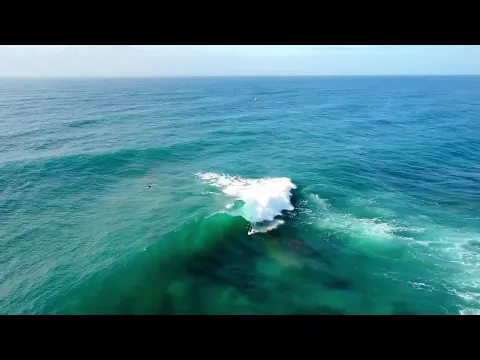
Artificial reefs can modify how waves break, creating longer or more consistent lines under certain conditions.
Although the main function attributed to Narrowneck is coastal protection, the institutional description itself emphasizes that it is an artificial reef, and the association with wave quality helps explain why this type of work arouses global curiosity: the same intervention that seeks to curb erosion can directly influence a sport that drives tourism, local commerce, and cultural identity in coastal cities.
Invisible Structure That Depends on Continuous Monitoring
This type of installation is also often observed for another reason: being submerged, it requires monitoring to assess performance and impacts.
The City of Gold Coast states that monitoring is ongoing and that the observed results indicate improvements in the beach’s ability to withstand storms and large swells.
In journalistic terms, this transforms the work into a case that does not end with the inauguration, as its effectiveness is measured in tidal cycles, seasons of the year, storm surges, and gradual changes in the beach profile.
Coastal Engineering Without a Wall in the Landscape
The story of Narrowneck Reef is often used as an example of how coastal works can adopt solutions outside the more commonly known repertoire of the public, which generally associates coastal protection with walls and large blocks.
By opting for a submerged structure constructed with geotextile bags filled with sand, the intervention distances itself from the stereotype of the “wall against the sea” and approaches an approach that works with the natural dynamics of the coast, influencing waves and sediments instead of just blocking the water at the last moment.
Maintenance, Reinforcements, and Adaptation to Dynamic Coastlines
For those living far from the ocean, the idea of “building a reef” with technical fabric bags filled with sand may sound strange, almost improvised.
In practice, it is an application of coastal engineering that seeks a calculated effect on wave energy and how the beach responds to extreme events.
For coastal cities with strong tourism, the combination of protection and potential impact on wave quality gives the project a social component that goes beyond the technical debate, bringing the subject closer to the everyday lives of residents, merchants, and beachgoers.
At the same time, the fact that the structure is renewed over time reinforces an important characteristic of this type of solution: it is not a “definitive object”, but an intervention that may require reinforcements and adjustments, especially in very dynamic coastlines.
The very institutional reference to the reinforcement made in 2018 indicates that the strategy involves maintenance and adaptation, rather than relying on a single static work forever.
If a city manages to reduce erosion with a submerged reef made of geotextile bags, while still influencing the shape of the waves, why is coastal protection still imagined almost always as exposed concrete on the beach line?







This must be a very old article i live on the Gold coast and the said geotextile bags are now all destroyed from eager fishermen anchoring over the reefs and tearing them apart,they had to introduce a no anchor policy to preserve what was left.
Oh good let’s add some more plastic to the mix
As a pilot I have been able to study reefs and and swell patterns for many years, and came to realise that such subsurface reefs create nodes on the shore line with bays in between, creating a model of the sea bed on the shore. The problem could be when the bays erode the shore line. Keep up the good work.