





 Portuguese
  English
  Spanish
  4 min of reading
  11 comments


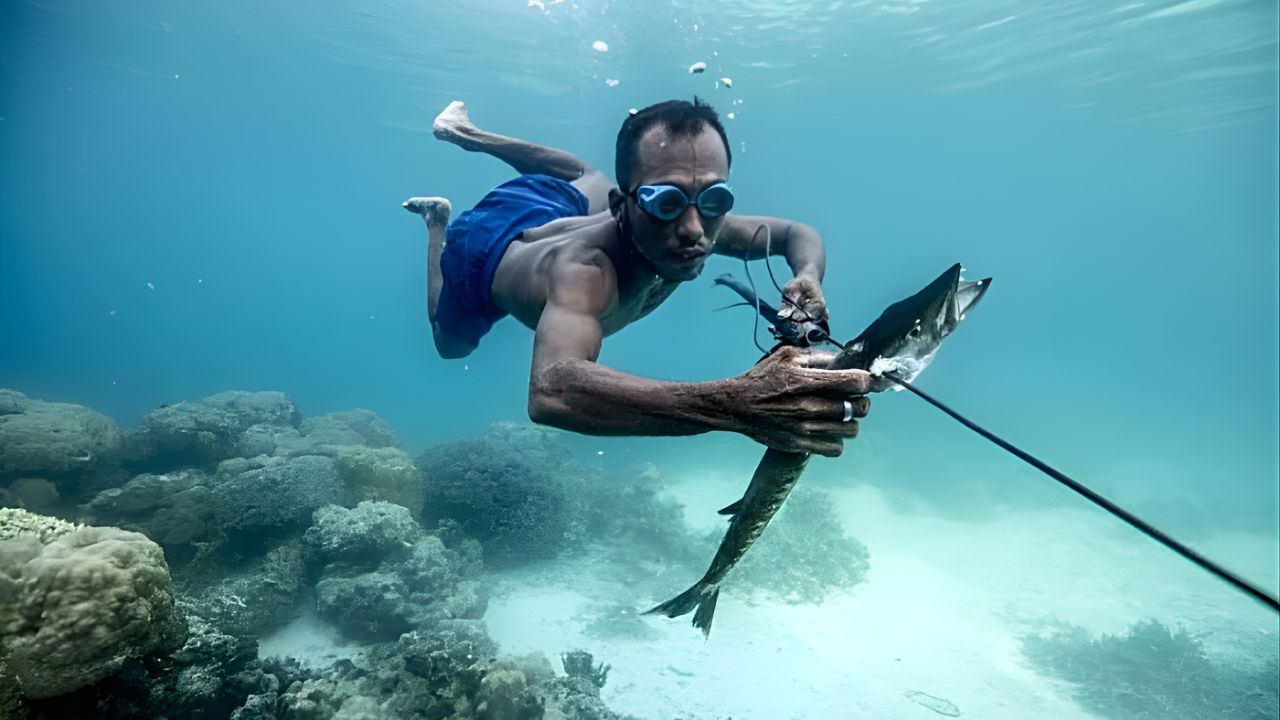


Discover How the Bajaus, the “Sea Nomads,” Developed Genetic Adaptations That Enable Them to Dive Deep Without Equipment. Learn How Their Lifestyle Shaped the Human Body Uniquely, with Scientific and Cultural Implications.
Who Are the Bajaus, Where Do They Live, and How Do They Manage to Dive for So Long? Researchers discovered that this group of people from Southeast Asia, known as Bajaus, developed unique physiological and genetic adaptations over more than a thousand years at sea.
They can hold their breath for several minutes and reach impressive depths while foraging for food in the waters of the Philippines, Malaysia, and Indonesia.
This phenomenon occurs because their bodies have been shaped by natural selection, particularly in a gene linked to spleen size, a vital organ for storing oxygen during dives.
-
With a cost per shot close to zero, the DragonFire laser could change naval warfare in 2027 and provide British ships with nearly unlimited defense against drones.

-
A British startup creates tires that generate electricity in electric vehicles when passing over potholes, speed bumps, and cracks.

-
Scientists have created robots made with living cells that have their own nervous system, swim on their own, explore the environment, and self-organize without any genetic engineering, and now they want to do the same with human cells.
-
Students create a solar-powered ambulance that operates without a plug, without fuel, and still keeps medical equipment running in remote areas.

Bajaus and Their Genetic Adaptation for Deep Diving
The Bajaus are often referred to as “sea nomads” for spending much of their lives on boats or stilt houses in the ocean.
Unlike most people, who can only hold their breath for a few minutes, some Bajaus can stay submerged for up to 13 minutes and dive to depths of dozens of meters to fish or collect shells and other marine resources.
A study published in the scientific journal Cell revealed that this extraordinary ability is not only the result of training but also of genetic adaptations.
Researchers identified variations in a gene called PDE10A that appear to increase the size of the spleen in Bajaus.
This organ acts as an extra reservoir of oxygen-rich blood cells, enabling them to keep more oxygen available during dives.

The Role of the Spleen in the Diving Response
The spleen is a relatively discreet organ in the human body, but it plays an essential role in the diving response.
When a person dives and holds their breath, the body activates the so-called diving response.
This response includes a reduction in heart rate and constriction of blood vessels to conserve oxygen.
For the Bajaus, a larger spleen means more stored oxygen, which helps them stay underwater longer without breathing.
Comparative studies between Bajaus and their land-dwelling neighbors, such as the Saluan, show that Bajaus have spleens about 50% larger on average.
This significant difference suggests that natural selection favored this trait over generations of life at sea.
Life at Sea: Routine, Techniques, and Tradition
The lives of the Bajaus revolve around the ocean. They employ traditional fishing techniques, such as spear diving, without the use of modern diving equipment.
This means that their physical and traditional skills are essential for family and community survival.
Throughout the day, many Bajaus spend long periods underwater — up to 60% of their working time — searching for fish, octopuses, and other seafood. This daily routine of diving and fishing, combined with genetic adaptations, reinforces their unusual pulmonary and cardiovascular capacity.
Scientific Implications and Human Curiosity
The discovery of genetic adaptations in the Bajaus has opened new frontiers in scientific research.
It shows that the human body can still evolve remarkably in response to unique environmental pressures.
For scholars, the Bajaus provide a rare example of modern biological adaptation in our species, directly related to an extreme lifestyle.
Moreover, understanding how the Bajaus’ bodies handle low oxygen levels may help scientists better understand medical conditions such as acute hypoxia, which occurs when the body’s tissues suffer from oxygen deprivation — a common situation in hospital emergencies.

Bajaus: Challenges and Preservation of a Millennia-Old Way of Life
Despite their impressive abilities, the Bajaus face increasing challenges.
Environmental changes, industrial fishing, and social marginalization threaten their traditional way of life.
Many communities are being forced to leave the sea, which can jeopardize not only their culture but also the continuity of knowledge and biological traits that could one day benefit human health studies.
Without effective preservation policies and respect for their rights as traditional peoples, the Bajaus risk losing their unique identity — a legacy of intimate exploration of the ocean that took generations to develop.
Source: National Geographic






Eu já acredito que possa ser uma espécie de biorretardo. Ou seja, a vida surgiu e evoluiu no mar e parte dessa vida foi-se adaptando à respiração atmosférica e perdendo a capacidade de respirar no meio aquático, sendo que eles talvez sejam uma minúscula parcela que permaneceu mais ligada às origens aquáticas.
Acredito que, mais do que a mutação genética relativa ao tamanho do baço do povo bajaus e a sua saúde cardíaca, mais provável a respeito de sua capacidade de estender sua permanência sem respirar submersos, deva-se a uma técnica que consiste no preenchimento pleno dos pulmões de ar até latejarem-se, seguido de ingestão de ar pela boca em pausadas succoes rompimento do sfincter da traquéia/esôfago o que proporciona a fantástica expansão limítrofe dos tecidos obviamente elásticos dos pulmões o que, associadamente a uma cinta chumbada necessária para manter o mergulhador na profundeza sem que ele boie com tanto ar armazenado em seus pulmões até mesmo suas condições fisiológicas até onde cabe são, na minha humilde opinião, a razão para que eles consigam passar tanto tempo submersos.
Tudo está no acredita ser. Somos o filho do maior!!! Mas não acreditamos pelos ensinamentos errôneos!!! Esqueça tudo q te enviaram!!! Acredidite em um outro ser humano. Tudo está em vós!!! Sem mais! Yeshua hamashiah ☀️💪