





 Portuguese
  English
  Spanish
  5 min of reading
  0 comments


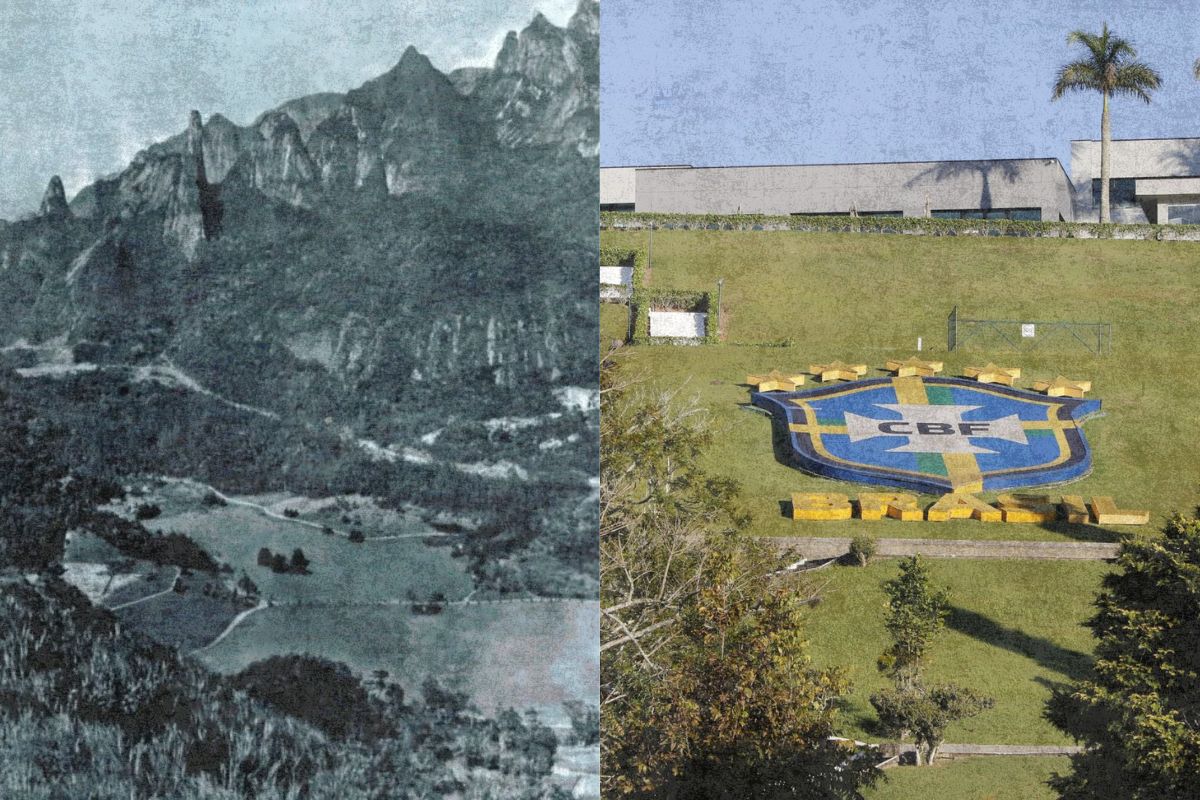
Know The Trajectory Of The Site That Started As A Luxury Farm, Became A Postcard Of Teresópolis And Today Houses The Largest Training Center Of National Football.
The history of Granja Comary begins long before the green-and-yellow jersey made its presence felt there. In 1920, businessman Eduardo Guinle, already a millionaire thanks to the concession of the Port of Santos, bought the old Fazenda Comary in Teresópolis to be the family’s mountain refuge.
The mountain scenery, mild climate, and view of Pedra do Soberbo resembled European summer retreats and attracted the elite of Rio at the time. The Guinle surname was already synonymous with luxury in Rio: they had established their presence at the Copacabana Palace and the Palácio Laranjeiras, among other architectural landmarks.
Upon acquiring the farm, Eduardo ordered internal roads to be opened, chalets in alpine style to be built, and gardens to be planned around a natural lake. The goal was not only to rest but also to host politicians, musicians, and diplomats at parties that reinforced the family’s prestige.
-
Friends have been building a small “town” for 30 years to grow old together, with compact houses, a common area, nature surrounding it, and a collective life project designed for friendship, coexistence, and simplicity.

-
This small town in Germany created its own currency 24 years ago, today it circulates millions per year, is accepted in over 300 stores, and the German government allowed all of this to happen under one condition.

-
Curitiba is shrinking and is expected to lose 97,000 residents by 2050, while inland cities in Paraná such as Sarandi, Araucária, and Toledo are experiencing accelerated growth that is changing the entire state’s map.

-
Tourists were poisoned on Everest in a million-dollar fraud scheme involving helicopters that diverted over $19 million and shocked international authorities.


With Eduardo’s death in 1941, the site came into the hands of his son Carlos Guinle, father of the famous playboy Jorginho. Carlos maintained the property and began to diversify the area, transforming it into an agricultural pole and later into a real estate project.
Still in the 1940s, the family was already talking about building a large recreation club there, but World War II delayed the plans. However, the period served to bring Teresópolis closer to the winter circuits frequented by society.
When the post-war period arrived, Granja was already seen as a gem of the Fluminense mountain range, ready to gain new functionalities and new stories.
French Chickens, Foxes, and Frogs: The Farm That Became An Attraction
Few people imagine that the first major investment by the Guinle family in Comary was… breeding chickens imported from France. The idea was to produce special eggs for hotels and restaurants in Rio.
The birds did not come alone. Documents from the family collection mention aviaries with pheasants, exotic ducks, and even a small batch of silver foxes, used for fur, a luxury fashion of the time.
By the lake’s edge, the family also tried to breed frogs for gastronomic export. The agricultural experiments lasted a short time but gave fame to the place: visitors would line up on weekends to see the Guinle family’s “show farm.”
Over time, the owners realized that the tourist potential was greater than the agro-industrial return. They opened gates for picnics and authorized guided tours; many residents of Teresópolis remember the “afternoons in the Comary gardens” as a childhood program.
The 1950s marked a turning point: Carlos Guinle hired engineers to transform the lands into high-end residential developments. The embryo of the Carlos Guinle neighborhood emerged, now one of the most valued areas of the city.
Still, the memory of the original farm survives in plaques, old barns, and in the stories that guides tell curious tourists looking for the unusual origins of the future national team’s training center.
From Farm to Neighborhood: Developments, Lake, and The Emergence Of Clube Comary
In 1950, excavators opened a canal and enlarged an old pond to create the Lake Comary, a postcard that today features in photos of the national team’s training sessions. The mirrored landscape became a spot for contemplation and sold lots like hotcakes.
Aiming to offer leisure to the new residents, ten local personalities founded, in 1968, the Clube Comary. Courts, pools, and a small stadium transformed the space into a mountain “country club” sought after by Fluminense society.
The urban model provided winding streets following the topography and preserved green areas. Each house had to follow setback and height standards, ensuring views of the lake and architectural harmony.
During this phase, contact with sports intensified. Weekend tennis and soccer tournaments began attracting athletes from Rio clubs, who took advantage of the altitude for physical training.
Sports media began to nickname the place “Brazil’s Little Switzerland” due to the combination of climate, pines, and chalets. The spontaneous marketing caught the attention of the then Brazilian Sports Confederation (CBD).
By the late 1970s, the Guinle family, no longer possessing the economic power of yesteryear, saw the CBD as an ideal buyer for the portion of land that had not yet been developed. The next chapter was born.
Business Of Footballers: The CBF Buys The Mountain Paradise
Between 1979 and 1983, the CBD (which would become CBF) negotiated approximately 149 thousand m² of Granja Comary to build the Training Center of the Brazilian National Soccer Team.
The project, audacious for its time, planned for official fields, accommodations, an auditorium, and a physiology lab. The Federation chose Comary for its mild climate, altitude of 870 m, and proximity to Rio.
The construction sought to integrate the buildings into the landscape. Architects preserved centennial trees and opened windows facing the lake, ensuring iconic photos that fans know to this day.
In 1987, the training center was inaugurated and used in preparation for the Copa América that same year. Since then, all major teams, from 1994 to 2022, have passed through the Comary locker rooms before World Cups.
In addition to the men’s team, youth teams and the women’s team also utilize the facilities. The place also hosts coaching courses, medical conferences, and historical exhibitions about national football.
The purchase changed the dynamics of the neighborhood: hotels, restaurants, and sports commerce grew to serve journalists and fans who flock whenever the national team gathers.
Affective Heritage Of Brazilian Football
For many Brazilians, hearing “Granja Comary” is to remind of the press conference for the team announcement, the bicycle kicks in open training sessions, or the photos of Neymar, Marta, and company on the wooden deck over the lake.
Champion campaigns were born there: the 1994 team adjusted their preparation on the mountain pitches before lifting the tetra in the USA; in 2002, Felipão repeated the ritual toward the penta.
Even in stumbles, like the 7 × 1 in 2014, the training center became a symbol of national catharsis: fans kept vigil at the main gate, mixing criticism and support.
For Teresópolis, the training center is a tourism engine. A study by the city hall points to a direct impact on the hotel network every time the national team gathers, not to mention the international projection of the city.
The lake, now lined with sculptures of stars, continues to be the backdrop of postcards — but also of Sunday strolls for local families, who enjoy the public boardwalk.
More than a sports center, Granja Comary became a collective memory. And to think that it all started with French chickens and the dream of a businessman to bring fresh air and European charm to the mountains.










Seja o primeiro a reagir!