





 Portuguese
  English
  Spanish
  5 min of reading
  0 comments



With Immediate Harvesting, Fine Grinding, and Controlled Mixing, Algae Stop Being a Threat in Lakes and Turn Into Input for Foams in Footwear and Other Items; In the Process, Part of the Pollution Is Removed from the Water, Emissions Are Avoided and Technical Limits of Recycling Remain Open in the Sector.
The algae that accumulate excessively in rivers and lakes often appear as a visible environmental problem, but the proposal to transform them into industrial raw material has opened a different front: removing harmful biomass from the water, processing this material, and incorporating it into everyday products without overlooking the technical limits of the solution.
In practice, the chain involves collection in areas with blooms, industrial processing at scale, and application in items such as footwear foams. The process spans distinct points, from the Mississippi to Dongguan, and combines environmental promise with concrete questions about performance, recycling, energy cost, and real long-term impacts.
When The Bloom Becomes More Than an Inconvenience and Turns into an Environmental Risk

The accelerated growth of algae in freshwater is not just a change in color on the surface. In harmful bloom episodes, the water column loses oxygen, light stops reaching lower layers, and aquatic organisms are left without stable survival conditions. This imbalance can affect fish, aquatic mammals, and food safety in regions that depend on these ecosystems.
-
Friends have been building a small “town” for 30 years to grow old together, with compact houses, a common area, nature surrounding it, and a collective life project designed for friendship, coexistence, and simplicity.

-
This small town in Germany created its own currency 24 years ago, today it circulates millions per year, is accepted in over 300 stores, and the German government allowed all of this to happen under one condition.

-
Curitiba is shrinking and is expected to lose 97,000 residents by 2050, while inland cities in Paraná such as Sarandi, Araucária, and Toledo are experiencing accelerated growth that is changing the entire state’s map.

-
Tourists were poisoned on Everest in a million-dollar fraud scheme involving helicopters that diverted over $19 million and shocked international authorities.


There’s also the sanitary component: certain blooms release toxins and can cause illness in humans and animals.
There’s also a climatic factor that is little noticed outside the technical debate: when this biomass dies and decomposes, methane is released, a greenhouse gas with much greater potency than carbon dioxide.
Removing algae prior to decomposition has become a race against time precisely because it combines ecological risk, health risk, and atmospheric effect.
How Collection and Industrial Transformation Work, Step by Step

To extract algae from the water in large volumes, the operation relies on specific harvesting machinery. In previous applications, a harvester was used in harmful blooms in New York and Florida.
The logic is simple in concept but demanding in execution: capture quickly, reduce moisture, stabilize the material, and avoid loss of efficiency until the processing stage.

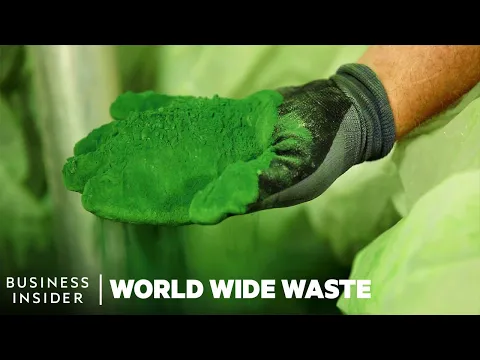
At the production facility in Mississippi, the biomass undergoes grinding to become fine powder with controlled granularity.
Then, this powder is mixed with conventional plastic, heated, extruded into filaments, and cut into pellets. Next, cooling occurs and storage in large bags for shipping to customers.

The key point is that the algae do not enter the final formula alone: to maintain elasticity and mechanical performance, the proportion usually ranges from 10% to 30%, varying according to the application.
From Laboratory to Market: Where This Material Already Appears and With What Numbers

The commercial entry started with simpler products, such as pots, and advanced to sports items. Today, the most common use is in foam for footwear, including the internal component that sits under the foot.

In a factory in Dongguan, the mixture used for this type of piece includes about 15% of algae pellets combined with the traditional material, with technical dosage control before molding.

The data released by the companies involved points to metrics per product: for inner footwear linings, the reported estimate was about 8 grams of CO2 conserved and approximately 17 liters of clean water per pair.
In the case of a brand that has already produced over 2 million pairs with this input, the reported figure reaches about 17 metric tons of CO2 between biogenic capture and emissions avoided by the partial substitution of fossil plastics.
These are relevant numbers for the scale of the product, but they do not eliminate the need for critical reading regarding the method, calculation boundaries, and the final destination of the material.
What This Solution Solves and What It Does Not Solve
The most consistent environmental gain appears in the water-pollution axis, because algae removed cease to feed repeated bloom cycles when there is proper intervention.
However, the final product continues to be a hybrid plastic, and this brings an important limitation: in footwear, recyclability remains challenging, as the combination of materials and adhesives is often poorly compatible with conventional recycling routes.
There is also a technical paradox that needs to be understood without simplification: to keep carbon stored in the product, it is desirable that it does not degrade quickly, because degradation may return carbon to the atmosphere.
In other words, durability and disposal enter into direct tension. Technology can contribute, but it does not replace design policies for disassembly, reverse logistics, and recycling infrastructure compatible with mixed materials.
Global Scale, Sewage Treatment, and the True Center of the Strategy

Even with the advancement of biomaterials, plastic alone does not carry the scale to solve the global climate crisis.
The comparison between annual CO2 emissions and annual plastic production volume shows a structural distance between the size of the problem and the potential reach of this route. This does not render innovation irrelevant; it merely repositions its role as a complementary tool, not as a sole solution.
In the long term, the more robust gain depends on tackling the source of excess nutrients: effluents and runoff that carry nitrogen and phosphorus to rivers and lakes.
The strategy of cultivating algae at treatment stations to capture these nutrients before they reach bodies of water points in that direction. Today, the raw material used comes from both lakes and sewage treatment, in similar proportions.
And, according to life cycle assessment cited by the companies, even considering processing and transport energy, algae pellets can outperform fossil pellets in sustainability, as well as requiring less land, water, and energy than corn and soybean-based bioplastic routes.
Transforming toxic algae into industrial input reorganizes a known environmental problem: the slime that degraded lakes now has economic value, and this creates an incentive for collection, treatment, and productive use.
Still, the outcome cannot be measured solely by the product on the shelf; it depends on the supply chain, impact calculation method, and waste management after consumption.
In your reality, what would make the most difference: increase algae collection in urban lakes, invest first in sewage treatment to cut nutrients at the source, or require brands to publish auditable metrics of clean water and carbon retained per product? Which of these paths do you consider most viable in your city and why?










-

-

-

-

4 pessoas reagiram a isso.