





 Portuguese
  English
  Spanish
  4 min of reading
  0 comments


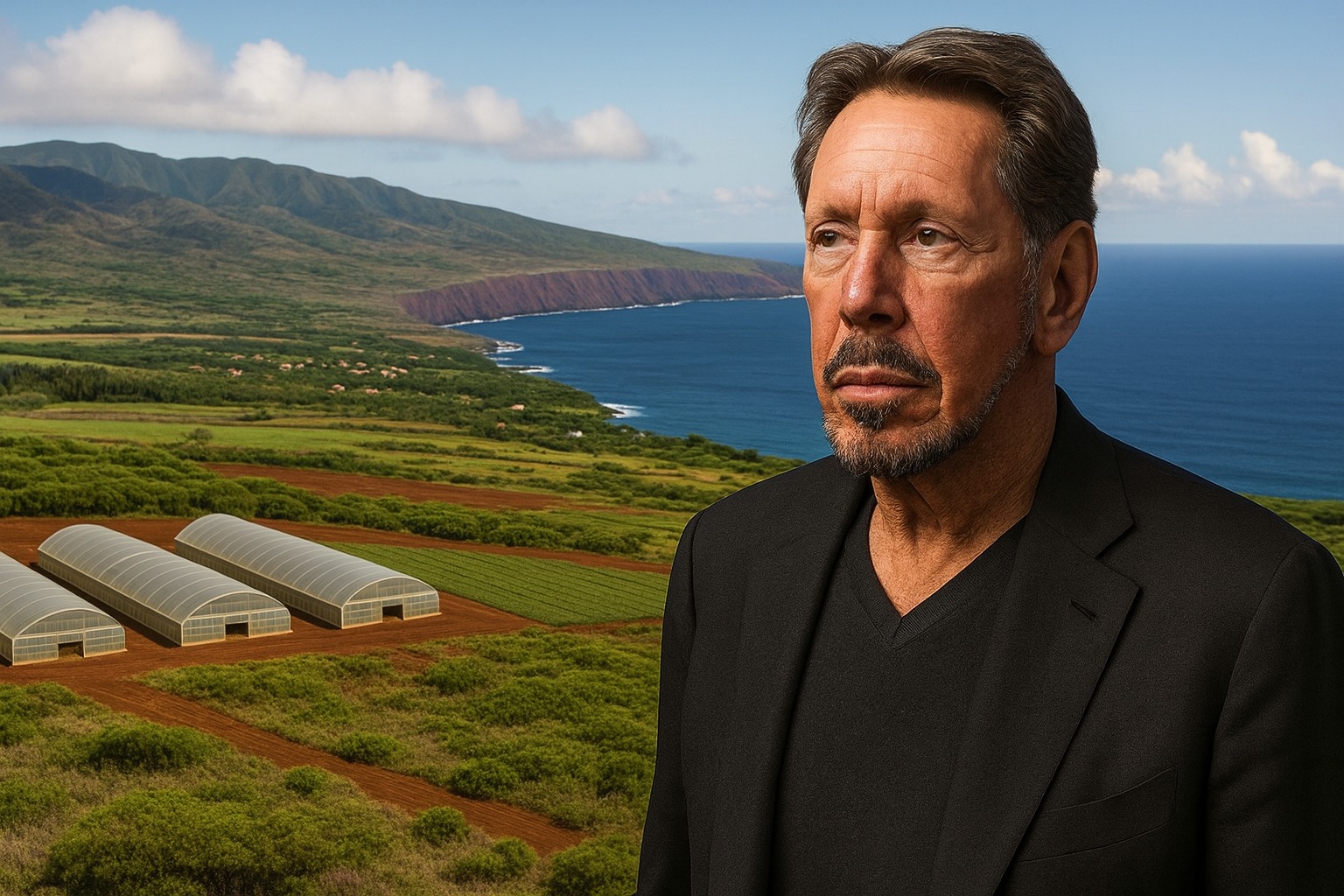
Technological Agricultural Project in Lanai After 98% Purchase of the Island for US$ 300 Million in 2012 Consumed More Than US$ 500 Million, Built Six Greenhouses, Faced Winds of 130 km/h and Ended Focused on Lettuce and Tomato
Larry Ellison transformed Lanai, Hawaii, into a technological agricultural laboratory after acquiring 98% of the island in 2012 for US$ 300 million, investing over US$ 500 million to test advanced greenhouses, whose promised global impact did not materialize.
Larry Ellison, co-founder of Oracle, envisioned Lanai as a showcase for sustainable agriculture, betting that advanced technology could overcome environmental limits and create a globally replicable model.
The ambition arose from the perception of the island’s food dependency and the belief that sensors, robotics, and clean energy could reverse historical productivity weaknesses.
-
Motorola launched the Signature with a gold seal from DxOMark, tying with the iPhone 17 Pro in camera performance, Snapdragon 8 Gen 5 that surpassed 3 million in benchmarks, and a zoom that impresses even at night.

-
Satellites reveal beneath the Sahara a giant river buried for thousands of kilometers: study shows that the largest hot desert on the planet was once traversed by a river system comparable to the largest on Earth.

-
Scientists have captured something never seen in space: newly born stars are creating gigantic rings of light a thousand times larger than the distance between the Earth and the Sun, and this changes everything we knew about stellar birth.

-
Geologists find traces of a continent that disappeared 155 million years ago after separating from Australia and reveal that it did not sink, but broke into fragments scattered across Southeast Asia.

The plan envisioned integrated innovation, high financial input, and rapid scalability, betting that the technological combination would address climatic, logistical, and human challenges present in Lanai.
The Purchase That Started the Experiment
The acquisition of 98% of Lanai in 2012 for about US$ 300 million marked the formal start of the attempt to reconnect the island to structured agricultural production.
According to a report by the Wall Street Journal, Ellison sought to restore the local agricultural vocation and test modern cultivation technologies with potential for international influence.
David Agus, co-founder of Sensei Ag, stated that the island did not produce enough food, justifying the company’s creation to execute the proposed agricultural strategy.
Sensei Ag received an initial investment of US$ 500 million, exceeding the purchase price of the island, directed toward robotics, sensors, hydroponics, and artificial intelligence.
The proposal anticipated that technology would replace natural limitations, creating a controlled environment capable of generating food in a predictable and efficient manner.

Greenhouses That Faced Reality
Six greenhouses were built in Lanai as the core of the project, designed to operate with high automation and minimal dependence on external inputs.
The Israeli engineers responsible for the design ignored strong winds and high humidity, factors that quickly compromised the structural integrity of the greenhouses.
Roofs valued at US$ 12 million were repeatedly torn off by gusts of up to 130 km/h, raising repair costs to approximately US$ 50 million.
These recurring damages delayed timelines, consumed additional resources, and reduced the operational predictability planned for the agricultural structures.
Technology That Should Have Helped but Hindered
Solar panels sent by Elon Musk suffered from constant dust accumulation, reducing efficiency and requiring frequent use of diesel generators.
The need for diesel contradicted the goal of sustainable operation, increasing operational costs and dependence on fossil fuels in the day-to-day running of the greenhouses.
Unstable Wi-Fi connections compromised sensors responsible for temperature, light, and ventilation, making environmental control irregular and less reliable.
The technical complexity shifted from distinction to obstacle, according to reports from a former manager, who pointed out a gradual loss of the original vision in light of the difficulties.
Results Distant from Global Ambition
Despite the high investment, Sensei Ag focused production on lettuce and cherry tomatoes to supply the local Hawaiian market.
The result ensured regional supply but fell short of the initial promise to revolutionize agriculture or feed populations on a large scale.
Frequent changes in strategy by Ellison hindered technical continuity, with attempts to regenerate soil, cultivate exotic fruits, and test new formats.
Molds for square watermelons, cultivation of mangoes in greenhouses, and testing with wasabi were abandoned due to cost, market, or practical viability.
Local chefs recommended simple methods for wasabi, leading to the discarding of the idea and a definitive return to the focus on lettuce and tomato.
Leadership More Technological Than Agricultural
The leadership of Sensei Ag was composed mostly of technology professionals, with no significant background in intensive agricultural production.
Dave Douglas, a software engineer residing in Massachusetts, took over management of the operation even while working remotely from the island.
The technology director, Danny Hillis, is recognized in computer networks but has no formal agricultural experience applied to the project.
This structure made it difficult to make decisions about cultivation practices, generating skepticism among the approximately 3,200 residents of Lanai.
The island continued to import between 80% and 90% of its food, reinforcing criticisms about the experimental use of the available land.
Course Correction
Faced with limitations, Sensei reduced ambitions and began developing software and technologies for indoor agriculture that could be licensed to third parties.
Testing centers in California focus research on robotics and systems to reduce agricultural labor costs.
Crops like peppers and cucumbers were discarded to prioritize lettuce mixes with higher financial returns.
David Agus explained that the decision reflected a lack of sustainable market for cucumbers, directing efforts toward more accepted products.
A Megaproject on the Island: An Experiment That Became a Lesson
The project highlighted the limits of Silicon Valley logic when applied to sectors dependent on climate, soil, and biological management.
Even with investment exceeding half a billion dollars, the results fell short of the initial promise of global transformation.
An employee compared the expectation to receiving a Bugatti and ending up with a Yugo, illustrating internal frustration.
Ellison continues to finance local improvements, such as a hospital, theater, and housing, while the agricultural experiment remains a costly learning experience.
With information from Luxurylaunches.







-

2 pessoas reagiram a isso.