





 Portuguese
  English
  Spanish
  6 min of reading
  3 comments




Operation in the Amazon Shows Military Helicopter Acting as Crane, Transporting Heavy Equipment Suspended by Cable in Long Flight to Isolated Base in Yanomami Land. External Load Technique Requires Rigorous Planning, Ground-Air Coordination, and Fine Stability Control to Transport Generator Without Continuous Ground Access.
A military helicopter from the Brazilian Air Force has taken on a typical crane function in the heart of the Amazon by transporting a generator weighing 830 kilograms over 228 kilometers to Surucucu, in the Indigenous Land of Yanomami, in Roraima, suspended by a cable.
The operation was carried out using external load, a technique in which the equipment hangs from the aircraft’s hook, requiring fine stability in flight and precise coordination with ground teams to avoid oscillations and ensure safety throughout the route.
External Load in the Amazon and Logistical Challenges Without Roads
The transport, described in official communications related to the logistics and humanitarian support operation in the region, illustrates how aircraft substitute for roads and cranes when terrain, distance, and the need for speed render ground access insufficient.
-
Friends have been building a small “town” for 30 years to grow old together, with compact houses, a common area, nature surrounding it, and a collective life project designed for friendship, coexistence, and simplicity.

-
This small town in Germany created its own currency 24 years ago, today it circulates millions per year, is accepted in over 300 stores, and the German government allowed all of this to happen under one condition.

-
Curitiba is shrinking and is expected to lose 97,000 residents by 2050, while inland cities in Paraná such as Sarandi, Araucária, and Toledo are experiencing accelerated growth that is changing the entire state’s map.

-
Tourists were poisoned on Everest in a million-dollar fraud scheme involving helicopters that diverted over $19 million and shocked international authorities.

In the case of Surucucu, the base is located in a remote area, surrounded by dense forest, with natural and operational limitations that increase the cost and time of any transport via conventional routes.
H-60 Black Hawk and the Role of Air Crane
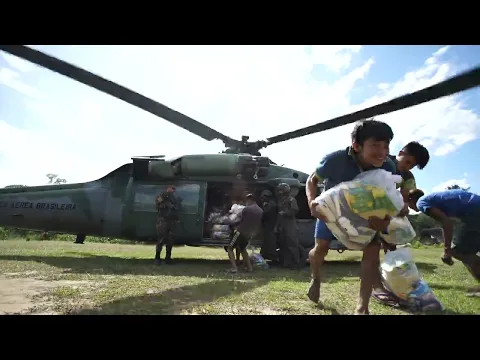

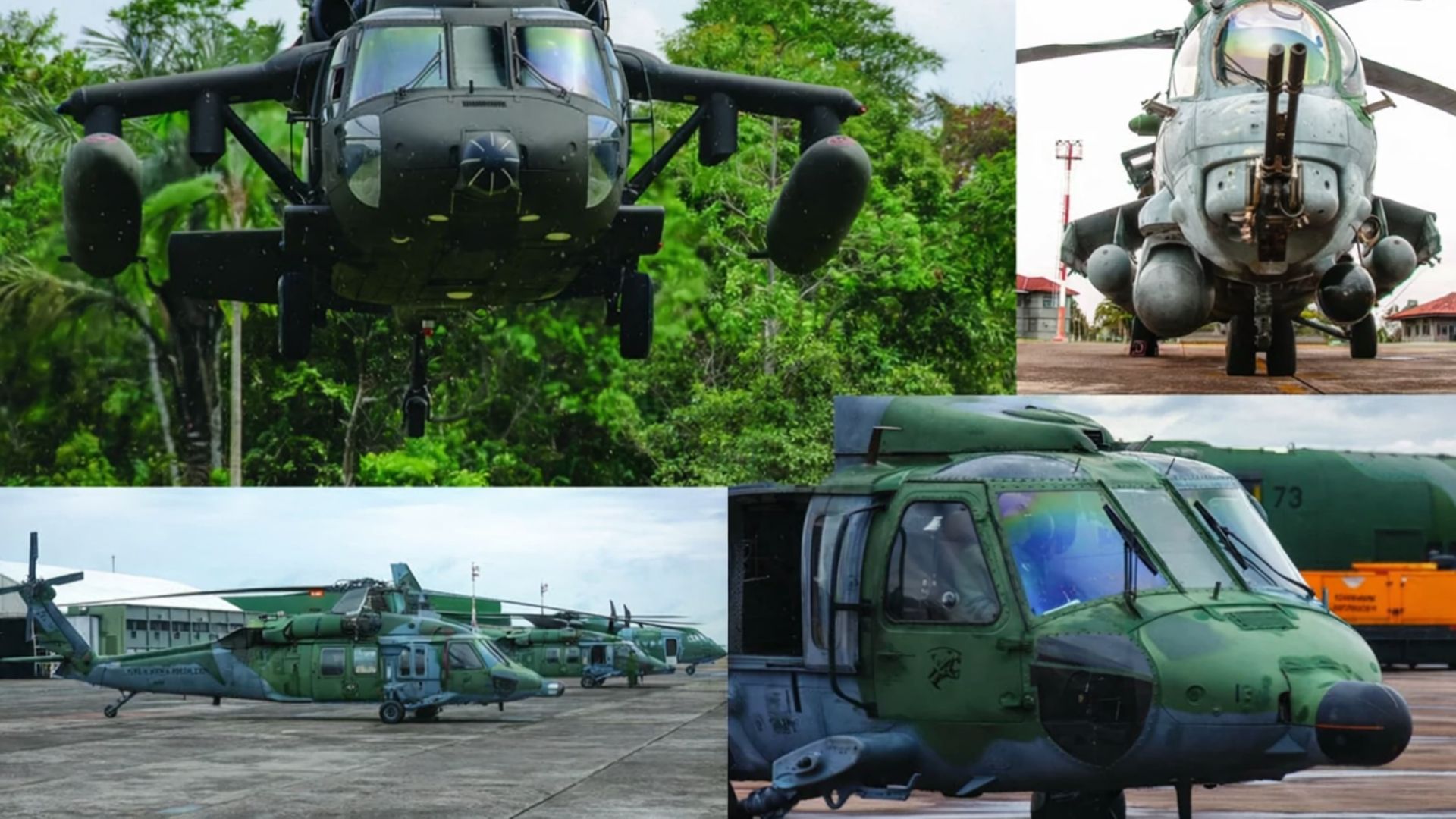
The helicopter used was the H-60 Black Hawk, a platform utilized in transport and support missions, capable of operating in demanding conditions and carrying loads both internally and on an external hook.
By opting for the lifting method, the planning takes on a new level: instead of accommodating the generator in the cabin, the team uses a set of cables and certified connections to keep the weight below the helicopter, freeing up internal space and allowing the item to be moved even when dimensions, shape, or the need for speed favor suspended loads.
The notable detail outside of the technical circle is not just the weight.
The distance traveled with the equipment hanging, according to information published by the Air Force itself, was 228 kilometers, a long stretch for this type of transport that imposes constant operational discipline.
In external load, the pilot is not “carrying a piece”; he manages a dynamic system in which the helicopter and the load respond to wind, speed, and direction changes, with more restricted maneuverability and a need for constant anticipation.
Mission Planning and Checks Before Flight
Before the aircraft takes off, the mission is outlined as a sequence of steps.
The preparation involves checks of the hook, cables, and attachment points on the generator, as well as defining signals and communication protocols between the crew and the ground team.

In general, the hooking and unhooking are critical moments, as they concentrate people and equipment under the aircraft, in an environment where rotor wind raises dust, displaces vegetation, and can affect visibility.
Safety depends on clear perimeters, standardized commands, and reduction of improvisation, especially when the load is heavy and the landing area has space restrictions.
Stability Control and Pendulum Effect
With the generator attached to the suspension system, the flight requires heightened attention to the behavior of the ensemble.
Oscillations can arise from gusts, small course corrections, or variations in speed, and need to be controlled to avoid wide movements.
The conduct tends to favor smoother trajectories and gradual adjustments, preserving stability and reducing the chance of “pendulum,” a term used to describe the swinging of the suspended load.
Altitude and speed are chosen to maintain safety margins, respecting parameters defined for the aircraft and for the type of load.
Arrival at Surucucu and Ground-Air Coordination
The arrival at Surucucu also requires choreography.
Instead of simply landing and unloading, the crew needs to position the helicopter so that the generator descends at the exact point, without touching obstacles and without endangering workers or facilities.

The ground team is responsible for guiding the approach within the authorized perimeter, maintaining a safe distance from the rotor and approaching the equipment only when there is authorization and conditions for the procedure.
In operations of this nature, small details matter: a sudden change in wind, uneven terrain, or a nearby obstacle can alter the safety margin in the final phase.
830 kg Generator and Critical Infrastructure in Remote Base
The reason for transporting a generator in this manner is not aesthetic, and the value of the maneuver is not just in its visual impact.
Generators are sensitive components for the infrastructure of advanced bases, as they provide power for communication, cooling supplies, lighting, and operation of essential equipment.
When electrical supply needs to be reinforced or quickly replaced, relying on long and complex ground routes can delay the response.
In practice, the external hook allows the equipment to reach its destination without waiting for a passage to be opened, without lengthy disassemblies, and with less dependence on a ground logistics chain that, in remote environments, is often vulnerable to weather, bogging, and traffic limitations.
Operation in Yanomami Land and Air Logistics Chain
The operation is part of a series of support actions in Yanomami Land conducted by federal agencies and security forces, which require constant transport of people, food, medicines, and equipment.
In these contexts, helicopters and planes function as a bridge between urban centers and isolated areas, maintaining the flow of supplies when geography imposes barriers.
Even with the use of aircraft, logistics is not limited to flight: it is necessary to coordinate fuel, maintenance, weather, and crew availability, as well as to plan operation windows with the teams that will receive and install the materials.

Versatility of the Black Hawk in Transport Missions
The H-60, being a utility helicopter widely used in transport missions, offers flexibility to switch between tasks, carrying internal cargo, teams, and, when necessary, executing lifts.
This versatility is one of the reasons why aircraft of this type are utilized in operations with vast territorial reach, such as those carried out in the Amazon, where long movements and distant support points make every flight hour a strategic resource.
At the same time, external load is not a “simple shortcut”: it requires rigorous standardization, trained personnel, and strict adherence to operational limits, as a procedural error can quickly escalate into a risky situation.
Operational Engineering Behind Lifting
While flying with a suspended generator attracts attention due to weight and distance, the episode reveals something broader about the infrastructure behind missions in remote areas.
There is an invisible layer of operational engineering in every movement: choice of equipment, certification of the lifting method, definition of safe routes, and construction of a communication routine that minimizes human errors.
When everything works, the final result seems straightforward, but it is the fruit of technical discipline and detailed planning.
In a country with extensive biomes, complex terrain, and thousands of communities beyond the reach of permanent roads, what other infrastructure tasks could still migrate to the air with external load operations conducted with this level of precision?









Já participei de algumas missões em Surucucu com o UH-1H, “SAPÃO” no início da década de 90. Um ambiente inóspito. Uma aula de profissionalismo e dedicação. Parabéns guerreiros de selva. Força Aérea Brasil. Selva!!!
2 motores e 4 hélices , pra quem é da FAB está bem por fora , quanto ao conhecimento 🤣🤣🤣🤣🤣
Helicóptero não utiliza hélice e sim pás deveria saber já que é da FAB não nos envergonhe 🚁
Trabalho de excelência, levado a cabo por experientes pilotos, bravos homens e mulheres, da FAB, e praticamente desconhecido pelas pessoas. Ótima e necessária matéria!