





 Portuguese
  English
  Spanish
  5 min of reading
  0 comments


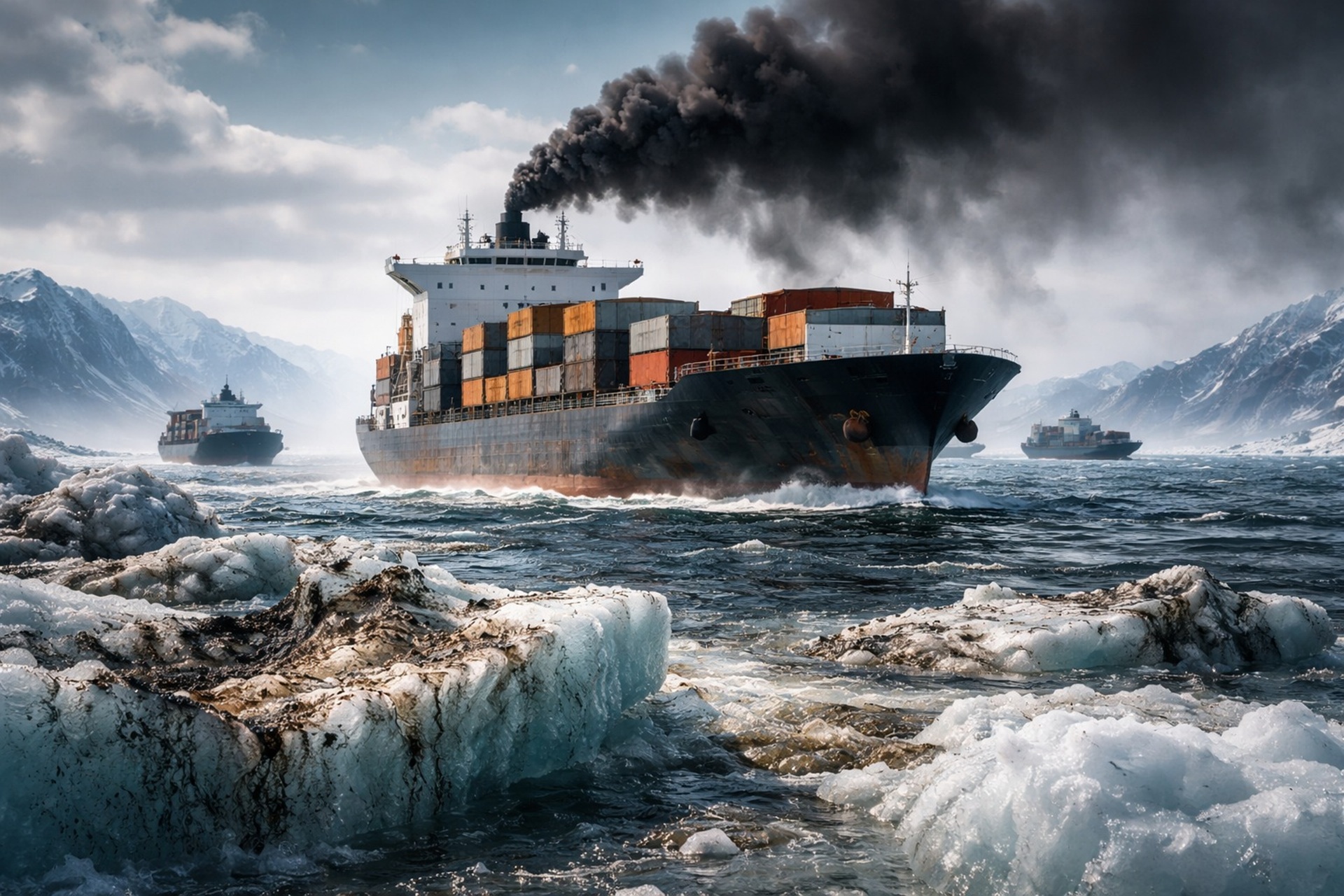
With A 37% Increase In The Number Of Ships North Of Latitude 60 Between 2013 And 2023 And An Increase From 2,696 To 3,310 Metric Tons In Emissions, Black Carbon Intensifies Ice Melting And Pressures The IMO For New Rules
Black carbon in the Arctic has become a focus of international concern following a 37% increase in the number of ships north of latitude 60 between 2013 and 2023, raising emissions of black carbon from 2,696 metric tons in 2019 to 3,310 in 2024 and accelerating the melting of sea ice.
Black carbon in the Arctic is identified as a contributing factor to regional warming amid the growth of maritime traffic on formerly frozen and impassable routes. The advance of thawing in the Arctic Ocean has opened up space for cargo, fishing, and cruise ships.
The increase in traffic gained more attention with President Trump’s pressure for the United States to take control of Greenland. The geopolitical debate occurred alongside environmental discussions on emissions and impacts in the region.
-
The government requests the Federal Revenue Service for a new system to automate the income tax declaration, reducing errors, time, and bureaucracy for millions of Brazilians.

-
Pix in installments, international Pix, and contactless payment without internet: the Central Bank revealed the new features coming to the tool that is already used by almost every adult in Brazil.

-
Mercado Livre has just started selling medications with delivery in up to three hours to your door, and this move could completely change the way Brazilians buy medicines on a daily basis.

-
In Dubai, rising tensions from the war in the Middle East are causing super-rich individuals to leave the Gulf and direct their fortunes to a new financial refuge in Asia.


The soot expelled by ships, known as black carbon, settles on ice, snow, and glaciers. By reducing the capacity to reflect sunlight, it increases heat absorption and contributes to the Arctic being the fastest-warming region on Earth.
Black carbon is a type of microscopic particle formed by the incomplete combustion of fossil fuels, wood, coal, diesel, and biomass. It is part of the material known as “soot” and is one of the main components of air pollution in urban and industrial areas.
Black Carbon Accelerates Melting And Strengthens Warming Cycle
Black carbon exacerbates the melting of sea ice by intensifying solar radiation absorption. With less white surface reflecting light, more heat is retained, strengthening a growing warming cycle.
“This ends up in an endless cycle of increasing warming”, stated Sian Prior, chief advisor to the Clean Arctic Alliance. According to her, emissions, especially black carbon, remain completely unregulated in the Arctic.
The melting of sea ice can affect climate patterns worldwide. The Arctic region, warming more rapidly, influences global atmospheric systems and amplifies environmental concerns beyond local borders.
Cited studies indicate that the impact of black carbon on global warming is 1,600 times greater than that of carbon dioxide over a 20-year period. This data reinforces the pressure for specific regulations.
Polar Fuels Proposal At The IMO Faces Uncertain Political Landscape
In December, France, Germany, the Solomon Islands, and Denmark proposed that the International Maritime Organization require the use of polar fuels by ships in Arctic waters. These fuels are lighter and emit fewer carbon pollutants.
The proposal covers all ships operating north of latitude 60. It includes compliance measures for companies and defines the geographic area of application. The text was to be presented to the IMO’s Marine Environment Protection Committee.
There was an expectation of further review by another committee in April. However, the international political context brought uncertainties regarding the speed of negotiations.
Last year, the IMO hoped to adopt regulations that would impose carbon fees on shipping. The measure aimed to encourage cleaner fuels and electrification of fleets. After pressure from Mr. Trump, the decision was postponed for a year.
Prospects are now considered uncertain. In light of this scenario, observers find it difficult to envision rapid progress in limiting black carbon in the Arctic.
Heavy Fuel Oil Ban Has Limited Impact Until 2029
A ban set for 2024 restricted the use of heavy fuel oil in the Arctic. The impact, however, has been classified as modest due to loopholes in the legislation.
Exemptions and exceptions allow some ships to continue using this type of fuel until 2029. A study by the Energy and Environmental Research Associates indicated that the measure would result in only a small reduction in black carbon emissions.
In 2019, ships north of latitude 60 emitted 2,696 metric tons of black carbon. By 2024, the volume reached 3,310 metric tons. The survey identified fishing vessels as the largest source of emissions.
Between 2013 and 2023, the number of ships in these waters increased by 37%, according to the Arctic Council. During the same period, the total distance traveled grew by 111%, increasing the region’s exposure to soot.
More maritime traffic means more soot in the air. The phenomenon accompanies the gradual opening of routes previously blocked by ice.
Internal Tensions In Arctic Nations Hinder Regulation
Even among countries with coastlines in the Arctic, there are internal divergences over regulations. Iceland is cited as an example of tension between environmental agendas and economic interests.
While it leads in green technologies, such as carbon capture and the use of thermal energy for heating, environmentalists argue that the country has made less progress in regulating maritime pollution.
The fishing industry, one of Iceland’s most important sectors, wields significant influence. According to Arni Finnsson, chairman of the Icelandic Nature Conservation Association, there is resistance to new costs.
He stated that the industry is satisfied with profits, dissatisfied with taxes, and minimally involved in issues such as climate or biodiversity. He added that the costs of cleaner fuels and electrification generate opposition.
The Ministry of Environment, Energy, and Climate of Iceland stated that the polar fuels proposal is positive regarding its purpose and basic content. However, it indicated a need for further studies before a definitive decision.
The statement also expressed support for stricter measures to combat maritime emissions and reduce black carbon.
Northern Sea Route Reduces Distances, But Poses Risks And Criticism
The fascination with fishing, resource extraction, and shorter distances drives the use of Arctic routes. Ships can save days on journeys between Asia and Europe by crossing the region.
The Northern Sea Route, however, is navigable only during a few months of the year. Even during this period, ships must be accompanied by icebreakers.
The operational risks and pollution concerns have led some companies to commit to avoiding the route. The discussion intensifies as thawing expands navigation windows.
Søren Toft, CEO of Mediterranean Shipping Company, stated in a LinkedIn post that the company does not and will not use the Northern Sea Route. MSC is the largest container shipping company in the world.
The debate about black carbon in the Arctic thus occurs amidst economic interests, political disputes, and global climate impacts. The region remains at the center of an international discussion that combines environment and geopolitics.









-

-

5 pessoas reagiram a isso.