





 Portuguese
  English
  Spanish
  4 min of reading
  0 comments


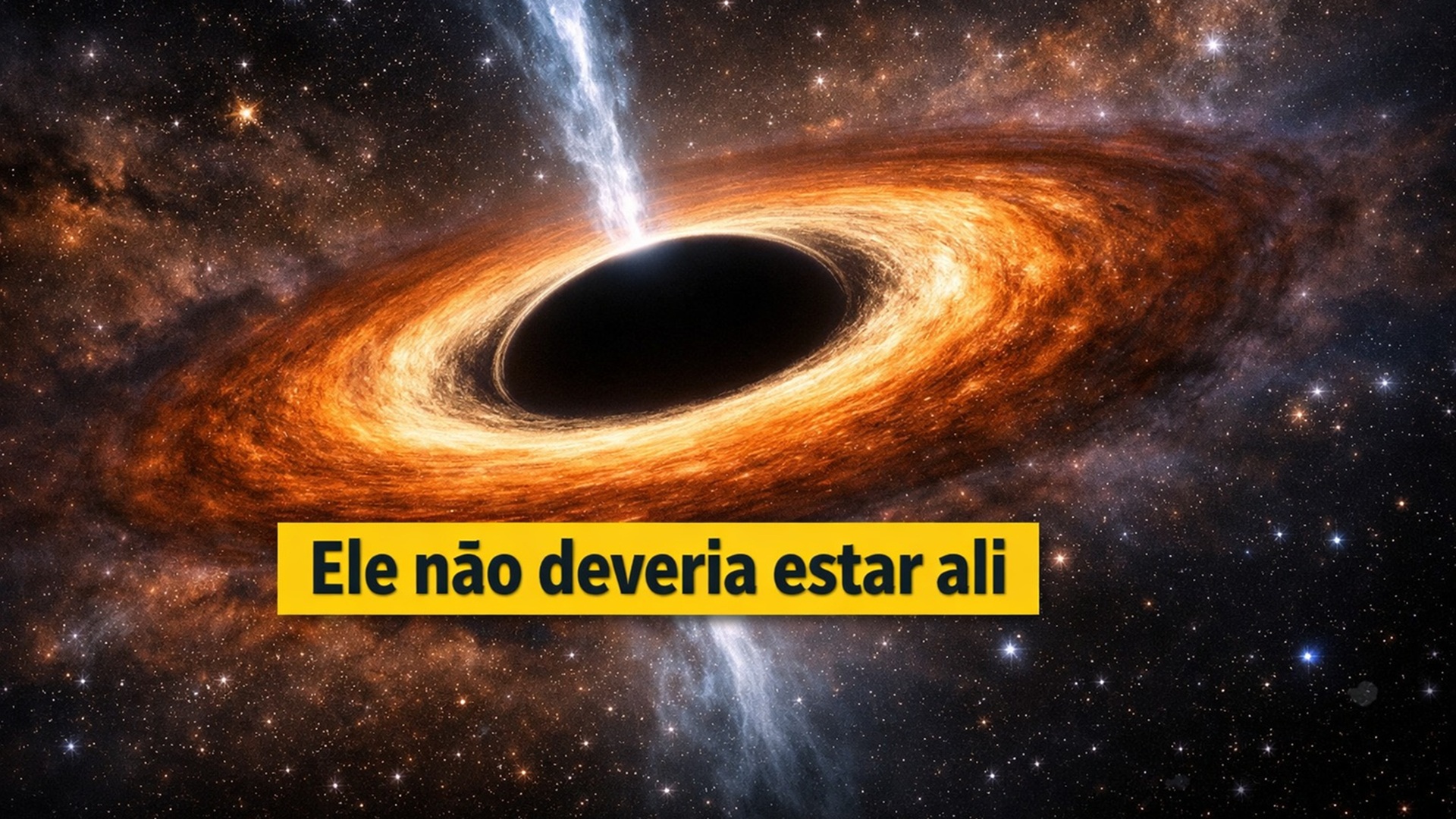
Observed Only 700 Million Years After The Big Bang, The Black Hole With About 50 Million Solar Masses Was Identified Almost Without Stars Around, In A Galaxy With Low Stellar Mass, Raising Central Questions About Classical Models Of Galaxy Formation And Black Hole Growth In The Primitive Universe
The James Webb Space Telescope revealed the existence of a black hole with approximately 50 million solar masses, observed 700 million years after the Big Bang, practically isolated from stars in the galaxy Abell 2744-QSO1, a scenario that challenges traditional models of cosmic formation.
An Unexpected Object In The Primitive Universe
Astronomers do not expect to find fully developed cosmic structures when observing the primitive universe. In general, early images show small galaxies, young stars, and black holes still slowly and progressively growing.
However, recent observations from the James Webb Space Telescope identified an object that completely defies this pattern. It is a gigantic black hole, with a mass equivalent to approximately 50 million times that of the Sun.
-
While the world looks at oil, the war with Iran is already disrupting helium supply from Qatar, affecting car and iPhone chips, threatening AI expansion, and putting pressure on aluminum packaging at the highest value in four years.

-
Global warming will expose a treasure hidden under the ice of Antarctica and may spark an international dispute over gold and valuable minerals.

-
A street vendor from Praia Grande built a robot made of scrap from scooters and washing machines that pulls his popcorn cart on the beach, emits sounds, and interacts with customers, becoming an attraction on the coast of São Paulo.

-
The specifications of the Xiaomi 18 Pro Max have been leaked, and the highlight is a dual 200 MP camera with a new 22-nanometer technology that promises to consume less energy and capture details in shadows and bright areas using LOFIC HDR.


This object was located in the galaxy Abell 2744-QSO1, existing only 700 million years after the Big Bang. This data is surprising because this time frame is considered short for the formation of such massive structures.
Beyond the extreme mass, another factor draws attention. The host galaxy presents an extremely low amount of stars, insufficient to explain the growth of the black hole according to currently accepted theories.
Contradiction With Traditional Models
In standard astrophysics, the formation of black holes is closely linked to stellar evolution. Stars arise from the collapse of gas clouds and, only after exhausting their fuel, the most massive can collapse and form black holes.
Over billions of years, these objects grow by absorbing gas and merging with other black holes. This gradual process makes it difficult to explain the presence of extremely massive black holes in the young universe.
In the case of QSO1, the contradiction is even greater. The low stellar mass of the galaxy indicates that there has not been sufficient star formation to sustain or originate a black hole of this size.
According to the study’s authors, this creates a fundamental impasse. The black hole appears to have reached a gigantic mass without a conventional galaxy having formed around it.
An Old Hypothesis Resurfaces
To investigate the phenomenon, researchers turned to a theoretical hypothesis proposed in the 1970s by Stephen Hawking and Bernard Carr: the so-called primordial black holes.
Unlike black holes formed from stars, these objects would have arisen directly from extreme density fluctuations shortly after the Big Bang. Most, if they existed, would have been small and short-lived.
The study evaluated whether a small fraction of these black holes could have survived and rapidly grown under specific conditions in the early universe.
Researchers led by Boyuan Liu from the University of Cambridge developed more sophisticated simulations than those used before to test this possibility.
Simulations And Compatibility With Observations
The simulations began with a primordial black hole already massive, with about 50 million solar masses. From there, the models tracked the behavior of the surrounding gas, the subsequent formation of stars, and the return of material to the black hole after stellar explosions.
Unlike simplified approaches, the new models considered multiple processes interacting simultaneously, including gas flows, star formation, and matter recycling.
When the results were compared with actual data from James Webb, the researchers found a close match. This included not only the final mass of the black hole but also the reduced number of stars and the chemical elements observed around QSO1.
According to Liu, these observations make the hypothesis of massive primordial black holes more plausible, given the difficulty of traditional models in reproducing the observed scenario.
Limitations And Open Questions
The authors emphasize that the study does not prove that the black hole in QSO1 is primordial. It merely demonstrates that this origin is compatible with the available data so far.
Still, there are significant challenges. Classical simulations of primordial black holes rarely produce objects larger than one million solar masses, a value much lower than the approximately 50 million observed.
This indicates that, under conventional assumptions, these black holes would struggle to grow quickly enough. One possibility discussed is that they formed in dense clusters, facilitating rapid mergers and accelerated mass gain.
Another unresolved issue involves the need for intense bursts of high-energy radiation for the formation of these objects, sources that have yet to be identified near QSO1.
Next Steps In Research
The researchers intend to refine the simulations and compare them with future discoveries from James Webb. Identifying more galaxies similar to QSO1 could provide decisive evidence about the origin of extremely massive black holes.
If these objects are found in greater numbers, the idea that some of the largest black holes in the universe are not final products of stars but relics from the dawn of the cosmos could gain traction.
The study was published in arXiv, detailing the results and current limitations of the model, keeping the debate open about the formation of the first cosmic giants.
The article was prepared based on information released by the authors of the study led by Boyuan Liu from the University of Cambridge, based on observations from the James Webb Space Telescope, with results presented in a scientific article available on the arXiv platform.








-

-

-

-

6 pessoas reagiram a isso.