





 Portuguese
  English
  Spanish
 4 min of reading
  0 comments


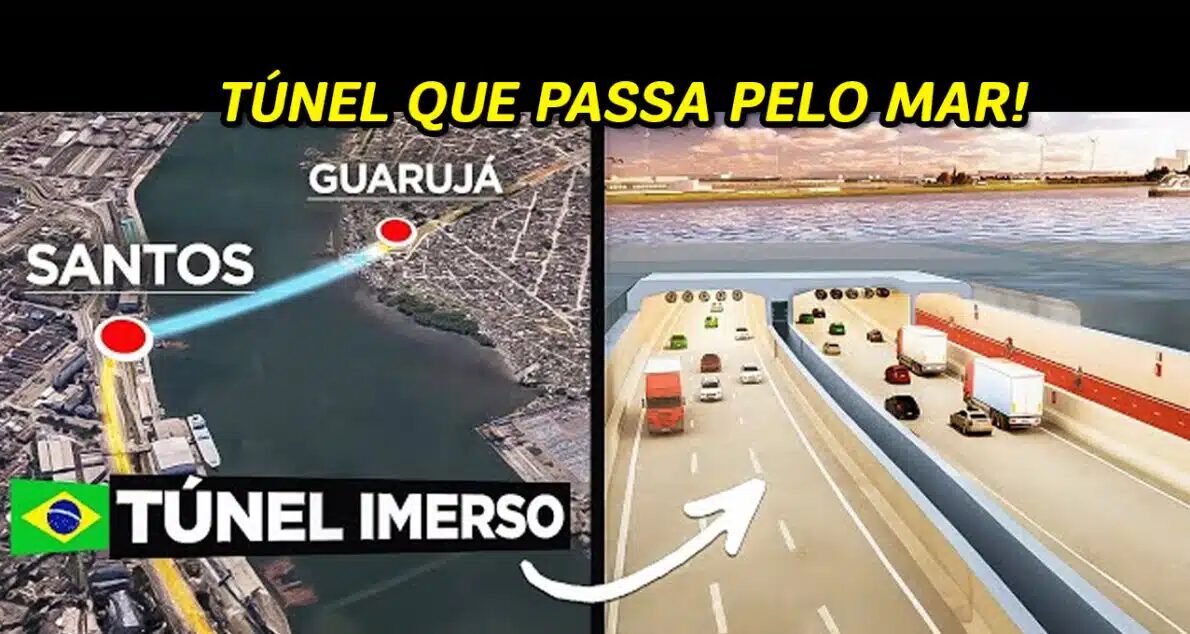
Brazil’s First Underwater Tunnel Between Santos and Guarujá Promises to Revolutionize Mobility, with Billion-Dollar Investments and a Direct Impact on the Regional Economy.
With an investment forecast of R$ 6 billion and the generation of 9,000 jobs, the Santos-Guarujá underwater tunnel promises to be a game-changer for Brazilian infrastructure
One of the country’s most ambitious engineering projects is set to break ground in the coming months:
the first underwater tunnel in Brazil will be built between the cities of Santos and Guarujá, on the São Paulo coast, with an auction scheduled for August 1, 2025.
The structure, which will have 1.5 km in length — with 870 meters completely submerged under the Santos Port estuary — is considered a historic solution to a mobility problem that has impacted the daily lives of the Baixada Santista population for decades.
-
The government requests the Federal Revenue Service for a new system to automate the income tax declaration, reducing errors, time, and bureaucracy for millions of Brazilians.

-
Pix in installments, international Pix, and contactless payment without internet: the Central Bank revealed the new features coming to the tool that is already used by almost every adult in Brazil.

-
Mercado Livre has just started selling medications with delivery in up to three hours to your door, and this move could completely change the way Brazilians buy medicines on a daily basis.

-
In Dubai, rising tensions from the war in the Middle East are causing super-rich individuals to leave the Gulf and direct their fortunes to a new financial refuge in Asia.


It is estimated that the project will generate 9,000 direct and indirect jobs, boosting the regional economy and increasing the logistical competitiveness of the largest port in Latin America.
Mega Project Will Be Carried Out Through a Public-Private Partnership
The project will be executed through a public-private partnership (PPP), with a 30-year concession for the construction, operation, and maintenance of the tunnel.
The Government of São Paulo is responsible for leading the initiative, which is part of the State Partnerships Investment Program (PPI-SP).
The projected investment is R$ 6 billion, with resources coming from the private sector, making the project one of the largest in the history of national infrastructure without depending on direct public financing.
The project meets a long-standing demand from the local population, who currently rely on ferries to cross between Santos and Guarujá.
According to experts, the tunnel will significantly reduce travel time, increase road safety, and contribute to the sustainable development of the region.
Modern Structure Adapted to the Future of Mobility
The tunnel will consist of six precast concrete modules — a technology considered efficient and widely used in similar projects abroad.
There will be three traffic lanes in each direction, with one lane adaptable for the LRV (Light Rail Vehicle).
Additionally, the project includes exclusive corridors for pedestrians and cyclists, expanding urban mobility options and encouraging non-polluting modes of transport.
The infrastructure will be constructed using techniques that respect the operations of the Santos Port, ensuring that the traffic of light vehicles, trucks, public transport, and even cyclists can occur safely without interfering with port operations.
Technology and International Inspiration
To ensure technical excellence, the São Paulo government has sought partnerships and inspirations from abroad.
During an official mission to Europe, state authorities presented the project to companies specialized in infrastructure engineering and urban mobility in countries such as Denmark, the Netherlands, and Norway.
Among the highlights of the trip was a technical visit to the Fehmarnbelt Tunnel, which connects Denmark to Germany via an 18-km submerged passage.
Considered a global reference, this tunnel uses the same immersion technique with precast modules that will be employed in Santos.
In addition to attracting potential foreign investors, the visit served to assess best practices and ensure that Brazil adopts international standards for safety, sustainability, and efficiency in project execution.
Project is Already Being Monitored by a Federal Subcommittee
The strategic importance of the project has attracted the attention of the National Congress.
Recently, the Chamber of Deputies approved the creation of a subcommittee dedicated to monitoring all phases of the underwater tunnel.
The group of parliamentarians will monitor the technical execution, compliance with deadlines, and the socioeconomic impact of the project.
It will also be responsible for ensuring that environmental, labor, and operational issues are addressed appropriately during the project’s progress.


Historic Project Will Transform the Baixada Santista
Today, about 80,000 people cross daily the canal that separates Santos and Guarujá using ferries or small boats.
During peak hours and high season periods, the crossing can take more than an hour, affecting the commute of workers, tourists, and cargo flow.
With the construction of the tunnel, the crossing between the two cities should take less than five minutes, at any time of the day.
The impact will be felt both by the local population and the national logistics sector, as the Port of Santos accounts for more than 25% of Brazil’s trade balance.
Furthermore, the tunnel could become a showcase for future similar projects in other regions of the country, serving as alternatives to bridges and elevated highways in coastal areas or regions with a strong presence of rivers and bays.
Sustainable Project Focused on Accessibility
One of the project’s differentiators is the focus on sustainability and social inclusion.
The structure will feature state-of-the-art ventilation and safety systems and will have accessible signage for people with disabilities.
The executive project includes environmental compensation for affected areas, as well as measures to ensure the protection of aquatic fauna during the immersion process of the modules.
Experts indicate that if deadlines are met, the underwater tunnel could be operational by the end of the decade, benefiting not only the residents of the Baixada Santista but also the entire national logistics chain.
Have you ever imagined crossing an underwater tunnel in Brazil in just a few minutes, with safety, comfort, and sustainability? Share your thoughts on this historic project and whether you believe it can inspire new mobility projects in the country!








Seja o primeiro a reagir!