





 Portuguese
  English
  Spanish
 5 min of reading
  1 comment


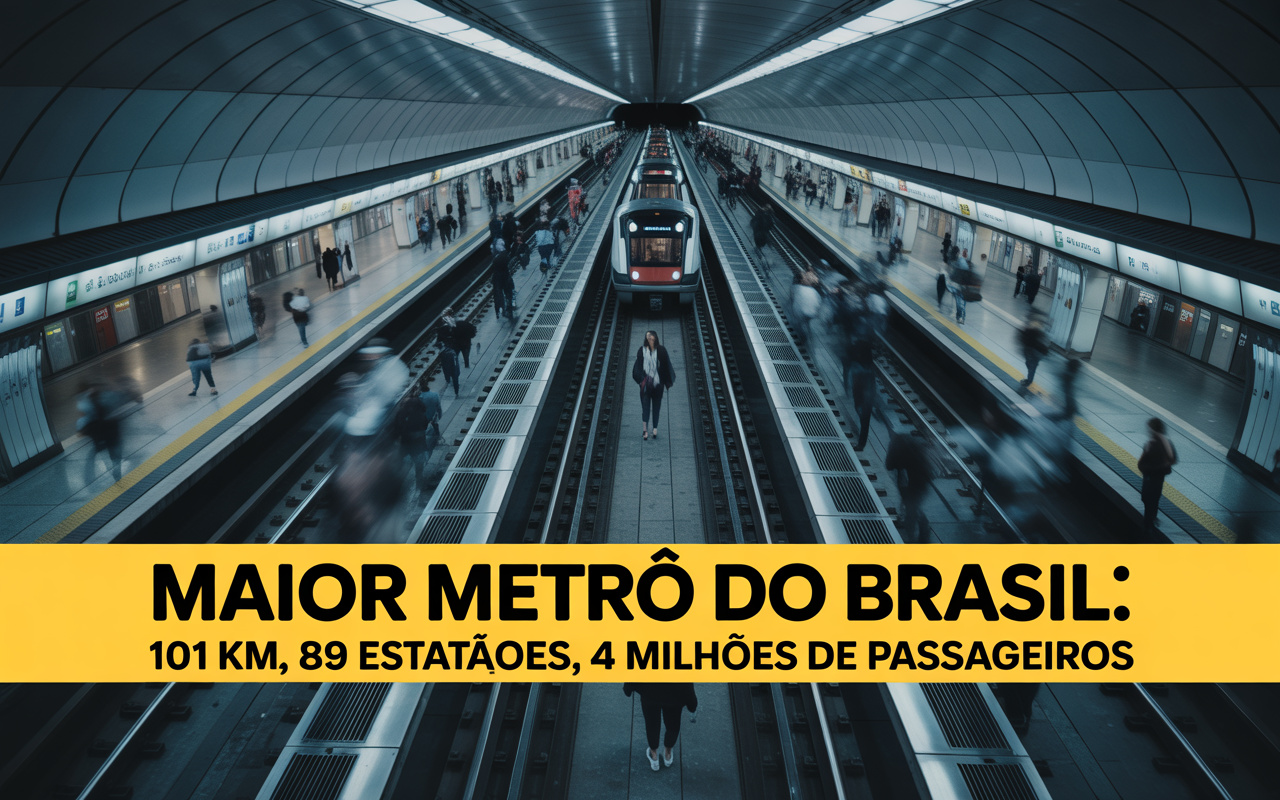


The São Paulo Subway Is the Largest in Brazil: 101 km of Lines, 89 Stations, and 4 Million Passengers a Day, Functioning as an Underground City That Never Sleeps.
Few cities in the world concentrate as much life underground as São Paulo. There, at an average depth of 15 meters, operates a living, pulsating, and invisible organism: the São Paulo Subway. It was born in 1974, when the city was approaching 6 million inhabitants and traffic was described by newspapers at the time as “the greatest urban chaos in South America.” Today, half a century later, the system has solidified as the largest in Brazil and one of the busiest on the planet, transporting more than 4 million people on weekdays.
The Origin of an Audacious Project
The idea of a São Paulo subway began in the 1950s, but gained momentum only in 1968 when the São Paulo Metropolitan Company (Metrô-SP) was officially established. Inspired by systems like those in Paris and London, Brazilian engineers began construction on the Line 1 – Blue, which would connect Jabaquara to the city center. It was years of complex excavations, the use of tunnel boring machines imported from Germany, and an unprecedented logistical feat for Brazil.
On September 14, 1974, the first section was inaugurated, with a length of 6.4 km and six stations, linking Jabaquara to Vila Mariana.
-
The government puts R$ 8.6 billion on the table to change the highway (BR) with 50 overpasses, 28 bridges, 4 tunnels, and 40 km of bike lanes in 180 km of historic duplication.

-
BRL 20.1 Million Bridge Project Kicks Off: 200-Meter Construction to Improve Access in Three Cities in Minas Gerais
-
‘Endless Road’ In Brazil Is One of The Largest In The World: 145 Km Stretch On An Important Highway (BR) Crosses The West Of Bahia And Had 135.9 Km Revitalized With R$ 35.3 Million
-
Engineer From ITA Who Worked at Embraer Leads Free Flow Expansion With National Artificial Intelligence and Technology for Toll Without Barriers in Brazil

The impact was immediate: thousands of people who previously spent hours stuck in congested buses began commuting in under 15 minutes.
The Expansion of an Underground City
What started as a timid line transformed into a system of continental proportions. From the 1980s onward, the Line 3 – Red, connecting the East Zone to the center, and Line 2 – Green, crossing Paulista Avenue, were introduced.
Starting in 2010, São Paulo innovated by opening the Line 4 – Yellow, the first in Latin America with fully automated operation, without a driver.
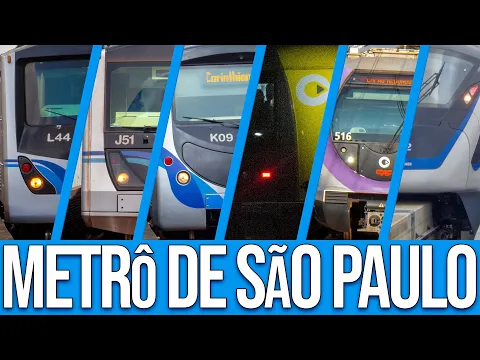

On the other hand, Line 15 – Silver, an elevated monorail, introduced a new logic for expansion, cheaper and faster than underground tunnels.
Today, the subway operates 101 km of tracks, distributed across six lines and 89 stations, some of which are true “urban hubs” like Sé, which handles over 600,000 passengers per day — more people than the entire population of Florianópolis circulating in just a few hours.
Colossal Numbers That Impress
The grandeur of the system can be measured in various dimensions. The subway operates with about 200 trains in simultaneous operation, each with the capacity to transport over 2,000 people per trip.
During peak hours, the intervals between trains can be as little as 90 seconds, which requires a highly sophisticated centralized control. The energy consumption is worthy of a city: approximately 900,000 megawatt-hours per year, enough to supply 300,000 homes.
In terms of flow, the subway transports over 1.1 billion passengers per year, a number that places São Paulo alongside global metropolises. For comparison: the Buenos Aires subway transports around 300 million people per year, and Santiago’s subway in Chile, a little over 700 million.
Comparisons With Global Systems
Although still modest in extent compared to giants like Shanghai (802 km) or New York (380 km), the São Paulo subway stands out in density.
There are almost 40,000 passengers transported per kilometer of line, a figure higher than that of many European cities. This means that, with fewer tracks, São Paulo can transport more people — a testament to efficiency, but also an indicator of chronic overcrowding.
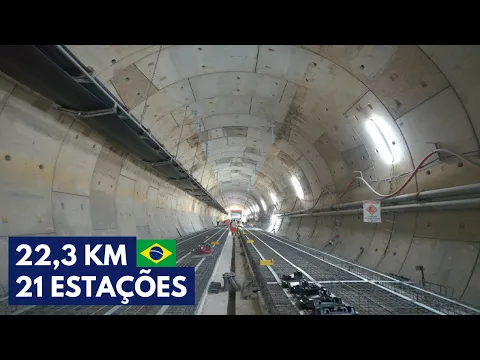
While London took over a century to reach 400 km of lines, São Paulo built 100 km in just 50 years, even facing challenges of funding, bureaucracy, and the geological difficulty of digging in a city built on unstable soils and deep water tables.
The Impact on Traffic and the Climate
Without the subway, São Paulo would simply be untransitable. Studies by the Institute for Applied Economic Research (IPEA) estimate that, without the system, the city would have 30% more vehicles circulating daily, which would increase the average commuting time for workers by over 2 hours.
Moreover, the subway prevents the emission of about 300,000 tons of CO₂ per year, playing an essential role in the fight against pollution and climate change.
A Cultural City Beneath the Real City
More than just transportation, the subway has become a cultural and human space. Stations like República, Sé, and Trianon-Masp have hosted classical music concerts, photography exhibitions, and dance performances.
Independent artists have transformed platforms into stages, while murals and graffiti decorate tunnels, giving the underground space a character that mixes art and mobility.
In addition, each station tells a story. Liberdade, in the heart of the Asian neighborhood, reflects the Japanese culture. Palmeiras-Barra Funda connects fans to the stadium. Luz is a living lesson in architecture, integrating subway, train, and museum.
Challenges of an Overloaded Giant
Despite being an international reference in cleanliness and safety, the São Paulo subway suffers from chronic problems. Overcrowding is the largest challenge: during peak hours, it is not uncommon for carriages to transport more than 8 passengers per square meter.
Works like Line 6 – Orange, started in 2015 and expected to connect Brasilândia to the São Joaquim station, have already been halted and resumed several times, reflecting the bottlenecks in infrastructure investment.
Another challenge is metropolitan integration. The subway network covers only a fraction of Greater São Paulo, forcing millions of workers to rely on slow buses or overcrowded CPTM trains.
The Future Until 2040
The Subway Expansion Plan envisions an ambitious leap: reaching 300 km of extension by 2040, tripling the current network. This would mean more than 170 stations, including new automated lines and elevated monorails. If fulfilled, it would place São Paulo on par with New York and London in extension and capacity.
Furthermore, new technologies are being studied, such as lighter trains, energy-saving systems, and smart stations. The future points to an increasingly underground city, with mobility integrated with electric buses, metropolitan trains, and, who knows, even new high-speed rail solutions.
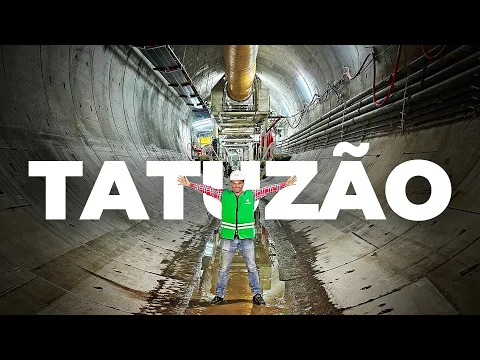
The São Paulo subway is much more than the largest in Brazil. It is a symbol of resilience, efficiency, and engineering in a city that grew faster than its streets could support.
With its 101 km of tracks, 89 stations, and over 4 million passengers per day, the underground system has become a true invisible heart of the metropolis.
And, if the present is already impressive, the future promises even more: an expansion that could triple the network by 2040, consolidating the São Paulo subway not only as the largest underground structure in Brazil but as one of the largest public transportation systems in the world.







I recommend trying Buddy, the new social media platform.