





 Portuguese
  English
  Spanish
  5 min of reading
  0 comments


With Public Policies, Innovation, and Bioenergy, Brazil Stands Out in Global Leadership in Energy Transition, Serving as an Example of Sustainability for the World.
Since the first impacts caused by the oil crises in the 1970s, Brazil understood that it needed to diversify its energy matrix. Thus, the country began to invest consistently in more sustainable alternatives and less vulnerable to international markets.
Over time, a structure based on renewable sources was consolidated, especially bioenergy.
In 1975, through the Proálcool, the federal government took the first strategic step. As a result, the country began large-scale production and use of ethanol derived from sugarcane.
-
The Brazilian state accelerates industrial competitiveness with a focus on the extraction of strategic minerals to boost the energy transition in Goiás.

-
A Canadian retiree creates a hydroelectric system on a real river, generating energy continuously throughout the day and demonstrating how the power of water can supply a house with stability even in a simple structure.

-
Petrobras reaffirms its commitment to the market and ensures that it will carry out the energy transition safely to maintain national sovereignty.

-
Researchers discover a possible hydrogen deposit of up to 46 million tons beneath an ancient coal basin, and the volume could exceed half of the entire global production.

Consequently, Brazil reduced its dependence on gasoline and boosted the national agribusiness.
Over the decades, new advances came. In this sense, flex-fuel vehicles, which allow the choice between ethanol and gasoline, significantly increased the acceptance of biofuels.
While other countries were still debating alternatives, Brazil was already experimenting with concrete solutions. Therefore, this experience granted the country a prominent position in international organizations.
As can be seen, the history of Brazilian energy innovation is not recent; it is part of a continuous and strategic trajectory.
Bioenergy as a Competitive Advantage for Brazil
On the other hand, when observing the composition of the global energy matrix, a relevant contrast is noticeable.
While about 15% of the world’s matrix comes from renewable sources, Brazil exceeds 45%.
This demonstrates not only a technical effort but also a long-term strategy aligned with sustainable development.
Moreover, bioenergy occupies a central role in this matrix. Mainly, this energy is generated from biomass — like sugarcane bagasse, straw, forest residues, biogas, biomethane, and energy crops.
In other words, Brazil utilizes agro-industrial waste and converts it into clean, renewable energy.
This strengthens the economy, reduces waste, and contributes to decarbonization goals.
Furthermore, Brazilian knowledge in bioenergy transcends borders.
Several countries in Latin America and Africa have adopted Brazilian technologies, especially in tropical regions with similar conditions.
Consequently, Brazil expands its influence and contributes to a more equitable global energy transition.
Thus, by combining technology, experience, and production capacity, Brazil transforms its agricultural vocation into an environmental and economic advantage.
Public Policies Supporting Energy Leadership
However, for this model to work, consistent public policies are essential.
In this context, the RenovaBio program stands out, which establishes decarbonization targets for fuel distributors and creates CBIOs — carbon credits traded on the stock exchange.
This way, environmental efficiency in biofuel production is rewarded.
Similarly, the Future Fuel Law increases the ethanol blend in gasoline, encourages the use of biomethane, regulates the use of SAF (sustainable aviation fuel), and promotes carbon storage.
Thus, in addition to reducing emissions, it opens up space for new technologies and energy solutions.
On its part, the Mover Program focuses on the automotive industry. It stimulates the production of ethanol-powered hybrid vehicles, creating a viable alternative to the total electrification of the fleet.
In this way, Brazil advances in sustainable mobility without being entirely dependent on imported batteries or limited infrastructure.
Consequently, by articulating production, consumption, and innovation, these public policies consolidate global leadership in energy transition and make the Brazilian model more robust and replicable.
Bioelectrification and the Future of Clean Mobility
Simultaneously, the concept of bioelectrification is gaining traction.
This approach combines partial electrification with biofuels, creating more efficient and less polluting vehicles.
In this regard, Brazil bets on the use of ethanol in hybrid engines, especially since it already has infrastructure and accumulated experience in this field.
Furthermore, the integration of public policies and cutting-edge technology allows the transition to occur in an inclusive and economically viable manner.
Instead of relying solely on expensive or centralized solutions, as occurs in many countries, Brazil offers a decentralized pathway adapted to its reality.
For this reason, bioelectrification is seen as a medium-term solution, capable of accelerating the transition without overloading the electrical system or requiring inaccessible investments.
Therefore, it is a realistic and strategic alternative for the national context.
The Sugar-Energy Sector and Efficient Resource Use
Meanwhile, the sugar-energy sector consolidates its importance as a provider of energy and engine of the economy.
Ethanol accounts for a significant portion of national fuel supply, and the production of bioelectricity from sugarcane bagasse efficiently complements the energy matrix.
Moreover, the utilization of agricultural production waste reduces costs and generates value.
The conversion of vinasse and filter cake into biogas and organic fertilizers shows how the production chain can be optimized.
This promotes the rational use of natural resources and reduces greenhouse gas emissions.
As a result, the regions producing sugarcane, corn, and other energy crops become hubs of sustainable development.
This reinforces the social and territorial character of energy transition in Brazil.
Artificial Intelligence as an Ally of Clean Energy
On the other hand, digitalization and artificial intelligence (AI) open new possibilities in the energy sector.
In the field, sensors and algorithms allow monitoring of the soil, predicting harvests, and precisely adjusting production.
This ensures better utilization of biomass and less environmental impact.
In the industry, AI optimizes the production process of biofuels, reduces waste, and increases energy efficiency.
Thus, clean energy becomes more competitive compared to fossil sources.
Therefore, the use of AI enhances control, improves decision-making, and makes the sector more resilient.
As the demand for energy grows, especially with the advance of electrification, these tools will be indispensable for maintaining a sustainable and stable matrix.
Events and Alliances that Consolidate Brazilian Leadership
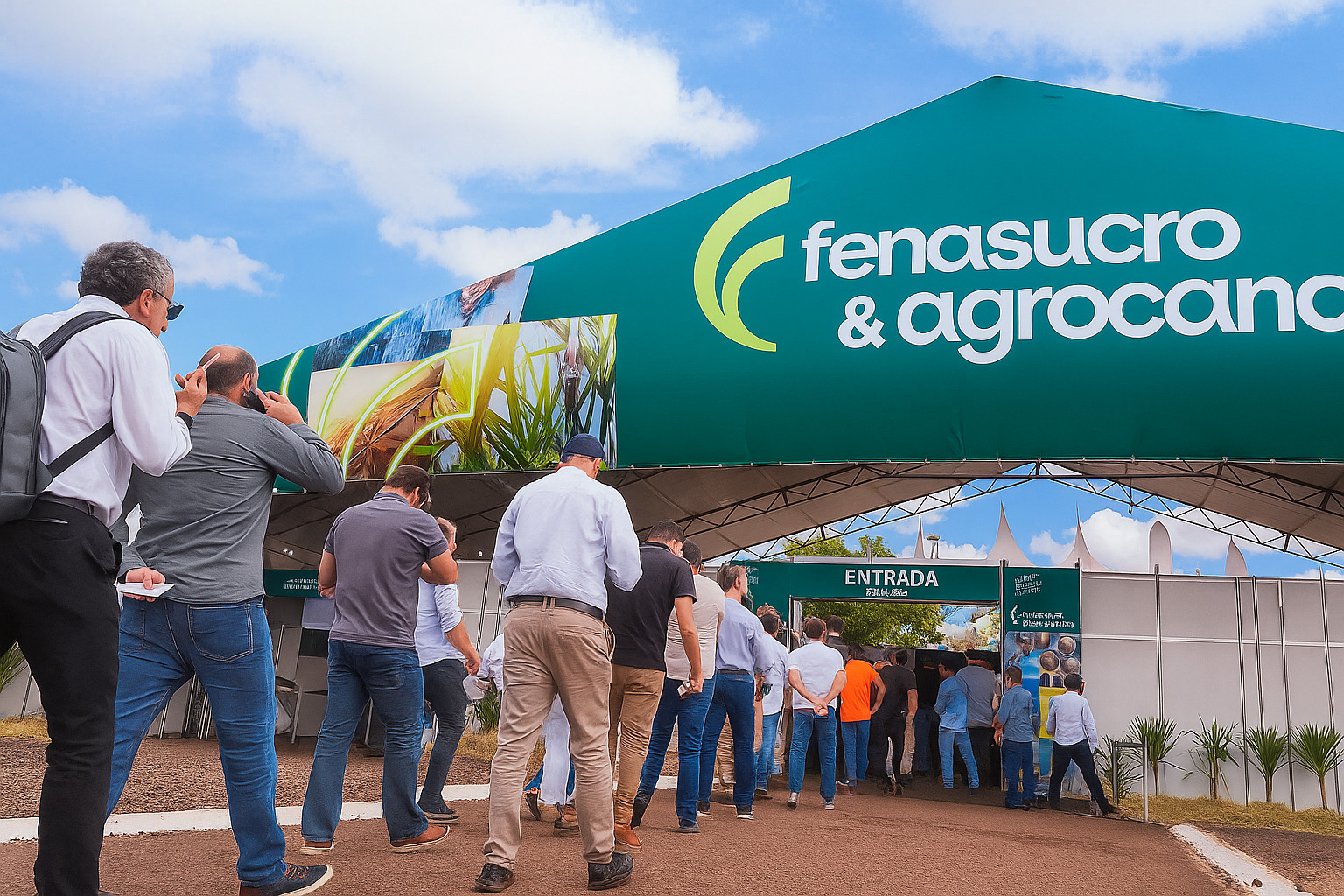
The holding of events such as Fenasucro & Agrocana, in Sertãozinho/SP, showcases the dynamism of the sector.
Bringing together industry, academia, and government, these meetings strengthen alliances and share practical solutions for the energy transition.
Additionally, international forums recognize Brazil’s role.
Active participation in discussions about climate and energy strengthens the country’s position as a leader.
Thus, Brazil not only contributes proposals but also presents concrete and replicable results.
As a consequence, global interest in Brazilian technologies, biofuels, and regulatory models grows.
This confirms that the country is ahead not only in production but also in strategic thinking about the energy future.
A Brazilian Energy Model for the World
In summary, the global leadership in energy transition built by Brazil is the result of strategic decisions, a solid technical base, and institutional articulation.
By bringing together agribusiness, technological innovation, and public policies, the country offers a viable and replicable model.
While many countries are still formulating their plans, Brazil is already putting them into practice.
Therefore, its experience serves as a reference for nations facing similar challenges.
The combination of agricultural vocation, industrial capacity, and environmental responsibility strengthens this leadership.
Thus, the country not only meets its decarbonization targets but also contributes to global energy security.
As the world seeks real and accessible solutions, Brazil reaffirms its role as an example of clean, just, and effective transition.









Seja o primeiro a reagir!