






 Portuguese
  Spanish


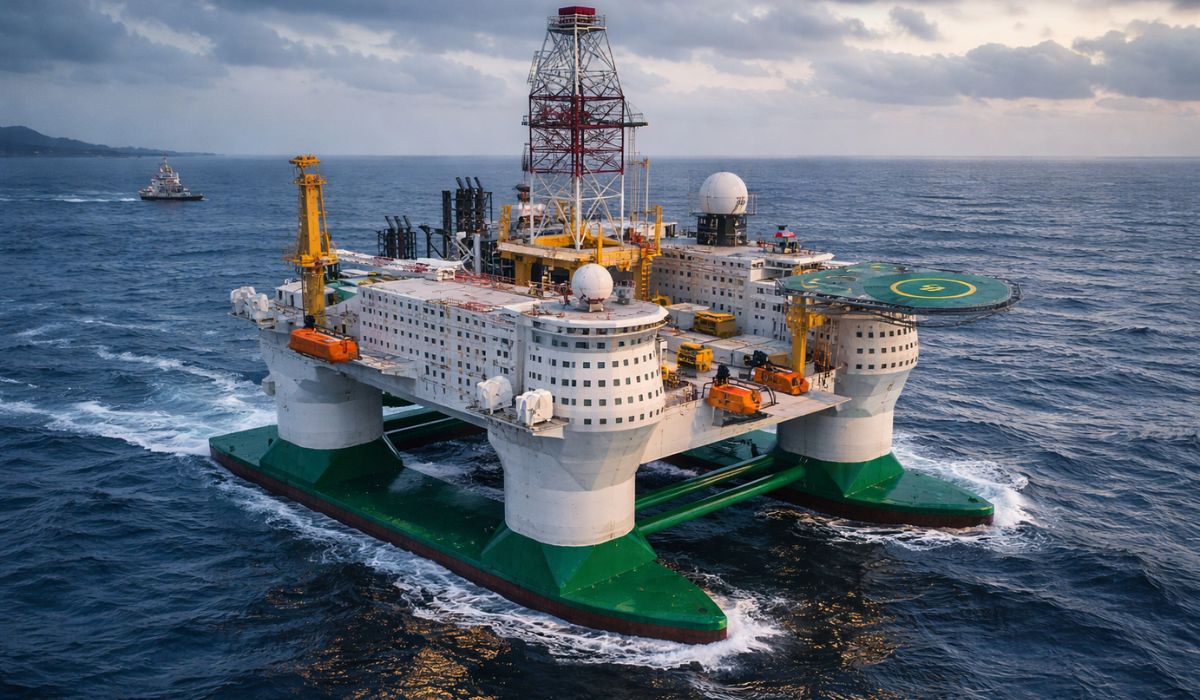


Chinese project focused on the deep sea advances with new scientific infrastructure in Shanghai and expands international attention on ocean research, offshore engineering, and deep-water operations, in a movement that brings together technology, logistics, and strategic ambition.
China announced in Shanghai, on Saturday, March 28, 2026, the start of construction of a new scientific infrastructure aimed at open-sea ocean research.
Named “floating island for open sea”, the project was presented as the world’s first ultralarge platform designed to support offshore research under different climatic conditions, focusing on long-term operations and deep-water environments.
The initiative is led by Shanghai Jiao Tong University and is expected to be completed by 2030.
-
In a Degraded Atlantic Forest Area, a São Gonçalo Resident Transforms Land into a Living Eco-Museum, Now a Model for Environmental Education

-
World’s First Lithium-Sulfur Battery Factory Launches, Promising to Double Range Without Relying on China

-
AI Data Centers Now Feature Built-In Nuclear Power Plants and Have Ordered Non-Existent Reactors
-
In India, thousands earn about $2.50 an hour cooking and cleaning with a phone strapped to their heads, as every move is recorded to train humanoid robots for jobs they might one day replace.



Contrary to the idea of a structure already ready and in use in the ocean, what Chinese authorities announced now was the start of construction of the venture.
The public presentation took place a day after the establishment, at the university responsible for the project, of an institute dedicated to science and engineering in deep waters.
According to the announcement made by Chinese state media, the platform falls into the category of large national science and technology infrastructures.
The goal is to meet research demands in areas such as marine equipment, marine resources, and ocean sciences, bringing together field experiments, onboard support, and land assistance within the same system.
Project in Shanghai for ocean research in open sea
The project was presented as a structure aimed at open-sea research and testing technologies applied to the ocean environment.
In practice, the announcement marks the beginning of the physical implementation of the facility, and not the operational start of the platform.
The responsible university also officially announced, the day before, the creation of an institute focused on science and engineering in deep and distant waters.
According to the institution, the unit will focus on coordinating research, training specialists, and developing the future facility.
What the structure of the floating island for open sea will be like
The project was designed with three main fronts.
The first is the central platform, which will function as the core of open-sea operations.
The second includes laboratories installed on vessels, responsible for part of the scientific activities and support testing.

The third is the land base, which will provide logistical, technical, and analytical support to the entire operation.
According to the official presentation, this arrangement seeks to connect engineering tests, scientific observation, and data processing within the same operational network.
The proposal is to bring together technological development, validation under real conditions, and the applied use of results.
Double hull semi-submersible and tests up to 10 thousand meters
The most highlighted element in the design of the future facility is the model described as “double hull semi-submersible”.
According to the official presentation, this format was designed to increase the stability of the structure in open sea and enable real-scale experiments with deep-water equipment that can weigh hundreds of tons.
In addition, the platform was designed to support research and testing across the entire ocean depth range, reaching 10 thousand meters.
According to Chinese disclosures, this range expands the possibilities for experimentation under extreme conditions of pressure, temperature, and operation.
Shanghai Jiao Tong University also described the installation as a “self-propelled scientific platform for deep and distant waters”.
According to the institution, the model was conceived to allow prolonged activities offshore and integrate construction, research, personnel training, and industrial application.
Deep sea mining, oil, and scientific research
When completed, the structure is expected to function as an open-sea testing ground for deep-sea mining systems, critical marine equipment, and offshore facilities linked to the oil and gas industry.
The proposal includes both scientific research and engineering tests with potential economic applications.
The official disclosure also states that the new facility is expected to contribute to the commercial development of marine resources, expand knowledge about the seasonal evolution of ocean ecosystems, and support studies on the origin and evolution of life.
Another point mentioned is the possibility of improving the accuracy of typhoon forecasts.
According to the material presented by Chinese authorities, this type of infrastructure can be used for both basic research and technological testing.
The project was designed to bring together, in the same environment, scientific activities and equipment validation under real open-sea and deep-water conditions.
Shanghai Jiao Tong University and the new deep-water institute
The execution of the project is under the responsibility of Shanghai Jiao Tong University, which officially announced on March 27, 2026, the creation of the Institute of Science and Engineering in Deep and Distant Waters.
At the ceremony, the university stated that the new unit will be its direct arm to organize research, connect the construction of the infrastructure with scientific production, and stimulate applications in areas such as underwater engineering equipment, deep-sea exploration methods, and utilization of ocean resources.
The institution also presented the project as part of a strategy to bring large scientific facilities closer to research and innovation activities.
According to the university, the proposal is to ensure that the platform advances while simultaneously producing scientific and technological results.
Construction schedule and expected completion in 2030
With the construction officially started, the disclosed schedule points to the completion of the installation in 2030.
By then, the project is expected to go through construction phases, system development, integration with onboard laboratories, and assembly of the land support base.
The announcement, therefore, marks the beginning of the implementation of the structure.
The full operational start will depend on the completion of these phases and the integration of the systems outlined in the project.

According to the official presentation, the future platform is expected to operate in open sea with a range of up to 10 thousand meters and simultaneous use for research and technological testing.
The initiative places ocean research in deep waters at the center of a long-term investment that combines infrastructure, engineering, and applied science.


