





 Portuguese
  English
  Spanish
  6 min of reading
  0 comments


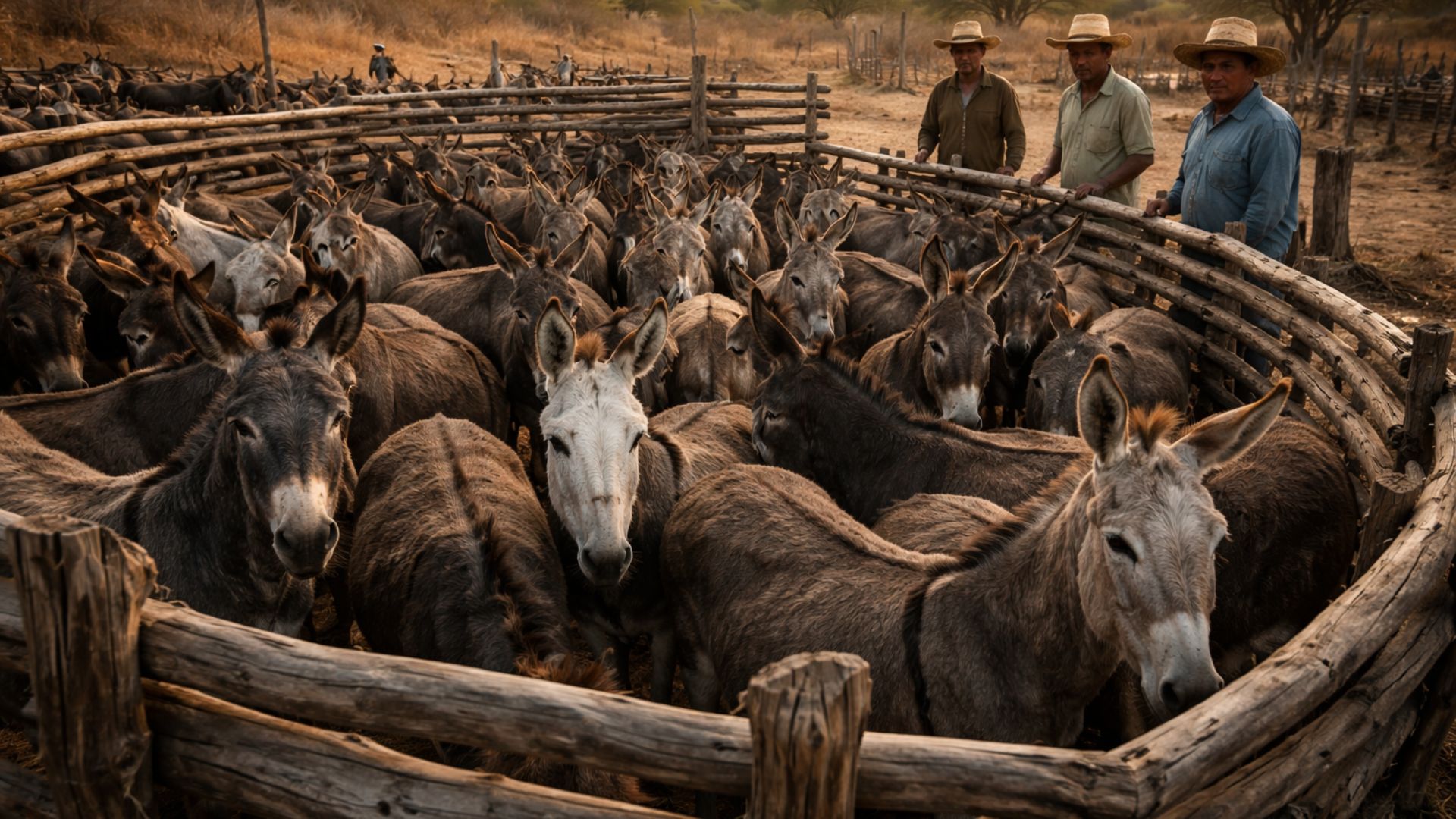
Judicial Decision Revives Debate on the Slaughter of Donkeys in Brazil, with Researchers Warning of Population Collapse Risk, Sanitary Impact, and Low Economic Relevance of Skin Exports to China.
Researchers from public universities have begun to contest the decision of the Federal Regional Court of the 1st Region (TRF1) that recognized the legality of donkey slaughter in Brazil, and have released an open letter requesting the immediate suspension of the practice based on economic, environmental, and sanitary arguments.
Signatories include faculty and researchers affiliated with, among others, the University of São Paulo (USP), the Federal University of Bahia (UFBA), the Federal University of Alagoas (UFAL), and the Federal University of Recôncavo da Bahia (UFRB), who point to the risk of population collapse of the northeastern donkey.
At the heart of the contestation is the assessment that the slaughter, now associated with the skin trade to China, operates without a structured production chain and tends to deepen the accelerated reduction of the herd, seen by the signatories as a threat to the genetic and cultural heritage of the Northeast.
-
Friends have been building a small “town” for 30 years to grow old together, with compact houses, a common area, nature surrounding it, and a collective life project designed for friendship, coexistence, and simplicity.

-
This small town in Germany created its own currency 24 years ago, today it circulates millions per year, is accepted in over 300 stores, and the German government allowed all of this to happen under one condition.

-
Curitiba is shrinking and is expected to lose 97,000 residents by 2050, while inland cities in Paraná such as Sarandi, Araucária, and Toledo are experiencing accelerated growth that is changing the entire state’s map.

-
Tourists were poisoned on Everest in a million-dollar fraud scheme involving helicopters that diverted over $19 million and shocked international authorities.


Open Letter Calls for Review of TRF1 Decision

The group requests that the judicial understanding be reviewed in light of what they call accumulated technical evidence, arguing that the issue does not end with the legality of the procedure, as it involves wildlife conservation, sanitary control, and impacts on the genetic diversity of an animal associated with the semi-arid region.
Although the decision mentioned in the letter was made at the end of 2025 and cited as rendered on December 6, researchers maintain that the discussion needs to incorporate information consolidated by academic studies and official databases used to monitor agricultural production and foreign trade.
In the signatories’ assessment, the judicial permission, in practice, reinforces an exploitation model based on the utilization of existing animals, without a robust population replacement plan, which would increase pressure on a biological stock treated as finite.
ESALQ/USP Study Questions Economic Viability
The main technical reference presented in the mobilization is the study “Economic Viability of Donkey Slaughter in Bahia,” conducted by Professor Roberto Arruda de Souza Lima from the Luiz de Queiroz College of Agriculture (ESALQ/USP), cited as a basis to support the lack of a consolidated production model.
According to the analysis attributed to the study, there would not be a stable breeding system in the country aimed at large-scale slaughter, with planned reproductive management, organized chain, regular herd replacement, and supply predictability characterizing a continuous productive activity.
With this design, the availability of animals would largely depend on capture and collection, a feature that researchers classify as extractive exploitation, supported by the progressive consumption of a population stock, rather than planned production to sustain the pace of slaughters.
94% Population Decline Raises Alarm

The letter points to a 94% reduction in the donkey population between 1996 and 2024, based on data attributed to compilations from FAO, IBGE, and Agrostat, and uses the variation to argue that the species is already under consistent pressure, at risk of regional exhaustion.
For the researchers, the speed of the decline is incompatible with the notion that the current system is sustainable, especially considering that replacement is biologically slow, with a gestation period of around 12 months and reproductive rates that do not keep pace with intensified slaughter.
Professor Chiara Albano de Araujo Oliveira from UFBA states in the document that biological limitations make it difficult to expand production at the same pace as demand, and researcher Iaçanã Valente Ferreira Gonzaga from UFRB argues that there is no national technical structure capable of replenishing the population.
Demand for Ejiao Drives Skin Exports
Signatories link the increase in slaughter to Chinese demand for ejiao, derived from collagen extracted from the animal’s skin, and assert that pressure from the international market has intensified with increased domestic consumption in China, resulting in heightened demand for the raw material.
“The increase in donkey slaughter is directly linked to the growing Chinese demand for ejiao,” says the open letter, which also associates the scenario with reliance on capture and the absence of a production chain, indicating a risk of collapse if extraction continues at the same pace.
Additionally, the document asserts that the share of this trade in Brazilian exports is less than 0.000003% of the total, a figure deemed negligible given the alleged risks.
Local Economic Impact Considered Limited
The study from ESALQ/USP mentioned by the researchers claims that municipalities with authorized slaughterhouses, such as Amargosa in Bahia, have not recorded significant economic growth or consistent increases in tax revenue during the period in which operations occurred.
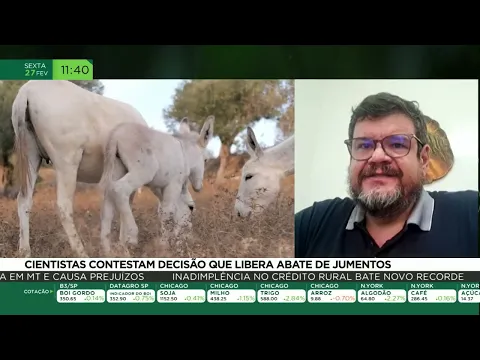

In the authors’ interpretation of the letter, the set of results reinforces the thesis that slaughter would not sustain a local development dynamic capable of justifying social, environmental, and sanitary costs, especially in a context of historical herd reduction.
Even so, the issue remains on the radar of sectors advocating the activity as an economic alternative and a way to organize a market that already exists, an argument that researchers rebut by insisting that the current base is not productive, but extractive.
Sanitary Risks and Questions About Traceability
The letter also highlights the sanitary component, stating that the absence of broad traceability and consistent controls could increase the risk of disease spread, especially when animals are captured, transported, and concentrated without well-documented sanitary history.
Researchers cite a study published in 2025 in the scientific journal Animals, which evaluated 104 donkeys intended for slaughter through physical examinations and hematological analyses, identifying signs compatible with poor body condition and systemic inflammation in the majority of observed animals.
In the document, veterinarian José Roberto Pinho de Andrade Lima, a PhD in Public Health from UFBA, states that the extractive logic tends to increase sanitary risks and produce legal insecurity, in addition to potentially affecting the country’s international image regarding animal welfare issues.
Discrepancies Between Slaughter and Export Volume
Another section of the letter points out discrepancies between the number of animals slaughtered and the volume of skins exported, recording that the average weight of skins shipped over the last ten years has been 3.8 kilograms per unit, below what is expected in technical assessments.
For the researchers, this data does not, by itself, allow for a conclusion about the origin of the difference, but it is sufficient to warrant an investigation, as commercial inconsistencies may indicate registration errors, classification problems, or distortions in the relationship between slaughter, processing, and export.
With the judicial decision in effect, the signatories advocate for the suspension of slaughter throughout the national territory, the acknowledgment of the northeastern donkey as a genetic and cultural heritage, and the formulation of conservation public policies before any expansion of the sector.









-

Uma pessoa reagiu a isso.