





 Portuguese
  English
  Spanish
  4 min of reading
  0 comments


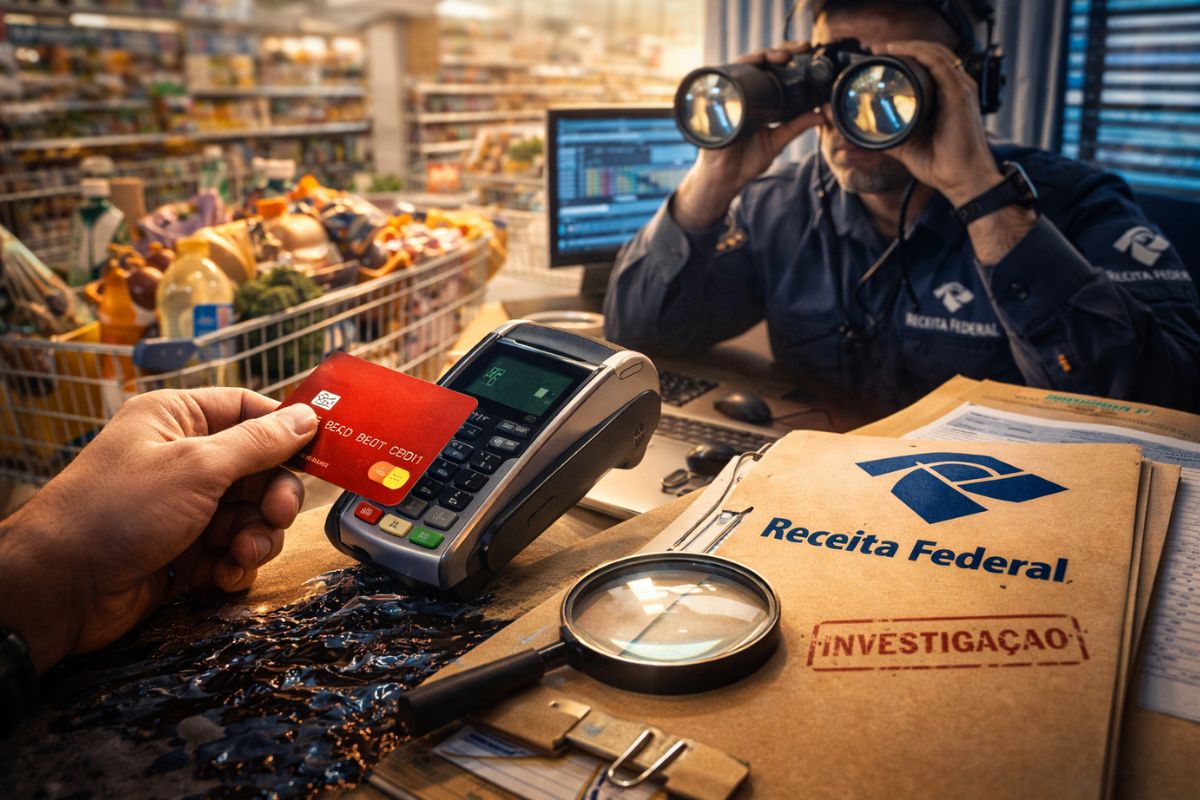
The Federal Revenue Observes The Credit Card As A Consumption Thermometer, And Upon Detecting A Recurring Bill Incompatible With The Income Reported In The Declaration, May Open Investigations That Run In Parallel To The Routine Of The Taxpayer, Until The Moment When The Convocation Arrives And Demands Documentary Explanations In Official Language
The credit card has become one of the most used payment methods, and this has widened the consumption trail that the Federal Revenue can compare with the declared income. When the Federal Revenue notices that the monthly bill is much higher than what was reported in the declaration, the case may move from the field of statistical curiosity to the field of investigation.
Spending above one’s income on a credit card is not, by itself, an automatic infraction, but the inconsistency between declaration and spending pattern may require clarifications. Many people only understand the weight of this crossover when they receive a formal summons and need to prove where the money came from that supported that bill.
What May Catch The Attention Of The Federal Revenue On The Credit Card
The Federal Revenue tends to focus on simple signs of incompatibility, especially when the credit card bill remains high for several cycles and the declared income does not keep up.
-
The government requests the Federal Revenue Service for a new system to automate the income tax declaration, reducing errors, time, and bureaucracy for millions of Brazilians.

-
Pix in installments, international Pix, and contactless payment without internet: the Central Bank revealed the new features coming to the tool that is already used by almost every adult in Brazil.

-
Mercado Livre has just started selling medications with delivery in up to three hours to your door, and this move could completely change the way Brazilians buy medicines on a daily basis.

-
In Dubai, rising tensions from the war in the Middle East are causing super-rich individuals to leave the Gulf and direct their fortunes to a new financial refuge in Asia.


The logic is objective: if the reported income is low and the recorded consumption is high, the system starts to see a risk of unreported income or unexplained source.
In practice, what becomes a problem is not buying once in a while, but rather the repeated pattern over time.
When the credit card becomes a permanent extension of the budget and the bill becomes a regularity above the income, the declaration becomes the first piece to be questioned, because it is there that the Federal Revenue finds the official basis of what the taxpayer claims to earn.
When Consumption And Bill Don’t Match, What The Investigation Usually Asks
The most didactic example is the one that frequently appears in discussions of financial education: income of R$ 3 thousand and bills above R$ 10 thousand regularly.
This type of mismatch draws attention because it requires an economic explanation: was there extra income, a loan, family assistance, sale of an asset, or is someone paying the bill on the side?
It is at this point that the Federal Revenue typically wants to understand the money’s path, and the central question is not moral; it is accounting.
Where did the funds that sustained the credit card come from, why did this not appear in the declaration, and what proof ties the financial flow to the registered bill pattern?
Common Errors That Increase The Risk Of Questioning
Some behaviors increase the noise between what is declared and what is spent.
According to Portal 6, the following frequently appear: not declaring extra income, lending credit cards to third parties, regularly paying the bills of others, not keeping receipts, and mixing personal and professional expenses.
These points converge into a classic problem: the declaration becomes an incomplete portrait, while the credit card becomes a detailed record of daily life.
When third parties enter the bill and proof does not accompany, the Federal Revenue may interpret this as omission, even if the source is legitimate, and it is the taxpayer who needs to demonstrate this.
How To Reduce Risk Before A Summons And What To Do If There Is An Error
The most defensible measure is simple and administrative: keep receipts, contracts, and statements that explain occasional income and payments outside of salary.
In scenarios with extra income, side jobs, and freelancing, the consistency between bill and declaration depends on minimal documentation, because the credit card leaves more detailed traces than memory.
If a person realizes they declared incorrectly, there is the option to correct the declaration through rectification, adjusting what was reported and aligning the consumption history with what was actually received.
Rectifying does not erase the past, but reduces the chance of surprise, because it signals that the declaration seeks to reflect reality before the Federal Revenue points out the inconsistency through an investigation.
The Federal Revenue monitors credit cards because credit cards have become a showcase of everyday consumption.
The same tool that facilitates installments also amplifies the contrast between income, bill, and declaration when accounts do not balance for a long time.
Has your case ever had a month where the bill was much higher than what you reported, and would you be able to explain that today with receipts and statements, or would you rely only on memory? And in your opinion, should lending a credit card to family members be treated as an acceptable routine or as unnecessary risk in front of the Federal Revenue?









-

Uma pessoa reagiu a isso.