





 Portuguese
  English
  Spanish
  4 min of reading
  0 comments


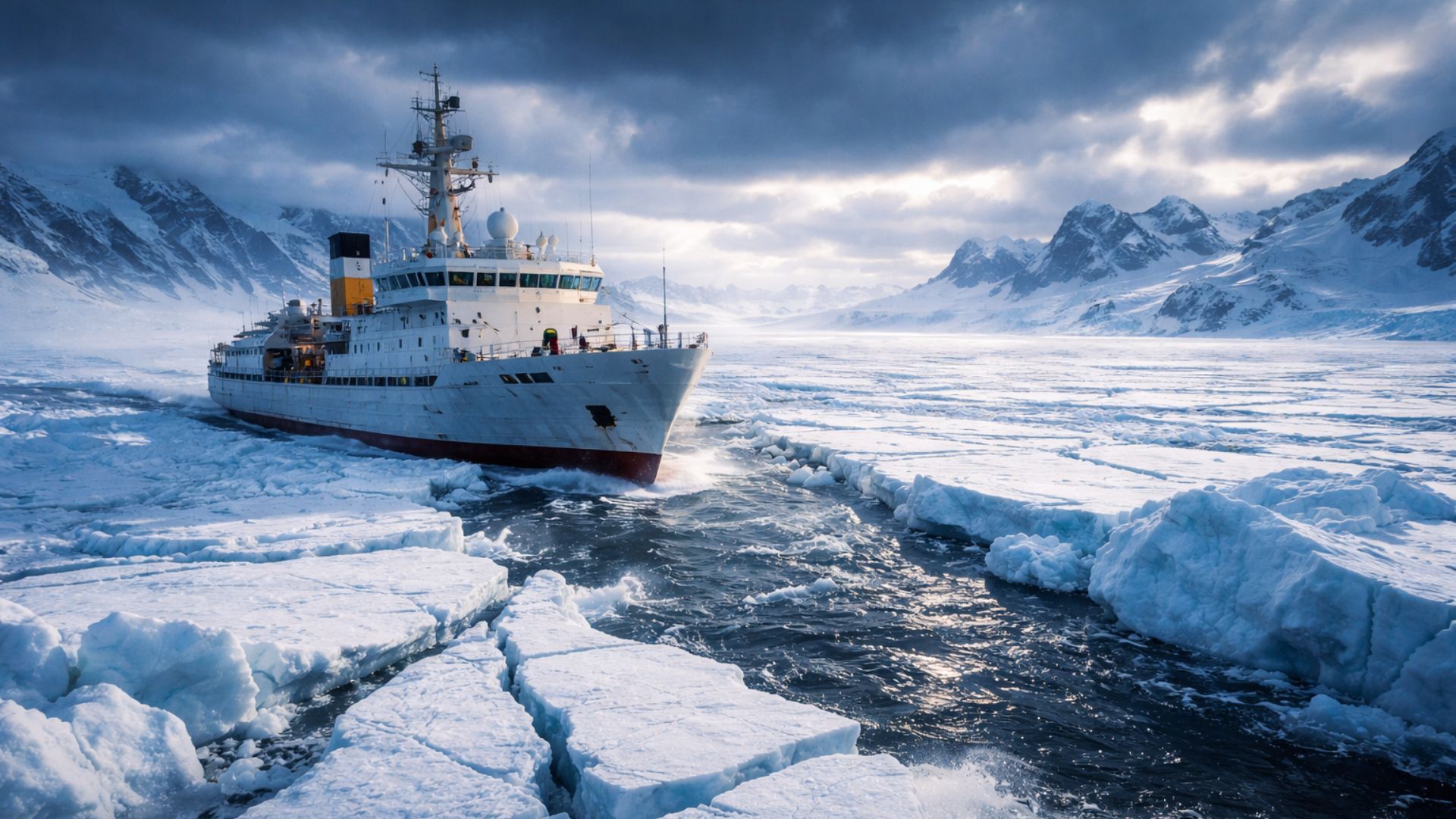
Crossing Beyond the Antarctic Polar Circle Reinforces Brazilian Presence in a Strategic Area of the Planet, with Embedded Scientific Structure, Million-Dollar Investments, and Direct Support for Research Conducted at the Comandante Ferraz Station During the Antarctic Operation.
The Brazilian Navy reported that the Polar Ship “Almirante Maximiano” performed, on January 27, 2026, its second navigation beyond the Antarctic Polar Circle, during the 44th edition of the Antarctic Operation (OPERANTAR), part of the Brazilian Antarctic Program (PROANTAR).
The line of the Polar Circle, located approximately at latitude 66°33′ S, marks one of the geographical references used to delimit the southern polar region and concentrates conditions that make navigation especially sensitive to weather windows and ice advancement.
According to the Navy itself, operating in these waters requires rigorous planning and continuous monitoring, as the scenario combines severe weather, a constant presence of ice, and extreme variations in brightness throughout the season.
-
Friends have been building a small “town” for 30 years to grow old together, with compact houses, a common area, nature surrounding it, and a collective life project designed for friendship, coexistence, and simplicity.

-
This small town in Germany created its own currency 24 years ago, today it circulates millions per year, is accepted in over 300 stores, and the German government allowed all of this to happen under one condition.

-
Curitiba is shrinking and is expected to lose 97,000 residents by 2050, while inland cities in Paraná such as Sarandi, Araucária, and Toledo are experiencing accelerated growth that is changing the entire state’s map.

-
Tourists were poisoned on Everest in a million-dollar fraud scheme involving helicopters that diverted over $19 million and shocked international authorities.

Antarctic Operation and Brazilian Presence on the Frozen Continent

OPERANTAR has been conducted regularly since the beginning of Brazilian activities in Antarctica in 1982 and serves as the logistical axis that maintains the national presence on the continent, supporting scientific campaigns and the operation of the Brazilian base.
In the 2025/2026 edition, the Navy describes the “Almirante Maximiano” as a platform that supports research and also actions in support of the Comandante Ferraz Antarctic Station, in addition to hydrographic surveys and meteorological data collection.
In a report released by the Force, the ship’s commander linked the operation in the Southern Ocean to the convergence between science, technology, and state presence in areas of international governance.
The same communication indicates that planning for embarked activities depends on high-precision weather forecasts, which guide everything from scientific research to air operations, conditioned by short periods of safe weather.
Scientific Structure: Five Laboratories and a Climate-Controlled Hangar
The “Almirante Maximiano” underwent structural changes to meet PROANTAR’s requirements, particularly with the installation of five laboratories and the construction of a flight deck and climate-controlled hangar capable of accommodating two helicopters.

In an institutional page about the ship, the Navy describes the distribution of these research spaces among dry and wet laboratories, with reported areas of 50 m² (dry) and 20 m² (wet), totaling five facilities dedicated to scientific work.
The aviation structure appears as part of the operational package that allows teams and equipment to be moved in short weather windows, enhancing the capacity for data collection and the support of logistical actions associated with the Antarctic program.
Investment of R$ 140 Million and Conversion for Polar Mission
The Secretary of the Interministerial Commission for Marine Resources informs that the ship was built in 1974 in the United States, initially used as a support vessel in the North Sea, and later underwent conversion before being selected by Brazil.
According to SECIRM, the acquisition was finalized on September 3, 2008, and the modifications for adaptation to PROANTAR took place at the Bredo shipyard in Bremerhaven, Germany, with formal incorporation into the Navy on February 3, 2009.
A record from the Navy Archive indicates that, considering the acquisition cost, the Brazilian government’s expenditure on the ship, by the end of 2008, was close to R$ 140 million, an amount associated with the acquisition and adaptation process.
Strategic Route and Historical Landmarks in Antarctica

In the report on the crossing, the Navy states that the ship navigated near geographical references such as Cruls Islands, Admiral Alexandrino de Alencar Peak, and Monte Rio Branco, mentioned as toponymic landmarks linked to Brazilian scientific, naval, and diplomatic memory.
The same note associates the Cruls Islands with the legacy of astronomer Luís Cruls and highlights the symbolism of Monte Rio Branco as a tribute to Baron of Rio Branco, while framing the crossing as part of a historical presence that combines research and institutional action.
Comandante Ferraz Station and the Requirement for Continuous Scientific Action
The Comandante Ferraz Antarctic Station is located on Keller Peninsula, in Admiralty Bay, on King George Island, and integrates the infrastructure network that supports Brazilian research projects in the region.
The federal government reported, at the reinauguration of the new station, that the structure has 4,500 square meters and capacity to accommodate 64 people, updating previous descriptions that mentioned an area of over 4,000 m².
The Navy’s historical page about the station records that Brazil joined the Antarctic Treaty in 1975 and that the country was accepted as a Consultative Party on September 27, 1983, a condition linked to the maintenance of relevant and continuous scientific activity on the continent.
If crossing beyond the Polar Circle reinforces Brazil’s operational capacity in extreme environments, what scientific and logistical results can these annual missions still reveal about the Southern Ocean and Brazil’s role in Antarctica?









-

-

-

-

-

-

64 pessoas reagiram a isso.