





 Portuguese
  English
  Spanish
  7 min of reading
  8 comments


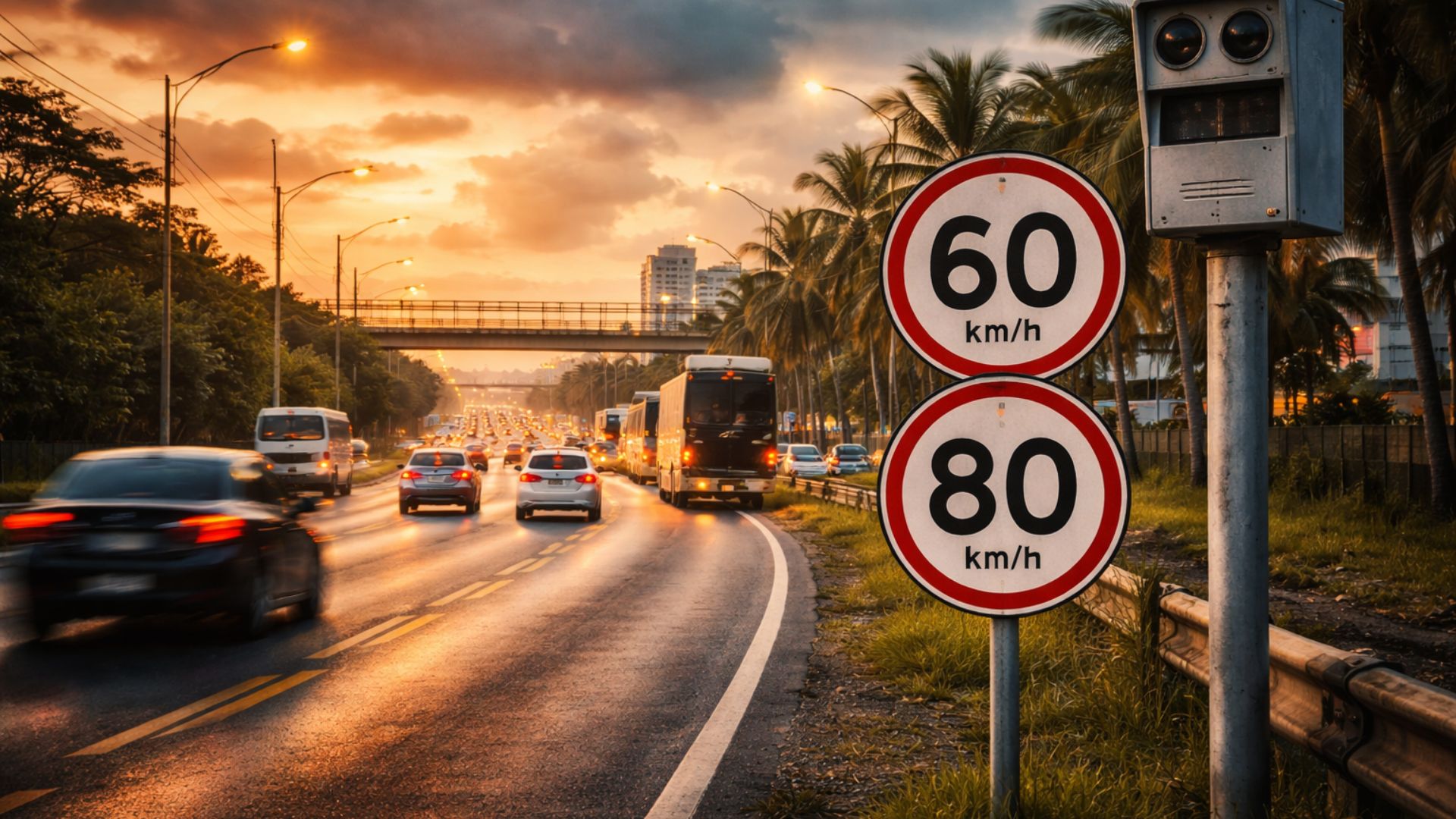


Urban Section of BR-101 in Natal Draws Attention for Speeding Fines in Sequence of Different Limits, Feeding Driver Complaints About Predictability and Sign Reading. Electronic Monitoring and Technical Criteria Enter the Debate, Focusing on Road Safety and Signage Clarity.
An urban segment of BR-101 in Natal, Rio Grande do Norte, has gained notoriety among drivers for concentrating speeding fines in a scenario that, according to recurring reports, mixes limits oscillating over a short distance and constant monitoring.
The discussion intensifies because, in the same corridor used daily by residents and those passing through the capital, the regulated speed can alternate between 80 km/h and 60 km/h in nearby stretches, which fuels criticism regarding predictability and clarity of signage.
BR-101 in Natal and the Section That Concentrates Complaints
Complaints often point out that the limit change occurs in a short sequence, requiring an immediate reduction in speed at points where the driver needs to divide attention with heavy traffic, lateral entries and exits, walkways, nearby stops, and unpredictable behavior typical of urban stretches.
-
Friends have been building a small “town” for 30 years to grow old together, with compact houses, a common area, nature surrounding it, and a collective life project designed for friendship, coexistence, and simplicity.

-
This small town in Germany created its own currency 24 years ago, today it circulates millions per year, is accepted in over 300 stores, and the German government allowed all of this to happen under one condition.

-
Curitiba is shrinking and is expected to lose 97,000 residents by 2050, while inland cities in Paraná such as Sarandi, Araucária, and Toledo are experiencing accelerated growth that is changing the entire state’s map.

-
Tourists were poisoned on Everest in a million-dollar fraud scheme involving helicopters that diverted over $19 million and shocked international authorities.


For those unfamiliar with the route, the sensation described by users is that they notice the change only after passing the monitored point, when the sign has already been left behind and the speed was not adjusted in a timely manner.
Electronic Monitoring and Focus on Road Safety
The electronic monitoring on BR-101 within the urban area of Natal, in turn, is regarded by responsible agencies and traffic specialists as a safety tool, aimed at reducing the severity of collisions and protecting pedestrians and drivers in areas with higher exposure to risk.
The technical logic underlying this type of control is simple: in environments with more access and interaction among different flows, speed has a direct impact on braking distance and the potential for injuries, which is why lower limits and monitoring tend to be adopted in points considered sensitive.
Limits 60 km/h and 80 km/h in Sequence and the Perception of Surprise

In this scenario, the debate shifts from merely the existence of lower limits to how the rule is communicated to the driver.
Part of the complaints does not focus on the presence of 60 km/h itself, but on the perception that the limit of 80 km/h predominates along a large part of the route and, at specific points, drops to 60 km/h in segments near monitoring equipment, reverting to 80 km/h ahead.
The interpretation of “surprise effect” arises when drivers claim that the alternation occurs without a comfortable time for gradual adjustment, especially when there is heavy traffic or reduced visibility.
Local Reports and Accounts on Violations in the Urban Section
Local reports have recorded this type of perception among drivers who travel near the entrance of Natal, mentioning nearby stretches with radars and different speeds, varying between 80 km/h and 60 km/h.
The most frequently reported account is of a driver traveling on a lane where they believe the limit is 80 km/h, finds a sign for 60 km/h just a few meters ahead, and, already under the stress of urban traffic, cannot reduce speed in the necessary rhythm before crossing the monitored area.
The outcome, in this narrative, is the violation perceived as unexpected, received days later by notification.
DNIT and Installation of Radars on BR-101 in Natal
The actions of the National Department of Transport Infrastructure, responsible for federal stretches, also enter the discussion because, over time, the agency has increased the presence of electronic monitoring equipment in urban segments of BR-101 in Natal.
In articles published in the local press, there are records of installation and initiation of operation of radars at points along the corridor, including areas near walkways and important access points, with reference to differentiated limits by vehicle type in certain phases, as well as changes in configuration and activation of equipment at different times.
Technical Criteria to Determine Speed Limits
When monitoring gains visibility, the question returns to the center regarding the criterion that defines why a stretch has a limit of 80 km/h while another, just ahead, is 60 km/h.
Traffic engineering typically considers elements such as the presence of pedestrian crossings, volume of entries and exits, road geometry, visibility distance, risk of lateral conflicts, and historical occurrences to establish limits that can be respected without abrupt disruptions in driving.
In urban stretches, where the environment changes rapidly, it is common for the limit to also vary, but controversy arises when drivers perceive the variation as unintuitive, difficult to anticipate, or poorly distributed along the route.
Signage and What Drivers Say About Legibility of Signs
Besides the technical discussion, signage becomes central because it bridges the rule and practice.
Drivers critical of the current design claim that limit signs, even when present, are not always easily perceived amid other visual information, and that the proximity between a sign and the monitored point does not favor a progressive decrease in speed.
On the other hand, proponents of monitoring argue that the driver’s obligation is to respect the regulatory signage and adjust driving to what is indicated on the road, especially in areas with higher urban traffic.
Brazilian Traffic Code and Article 90 on Signage
The Brazilian Traffic Code is often cited in the debate on violations when there are questions regarding signage.
Article 90 states that sanctions should not be applied when signage is insufficient or incorrect, attributing to the agency with jurisdiction over the road the duty to implement and maintain signage.
In practice, this does not mean that any fine in a stretch with a limit change is invalid, but reinforces that clarity, coherence, and positioning of the signs are relevant aspects in discussions about predictability and safety.
Routine of Those Who Use BR-101 as a Daily Corridor
The controversy in Natal, however, is not limited to a legal dispute and connects to the routine of those who use the BR-101 as a daily corridor.
During peak hours, drivers must deal with variations in flow speed, lane changes, heavy vehicles, motorcycles weaving between lanes, and lateral access points.
In this environment, users argue that frequent changes in limits require additional attention and may stimulate abrupt braking when a driver notices the reduction sign too late, which consequently affects fluidity and may increase the likelihood of incidents due to sudden differences in speed between vehicles.
Lower Limits at Critical Points and the Justification of Safety
On the road safety side, the justification for lower limits in specific segments tends to rely on the protection of lives at critical points.
The presence of walkways, crossings, and concentrated access points is often associated with higher risk, and a speed reduction is seen as a measure to reduce the severity of collisions.
In local coverage of the topic, there is also a record of occurrences and concern about accidents in stretches where drivers reduce speed abruptly, which positions the predictability of the limit as a factor as important as the number established on the sign.
Demands for Standardization and More Predictability in Driving
Amid the complaints, the most common demand among drivers is for standardization and for a more “legible” communication of the limit along the route, with signage perceived as sufficiently anticipated and repeated to guide those unfamiliar with the path.
In public discussions, the idea often arises that the driver needs to easily understand where and why the limit changes, so that monitoring is seen as consistent with risk prevention, not as a mechanism that penalizes momentary distractions in an environment already filled with stimuli.
Alternation of Limit, Radar, and the Balance Between Rule and Predictability
What keeps the subject in the spotlight is precisely the delicate balance between two objectives that, in theory, should go together: reducing speed where there is real risk and ensuring that the rule is applied predictably, without inducing dangerous behaviors such as sudden braking.
If the limit changes frequently in the same corridor and monitoring remains intense, the way signage guides the driver becomes as decisive as the radar itself.
Once an urban stretch of a federal highway becomes a popular reference for accumulating fines, the question that remains for drivers and those defining the rule is straightforward: does the alternation between 60 and 80 km/h, as indicated on BR-101 in Natal, help the driver to operate safely or increase the likelihood of error on a route already filled with quick decisions?









É a famosa indústria de multas para alimentar os cofres públicos e quem sabe de alguns.
Infelizmente estamos no Brasil, onde a corrupção é notória. Lamentavelmente.
Sea Engenharia de tráfego conhecem os riscos, a sua obrigação é eliminar os riscos e não penalizar os condutores. É fácil transferir responsabilidade, difícil é cumprir a nossa responsabilidade.
AQUI NO RIO DE JANEIRO TEVE UM CASO SEMELHANTE NUMA ESTRADA ONDE AS PLACAS DE SINALIZAÇÃO MARCAVA 60 KM, E A QUE ESTAVA COLOCADA JUNTO A AO RADAR MARCAVA 40 KM E AINDA ESTAVA VIRADA DE LADO, O QUE REDUZIA SUA VISUALIZAÇÃO A MENOS DE 10 METROS DE DISTÂNCIA.