





 Portuguese
  English
  Spanish
  6 min of reading
  4 comments


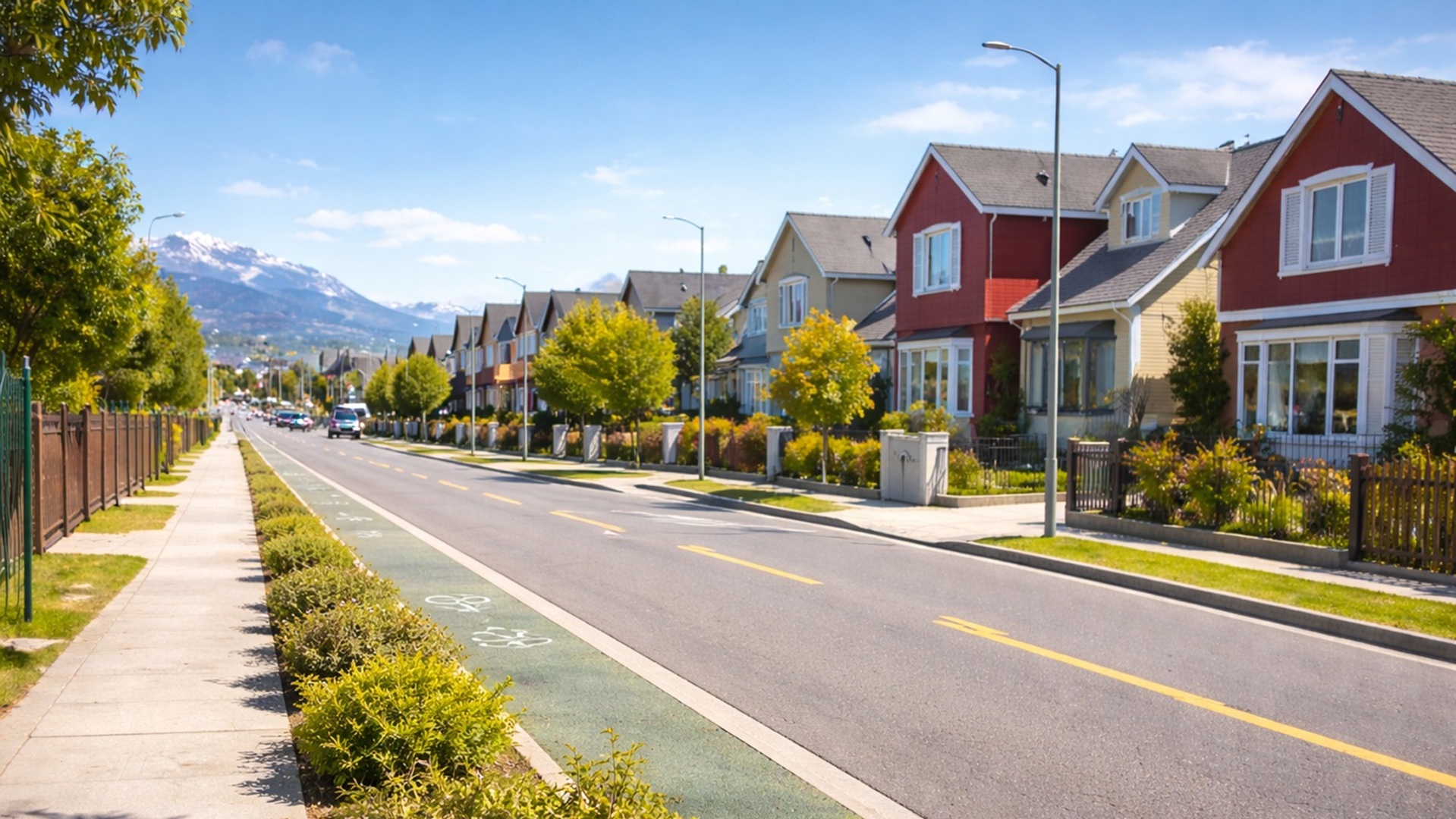


A Brazilian’s Account in a Common City in Chile Shows Peripheral Neighborhoods with Silent Streets, Organized Urban Infrastructure, Accessible Public Services, and Construction Standards Adapted to the Climate, Generating Direct Comparisons with the Reality of European Countries and Provoking Debate on Regional Development
A direct observation conducted in peripheral neighborhoods of Punta Arenas, in the far south of Chile, describes urban patterns, residential infrastructure, climate conditions, public services, and land organization, offering a detailed picture of daily life, urban expansion, and construction characteristics in an average city of Patagonia.
Chile Observed from a Peripheral Neighborhood in Punta Arenas
The observation begins in a peripheral area of Punta Arenas, characterized by residential streets without gated communities, high walls, or ostentatious security structures.
The houses have low fences or, in some cases, no physical separation between the private space and the public road.
-
Friends have been building a small “town” for 30 years to grow old together, with compact houses, a common area, nature surrounding it, and a collective life project designed for friendship, coexistence, and simplicity.

-
This small town in Germany created its own currency 24 years ago, today it circulates millions per year, is accepted in over 300 stores, and the German government allowed all of this to happen under one condition.

-
Curitiba is shrinking and is expected to lose 97,000 residents by 2050, while inland cities in Paraná such as Sarandi, Araucária, and Toledo are experiencing accelerated growth that is changing the entire state’s map.

-
Tourists were poisoned on Everest in a million-dollar fraud scheme involving helicopters that diverted over $19 million and shocked international authorities.


This type of occupation is not treated as a local exception. The described pattern appears in different cities in Chile previously visited, including Valdivia, Pucón, Santiago, and Puerto Varas, always outside enclosed areas or private condominiums.
The neighborhood analyzed is located in an area considered peripheral in a medium-sized city. Even so, urban organization is presented as continuous, integrated, and functional, without obvious ruptures between center and periphery.
Urban expansion is visible. There are housing developments still under construction, undeveloped lots, and newly opened streets, indicating progressive growth of the urban fabric of Punta Arenas.
Urban Infrastructure, Silence, and Space Organization
The observed residential streets are described as silent. Ambient noise is limited to the occasional passage of vehicles and the sound of dogs, with no record of loud music, shouting, or constant noise activities.
In certain points, the silence level is so high that one’s voice echoes when speaking in a normal tone. This aspect is presented as a recurring characteristic of the neighborhood, not as a punctual situation.
The absence of visual pollution is highlighted. Much of the electrical wiring is underground, contributing to visually clean streets, without poles loaded with visible cables.
The pavement is uniform, with continuous and well-defined sidewalks. Road signage is clear, and the streets are wide enough for the smooth circulation of vehicles and pedestrians.
Construction Standards and Residential Architecture in Chile
The residences have varied styles, including single-story houses, duplexes, and small residential buildings. Some facades use neutral colors, while others adopt more vibrant shades, forming visually diverse groups.
Windows with designs similar to those found in residences in the United Kingdom are observed in several houses. This architectural element appears repeatedly throughout the neighborhood.
There are style differences between nearby blocks, but without abrupt contrasts. Simpler houses coexist with larger constructions, maintaining aesthetic and functional coherence.
Fences, when present, serve a symbolic delimitation function. They are neither high nor reinforced structures, indicating a different relationship between public and private space compared to other urban realities.
Climate, Wind, and Impact on Constructions
The climate is a central factor in the organization of urban life in Punta Arenas. Even during summer, temperatures remain low, with constant wind and reduced thermal sensation.
At the time of observation, the daytime temperature was approximately 22 °C, dropping to around 8 °C at night. These conditions are described as a positive exception within the local climate pattern.
The winds are frequent and intense. At certain times, they can reach speeds of up to 120 km/h, directly influencing architecture, landscaping, and the use of open spaces.
Due to these conditions, the residences feature efficient thermal insulation. The construction standard includes internal heating and, in some cases, heated flooring, ensuring thermal comfort inside the houses.
Thermal Insulation and Internal Comfort
Thermal insulation is presented as an essential element, not as a differential. The houses are designed to withstand harsh winters, with very low external temperatures.
Internal comfort allows for warm environments even when external cold is intense. In certain situations, the interior of the residences may become warmer than necessary.
This construction pattern is compared to that found in cold regions of North America. In the local context, it is a basic requirement for safe and functional housing.
The absence of this type of insulation is pointed out as unfeasible in the long term, given the risks associated with low temperatures and constant wind.
Public Facilities and Leisure Areas
The neighborhood has infrastructure geared towards leisure and community. There are enclosed sports courts, areas for physical exercise, and structures designed for calisthenics.
These facilities are distributed throughout the residential area, with easy access for residents from different blocks. The quality of the structures is described as high.
Parks also form part of the urban environment. In one of them, there is an accumulation of plastic bags and debris brought by the wind, not necessarily generated in the area itself.
The strong wind carries trash from distant areas, requiring periodic cleaning actions. According to the account, volunteer groups carry out these activities at certain times.
Geographical Location and Strategic Role
Punta Arenas is presented as the last major city of the American continent to the south. Its geographical position gives the city historical and logistical importance.
Located on the shores of the Strait of Magellan, the city connects the Atlantic and Pacific Oceans. Before the opening of the Panama Canal, this route was essential for international navigation.
Even after the shift in global routes, the strait continues to be used by vessels circulating around the far south of South America.
The city remains connected to the continent, unlike even more southerly locations that are already on islands, reinforcing its strategic position.
Urban Expansion and Land Planning
Residential expansion occurs continuously. New houses follow the same construction pattern as already consolidated areas, maintaining uniformity in the urban fabric.
The road network includes wide avenues, traffic lights, bike lanes, and well-defined sidewalks. Even in peripheral areas, urban planning is noticeable.
The presence of bike lanes integrates residential neighborhoods with commercial and service areas, facilitating non-motorized commuting.
The spatial organization suggests planned growth, with integration between housing, leisure, and commerce, without obvious signs of disordered occupation.
Commerce, Free Trade Zone, and Services
Punta Arenas houses a free trade zone, considered a significant commercial hub in the far south of Chile. The location offers electronic products, clothing, and other goods with tax incentives.
The free trade zone is accessible via large avenues and integrates into the city’s road system. In addition to it, there are shopping centers and hypermarkets in areas close to residential neighborhoods.
The commerce serves both local residents and visitors, functioning as an important economic element for the city.
The availability of services and commercial facilities near residential areas reinforces the urban functionality observed.
Urban Daily Life and Space Perception
The described daily life is marked by tranquility, low noise, and shared use of public space. The circulation of people occurs without signs of tension or visible segregation.
The coexistence between different types of housing does not present significant physical barriers. The peripheral neighborhood maintains a structural standard similar to other areas of the city.
The urban environment is described as stable and organized, even in a region subject to extreme weather. This balance is attributed to constructive adaptation and local planning.
Throughout the observation, Chile appears as a setting for a specific urban reality, shaped by geography, climate, and structural decisions, composing a detailed picture of daily life in Punta Arenas.
This article was prepared based on an analysis of a video published by the Canal Ideias Internacionais, which documents direct observations conducted in peripheral neighborhoods of Punta Arenas, Chile.











Amei esta cidade quando estive aí há dez anos.
Muy buena sinceramente sus autoridades trabajan con amor al pueblo chileno
Se cansaron los Chilenos del capitalismo…ahora quieren ser **** a toda costa…pobres tontos.