





 Portuguese
  English
  Spanish
  4 min of reading
  0 comments


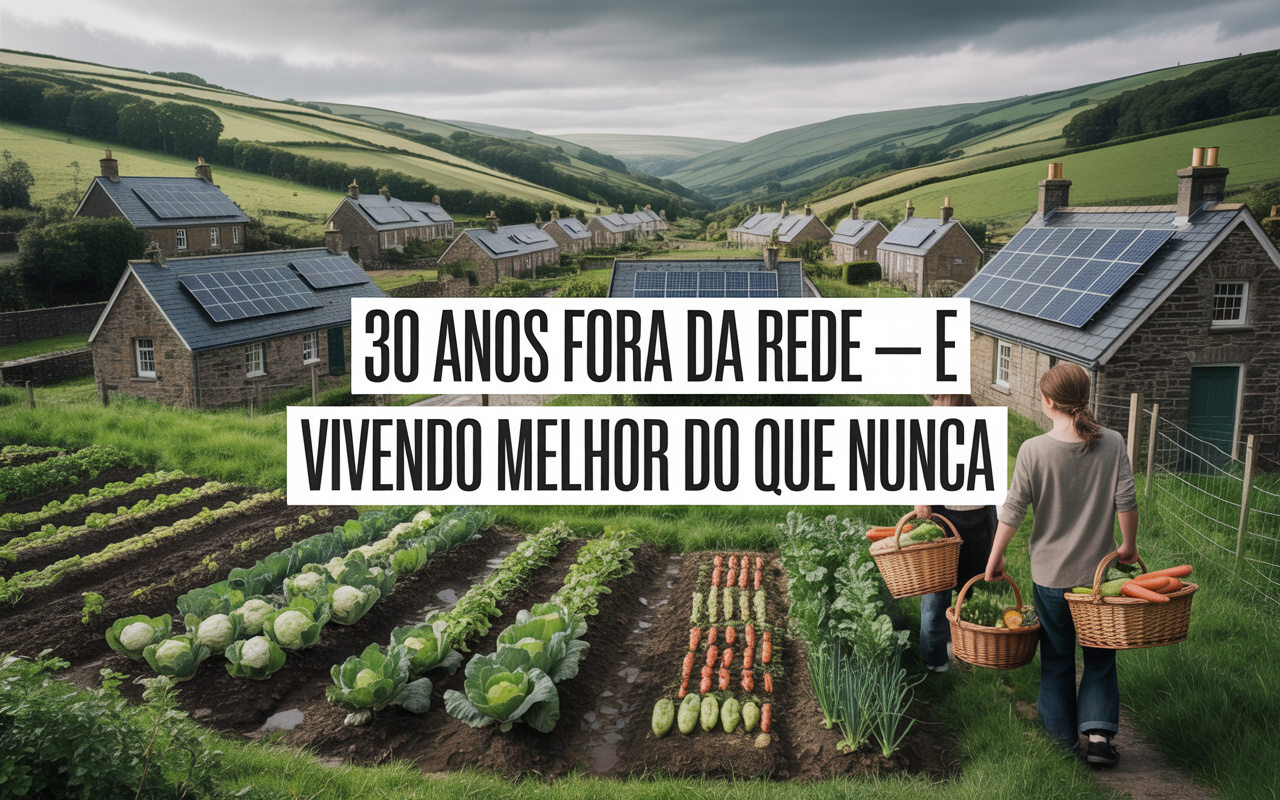
For Almost 30 Years, the Brithdir Mawr Community in Wales Has Lived Without Electricity or Supermarkets, Producing Its Own Food and Energy Sustainably.
In the green hills of Wales, hidden among damp valleys and surrounded by forests, there is a community that has chosen to live in a radically different way from the rest of the world. The name is Brithdir Mawr, an ecological settlement formed in the early 1990s by a small group of families who believed it was possible to live without depending on modern infrastructure — without public electricity, without supermarkets, without excessive consumption, and with minimal environmental impact. Nearly 30 years later, the project has become one of the longest-lasting experiments in sustainable living in Europe, a symbol of resistance and simplicity.
A Return to Origins in the Digital Age
Brithdir Mawr emerged in 1993 when farmer Tony Wrench and his partner, Jane Faith, bought an old farm in west Wales, near the village of Newport. The goal was to create a community living space where people could grow their own food, generate their own energy, and live self-sufficiently. The idea, considered utopian at the time, quickly attracted other families and volunteers interested in experimenting with a lifestyle more connected to the land.

Today, the community houses between 15 and 25 permanent residents, in addition to occasional visitors. Their homes, built from natural materials such as clay, wood, and straw, blend into the rural landscape. None of them is connected to the national electricity grid. Energy comes from solar panels and small wind turbines installed by the residents themselves. Water is sourced from local springs and filtered by hand.
-
One of the most important lakes in the United States for birds, the balance of nature, and the climate has dried to historic levels, leaving boats stranded, revealing salt flats, and showing how the lack of water can transform an entire landscape.

-
It’s not Cristiano Ronaldo or Messi: the richest football player in the world is only 27 years old, has a fortune of 100 billion reais, and is the nephew of a sultan from an Asian country that few people know about.

-
At 77, the king of one of the most famous and powerful crowns on the planet is said to be under pressure to leave the throne, while behind the scenes there are already talks of a new coronation that could cost R$ 260 million.

-
Chinese researchers have created bamboo drones that fly with the same precision as conventional models and have released the flight control software for free to the entire world in a technology that could revolutionize sustainable aviation.


Self-Sufficiency and Sustainability as a Philosophy of Life
Food is one of the pillars of self-sufficiency. The community grows almost everything it consumes: potatoes, carrots, cabbages, grains, fruits, and medicinal herbs. Each resident contributes hours of work in the fields and greenhouses, and the surplus is exchanged with neighboring communities or used to feed visitors. Animals such as chickens and goats are raised in free-range conditions, ensuring fresh eggs and milk.
Nobody wastes anything. Organic waste is turned into compost, and solid waste is recycled or reused. The houses have composting systems, and dry toilets prevent the use of potable water for flushing. “We live simply but with purpose. Here, everything we do has a direct impact on the land,” Tony Wrench said in an interview with the BBC.
The Controversy Over the “Round House” and the Clash with the Government
The lifestyle of Brithdir Mawr has also generated controversies. In 1998, the Welsh government discovered Tony Wrench’s famous “round house” — a hobbit-like structure made of wood, clay, and grass roof, completely camouflaged in the forest. Due to lacking official authorization, the building became the subject of a long legal dispute. The case gained international attention and mobilized environmentalists and advocates for alternative living, who saw Brithdir Mawr as an example of real sustainability.
After years of negotiations, the local government recognized the ecological value of the project and created specific rules that allowed the community to remain, provided the residents maintained clear commitments to low environmental impact. The victory established the settlement as one of the pioneers of the “low impact living” movement in the United Kingdom.
Living with Less and Discovering the Essential
In Brithdir Mawr, there are no signs of modern luxury. Internet access is limited, electronic devices are few, and nights are illuminated by LED lights powered by solar batteries. But, according to the residents, the absence of comfort is compensated by tranquility, community spirit, and the freedom to live in harmony with the environment. “Life is slower, quieter, and more mindful,” one of the residents shared in a recent testimony.
Children grow up learning about organic farming, bioconstruction, and respect for nature. Many who have passed through the community have gone on to similar projects in other countries, spreading the philosophy of self-sufficiency. Brithdir Mawr is now studied by universities and cited in environmental reports as a functional model of small-scale sustainable economy.
An Experiment That Became Global Inspiration
More than an ecological refuge, Brithdir Mawr represents a concrete alternative to the fast pace of cities and rampant consumption. There, every decision — from using a piece of wood to planting a seed — is made collectively. In times of environmental crisis and rising living costs, the model attracts more and more attention from those seeking simplicity and purpose.
Over three decades, the isolated community has resisted external pressures, modernizations, and bureaucracy, staying true to the original idea of living with less and caring for the land. In the silence of the Welsh fields, surrounded by the wind and the sound of birds, Brithdir Mawr continues to be a reminder that, even in a world dominated by technology and consumption, it is still possible to live in balance with the essential.






-

-

-

-

-

19 pessoas reagiram a isso.