





 Portuguese
  English
  Spanish
  4 min of reading
  0 comments


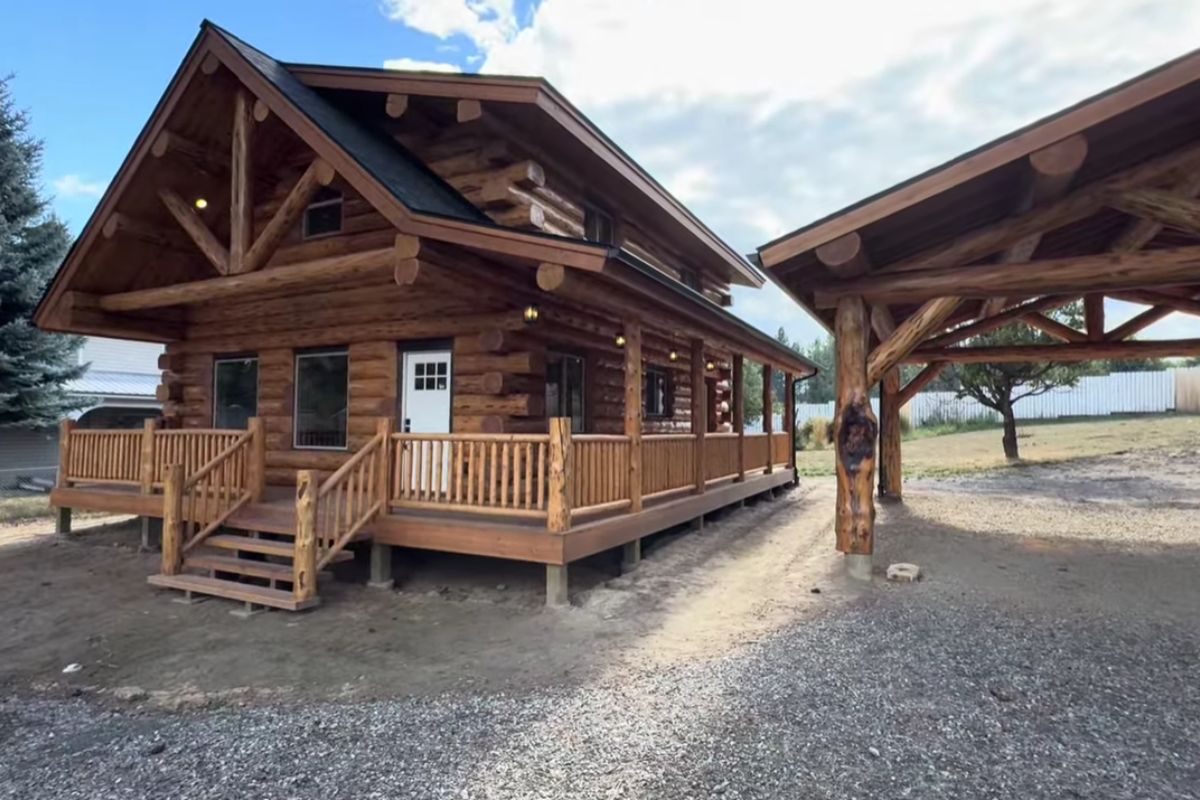
In Denali 24×32, a Wooden Cabin Built by Meadowlark Log Homes in Montana, Non-Standard Logs, Vaulted Ceilings, and Foam Insulation Create Thermal Mass and Sealing, While the Covered Garage Mirrors the Structural Logic of the Ensemble, Highlighting Layout Decisions, Cedar Finish, and Actual Use of the Loft in Different Climates
The Denali 24×32 wooden cabin is designed to appear simple on the outside and precise on the inside. What stands out is not a loose “style,” but the sum of technical choices: larger-than-standard logs, a vaulted ceiling to free internal volume, and high-performance insulation in the roof, all aligned for everyday use.
The ensemble also includes a covered garage built to the same standard, which helps to see the project as a system rather than an isolated piece. When the wooden cabin and the covered garage share structural logic, the result is evident in maintenance, durability, and how the loft and bedrooms respond to the climate in the United States.
Non-Standard Logs Change the Structure and Perception of Space

The most visible element of the wooden cabin is the logs.
-
Friends have been building a small “town” for 30 years to grow old together, with compact houses, a common area, nature surrounding it, and a collective life project designed for friendship, coexistence, and simplicity.

-
This small town in Germany created its own currency 24 years ago, today it circulates millions per year, is accepted in over 300 stores, and the German government allowed all of this to happen under one condition.

-
Curitiba is shrinking and is expected to lose 97,000 residents by 2050, while inland cities in Paraná such as Sarandi, Araucária, and Toledo are experiencing accelerated growth that is changing the entire state’s map.

-
Tourists were poisoned on Everest in a million-dollar fraud scheme involving helicopters that diverted over $19 million and shocked international authorities.


Here, they are sized above what is usually used in cabins of this size: about 11 inches face-to-face on the flat logs, equivalent to approximately 12 to 14 inches in diameter, according to the tour guide’s description.
In the most common standard cited, the reference would be something like 8 to 9 inches face-to-face.
This increase is not just aesthetic.
Larger logs raise the mass and alter thermal inertia, which influences the feeling of heating and cooling throughout the day.
In practice, this relates to the vaulted ceiling, which creates a higher warm air zone, and the roof insulation, which becomes the “closure” of efficiency.
Vaulted Ceiling, Loft, and Air Circulation Without Tricks

The vaulted ceiling is the component that reorganizes the interior of the wooden cabin.
It frees height in the main room and gives meaning to the three-bedroom loft, which functions as a multifunctional area: reading, bunk beds, seating support, or workspace, maintaining a direct view of the common area.
The composition of the loft itself depends on the vaulted ceiling and a dormer window of full-length, cited as 32 feet, which increases usable height on the upper floor wall.
When the vaulted ceiling meets the loft, the house gains volume without increasing the footprint on the land, but this requires care with sealing, especially at the junction between structure, rafters, and ceiling.
High-Performance Insulation and the Logic of Heating
The technical report attributes part of the thermal performance to the expanded polyurethane foam insulation applied to the roof.
In a wooden cabin with a vaulted ceiling, this point is critical because heat tends to rise and concentrate at the top.
The combination of continuous insulation and the mass of the logs reduces abrupt variations, provided that the joints are well treated.
The heating system is also described with two pillars.
One is the wood stove sized for the volume of the space; the other is the use of a mini-split in the upper room, which adds point temperature control.
Insulation does not solve everything by itself, but when insulation, logs, and vaulted ceiling work together, the project approaches predictability, something rare in constructions seen solely as rustic.
Covered Garage as an Extension of the Ensemble’s Engineering
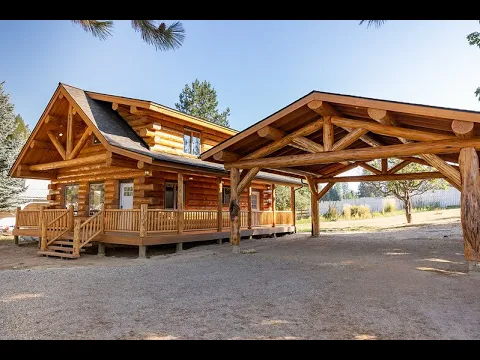

The covered garage appears as a second piece that reinforces the strategy of the wooden cabin.
It was built with the same care for logs, eaves, and finish, and it is described as large enough for two cars; the guide suggests an estimate close to 20 by 22 feet, acknowledging that he does not recall the exact measurements.
There is also a detail of construction solution in the roof of the covered garage: the use of exposed beams with stained plywood as a simpler execution option, but still coherent with the rest.
In terms of property operation, the covered garage changes routines, protects equipment, and reduces exposure to rain and snow, while the wooden cabin maintains dry transition areas, such as covered porches.
Finishes and Layout as Part of Performance, Not Just Aesthetics
The interior of the wooden cabin is described as an arrangement of two bedrooms and two bathrooms, with integrated kitchen and living area.
The finish appears mostly in cedar for the door and window trims, with focal elements like a walnut bar and quartz countertops, in addition to painted alder cabinets used as contrast.
These choices affect maintenance and use.
Cedar and exposed logs require discipline regarding humidity and cleaning, and the presence of a side porch approximately 6 feet long along the length of the wooden cabin, as well as a front porch and full eaves of about 6 feet, creates shading and facade protection.
In cabins, durability starts at the edges, and this applies to both the wooden cabin and the covered garage.
The Denali 24×32 shows that a wooden cabin can be rustic in appearance and technical in decision-making: larger logs, vaulted ceiling, well-thought-out insulation, and a covered garage that completes the ensemble’s use.
The result does not depend on embellishment, but on compatibility between structure, sealing, and routine.
If you were to build or buy a wooden cabin, what would weigh more in your decision: larger logs for added mass, a vaulted ceiling to open up the loft, insulation to reduce thermal variation, or the covered garage to address daily logistics? And which point do you think tends to cause the most problems in practice: roof sealing, log maintenance, or drainage around?










-

-

-

7 pessoas reagiram a isso.