





 Portuguese
  English
  Spanish
  5 min of reading
  22 comments


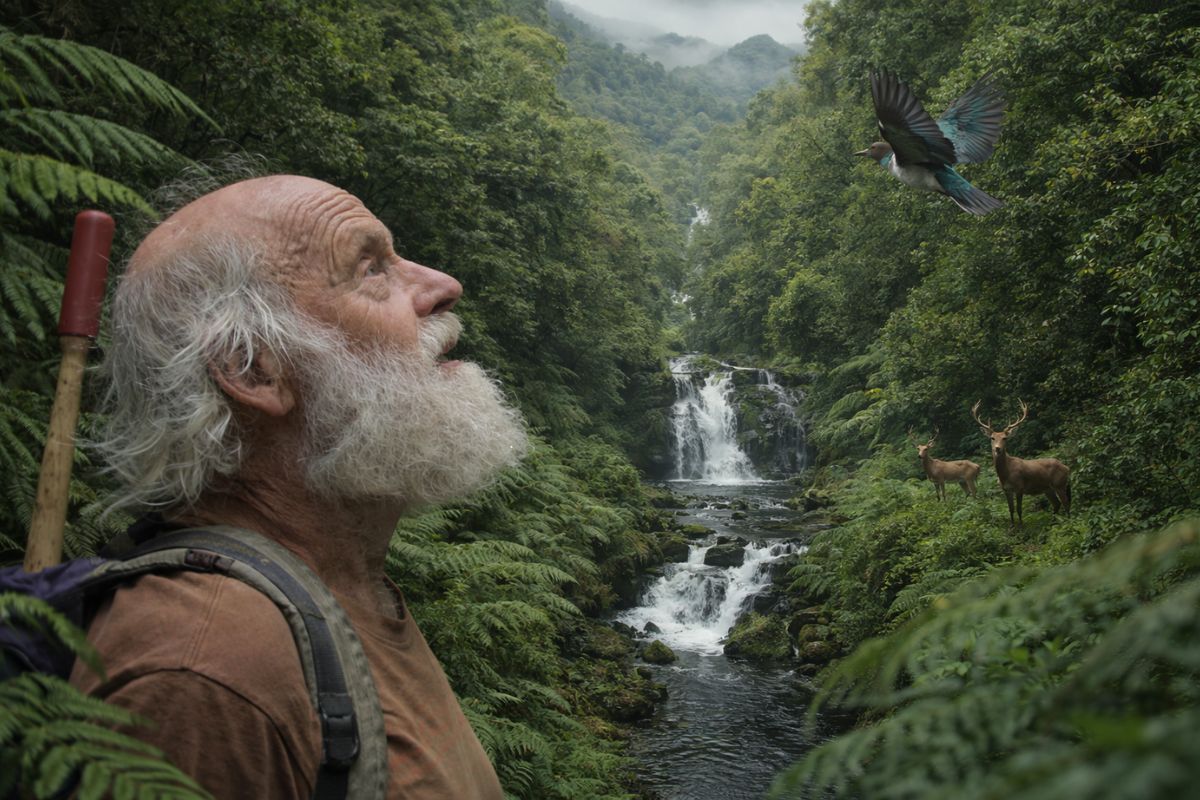


On Banks Peninsula, An Area Previously Considered Unproductive Became Forest Through Natural Regeneration Guided By Minimal Interference: Gorse Was Used As Cover, Biodiversity Returned, Water Courses Remained Active, And A Discredited Experience Redefined Conservation, Rural Management, And Community Trust Over Decades.
The recovery of the forest in Hinewai began with a simple and, for many, unacceptable decision: to stop fighting against every plant considered an “enemy” and observe how the ecosystem would respond. Instead of promising quick results, the project took a long-term horizon, focusing on natural regeneration, soil protection, and the progressive return of native life.
At the center of this journey is botanist Hugh Wilson, who, together with the Maurice White Native Forest Trust, began purchasing the original area in 1987 and expanded the territory in the following years. What seemed to be an improbable bet on degraded hills evolved into a continuous restoration process, with visible effects on the landscape, water, and the community’s relationship with the land.
From Marginal Area To Real-Scale Ecological Mosaic

For decades, Banks Peninsula suffered from successive cycles of occupation and intensive land use. The original cover was reduced until only a minimal fraction of the old vegetation remained.
-
Friends have been building a small “town” for 30 years to grow old together, with compact houses, a common area, nature surrounding it, and a collective life project designed for friendship, coexistence, and simplicity.

-
This small town in Germany created its own currency 24 years ago, today it circulates millions per year, is accepted in over 300 stores, and the German government allowed all of this to happen under one condition.

-
Curitiba is shrinking and is expected to lose 97,000 residents by 2050, while inland cities in Paraná such as Sarandi, Araucária, and Toledo are experiencing accelerated growth that is changing the entire state’s map.

-
Tourists were poisoned on Everest in a million-dollar fraud scheme involving helicopters that diverted over $19 million and shocked international authorities.


Hinewai was born as a long-term response: not to “freeze” the landscape, but to reopen ecological processes that had been interrupted.
The area that started with 109 hectares grew to reach 1,500 hectares, forming a set of catchments, slopes, and valleys with different dynamics.
This size matters because it allows for ecological continuity: instead of isolated fragments, the reserve operates as an integrated system where the forest can gradually recompose itself, connecting soil, water, plants, and fauna in a single functional logic.
The Most Criticized Choice: Letting Gorse Play A Transitional Role

The technical decision that generated the most resistance was to allow the advance of gorse (locally referred to as “bulrush”/weed), an invasive plant widely rejected in livestock areas. For farmers, the rule was to eliminate: burn, poison, cut.
In Hinewai, the reasoning was different: on a marginal hill already dominated by this species, constant fighting could worsen the situation and keep the soil exposed for longer.

The management adopted was based on a classic ecological principle of succession: gorse quickly occupies open areas, creates cover, improves the microclimate, and, by fixing nitrogen, enriches the soil with nutrients. Under this “nursing,” native species tolerant to shade begin to grow.
When they surpass the height of the gorse, they create shading; the invader, dependent on intense light, loses vigor and retreats. Instead of a permanent war against the landscape, there was guidance of the transition until the return of the native forest.
This process also disproves the idea that restoration, in a large mountainous area, always depends on massive planting and heavy mechanization. In Hinewai, the foundation was minimal interference: remove destructive pressures, protect regeneration, and let nature do the work at scale. The forest was not “manufactured”; it was unlocked.
Water, Waterfalls, And Permanence Of Flows: When The Result Appears In The Territory

Among the most concrete indicators of change are the water courses. The team’s report indicates permanent streams even in dry years, something relevant for a region often perceived as open and dry.

When the vegetation cover is structured, infiltration, water retention, and ground stability increase, effects that reflect in the constancy of flows.
Today, the area records 47 known and named waterfalls, as well as trails that allow observation of the system in operation.

This data is not merely scenic: it signals that the regenerated forest is fulfilling a hydrological function, creating conditions for water to flow with less disruption throughout the seasons. Where there was once degradation and loss of resilience, there is now a living network of springs, streams, and connected valleys.
With stable water, fauna follows. The return of birds and other species does not occur as an isolated event, but as a consequence of continuous habitat, food, and shelter.
Biodiversity, in this case, is not an ornament: it is the functional result of restored ecological processes on a landscape scale.
Management Routine, Public Access, And Real Risk: Conservation Without Romanticization

The management of Hinewai was not limited to ecological theory. It required intense routine, difficult logistics, and daily work in tough terrain, with walking and biking displacements as a significant part of the activities. This reduced dependence on fossil fuels and reinforced the project’s coherence, but also raised the human cost of constant care.

At the same time, the reserve was designed for open access via trails, without turning conservation into a closed space for a few. This openness had an important social effect: locals and visitors were able to see the transition of the landscape with their own eyes. When the forest ceases to be discourse and becomes concrete experience, resistance tends to diminish.
The fire episode in 2011 exposed the extreme risk: lightning, wind, and fire in a sensitive area. The response mobilized helicopters and evacuation, with a strong emotional impact on those living in the area.
Even so, the behavior of the fire brought a technical lesson: sections with regenerated native forest functioned as a more effective barrier than areas dominated by flammable cover. Restoration did not eliminate risk but increased the resilience of the system.
Cultural Change, Climatic Limits, And What Hinewai Really Teaches

At first, the local community treated the proposal as recklessness. Over the years, the perception changed: producers who saw only loss began to see ecological function and practical possibilities for marginal low-productivity areas.
This shift did not occur due to an advertising campaign, but through accumulated evidence on the ground.
The experience also repositions the debate about land use. Not every degraded hill needs to insist on the same model of exploitation.
In certain contexts, allowing the regeneration of the native forest can provide multiple benefits: more stable soil, more water, more biodiversity, more ecological connectivity, and potential carbon capture with real co-benefits.
Still, the project itself recognizes a crucial limit: restoring forest helps with climate, but it does not resolve the crisis alone if fossil fuel use continues at the same pace.
This distinction is central to avoiding simplistic solutions. Forest is a robust part of the answer, not the only answer.
Thirty years later, Hinewai shows that the recovery of degraded landscapes does not depend only on a high budget or heavy intervention; it depends on a coherent ecological strategy, maturation time, and consistent management.
The case also shows why unpopular decisions at the beginning can become a reference when results appear in permanent water, returning fauna, and territory stability.
In your region, is there any degraded area that could benefit from natural regeneration instead of continuous aggressive control? And, looking at your daily life, what concrete change would you help sustain first: more forest in marginal areas, reduced use of fossil fuels, or both fronts at the same time?










Matéria mal escrita, copia o release SEM CITAR ONDE FICA o lugar. E o que é giesta? Essa informação tb é crucial pars entender como foi possível regenerar a floresta. A Reserva Hineway fica na Nova Zelândia. Giesta é uma planta invasora que destrói as lavouras mas, neste caso, foi responsável por nutrir o solo onde deixa nitrogênio.
Você começou muito mal o comentário.
Graças à Deus você o salvou com as informações complementares que, todos como eu e você, precisávamos, agradeço por acrescentada-las.
Na próxima, substitua a critica inadequada à esta iniciativa e luta, por elogios alanvancadores por trabalhos semelhantes, sem dependerem da participação do erario público, também em outras situações como: eliminar com destinação adequada o lixo que nós todos, erradamente destinamos aos mananciais e deles são “carreados” aos lagos e mares.
Só em eliminar fontes poluidoras, o resultado futuro para nossos descendentes será maravilhoso.
Ele e seus seguidores acredito, estão usufruindo do benefício natural e seus descendentes muito mais irão também, desde que acreditem e continuem a tarefa, sem usura e imediatismos.
Afinal ainda prevalece, “a roda” com o alerta ‘Pai rico, filho nobre e neto pobre”
Esse é meu herói
Sim, isso é biblico a terra pre Isa de descanso para poder se regenerar e voltar a ter produtividade, como tido que é vivo.