





 Portuguese
  English
  Spanish
  5 min of reading
  0 comments


Investor Announcement Places Smart Glasses at the Center of Samsung’s Strategy for 2026, with Integration to Android XR, Use of Google Gemini Artificial Intelligence, and Partnerships Focused on Design and Usability, in a Market Still in Development and Contested by Major Technology Companies.
The Samsung informed the market that it plans to launch smart glasses in 2026, integrated with the Android XR system and equipped with artificial intelligence features.
The announcement was made during the financial results teleconference for the fourth quarter of 2025, held at the end of January, when executives detailed the company’s priorities for the coming years.
Without disclosing pricing, launch markets or complete technical specifications, the South Korean manufacturer indicated that the project is part of a broader strategy to expand in the wearable devices segment.
-
Motorola launched the Signature with a gold seal from DxOMark, tying with the iPhone 17 Pro in camera performance, Snapdragon 8 Gen 5 that surpassed 3 million in benchmarks, and a zoom that impresses even at night.

-
Satellites reveal beneath the Sahara a giant river buried for thousands of kilometers: study shows that the largest hot desert on the planet was once traversed by a river system comparable to the largest on Earth.

-
Scientists have captured something never seen in space: newly born stars are creating gigantic rings of light a thousand times larger than the distance between the Earth and the Sun, and this changes everything we knew about stellar birth.

-
Geologists find traces of a continent that disappeared 155 million years ago after separating from Australia and reveal that it did not sink, but broke into fragments scattered across Southeast Asia.

The move occurs in a context of competition among major technology companies for new formats of personal computing, seeking to reduce reliance on smartphones as the main digital interface.
Smart Glasses in Samsung’s Planning for 2026
In the presentation to investors, Samsung mentioned the development of “next-generation AR glasses” as part of the product pipeline expected for 2026.
According to what was communicated, the proposal is to offer experiences based on multimodal artificial intelligence, combining voice commands, environmental recognition, and contextual information.
Reports from the specialized press indicate that the company sees the glasses as a natural evolution of its wearable line, which is currently focused on smartwatches and earbuds.

Still, Samsung itself did not indicate a more detailed timeline beyond the year of launch, nor confirmed when the product will be officially presented to the public.
Android XR and Google Gemini as the Basis of the Experience
The Android XR system, developed by Google, is the central axis of the project.
The platform was created for extended reality devices and promises to prioritize energy efficiency and integration with already established services in the Android ecosystem.
According to Google, the idea is to adapt the interface to the format of the glasses, with quick interactions that are less dependent on traditional screens.
In this scenario, Google Gemini’s artificial intelligence appears as the component responsible for interpreting voice commands, images, and context.
According to the company’s institutional materials, the goal is to enable users to receive relevant information at the moment they need it, such as directions, reminders, or translations.
However, Samsung did not detail how this integration will work in practice nor which features will be available in the first generation of the glasses.
So far, the confirmed information is limited to the use of Android XR and the presence of AI as a pillar of the experience.
Indications of More Than One Model and Possible Embedded Display
Reports from international outlets indicate that Samsung is working on more than one model of smart glasses, targeted at different use profiles.
One of the versions in development could include some type of display directly on the lens, allowing for the overlay of digital information onto the user’s field of view.
This type of solution has already been discussed by companies in the sector as a way to provide quick access to data without completely isolating the user from the physical environment.
Despite this, Samsung has not officially confirmed the adoption of an embedded display nor provided technical details about this possible feature.
Experts consulted by international publications point out that the challenge of this type of product is to balance functionality and comfort.
Glasses with displays need to be lightweight, discreet, and usable for long periods, characteristics that have historically hampered large-scale adoption of such devices.
Technical Specifications Still Awaiting Official Confirmation
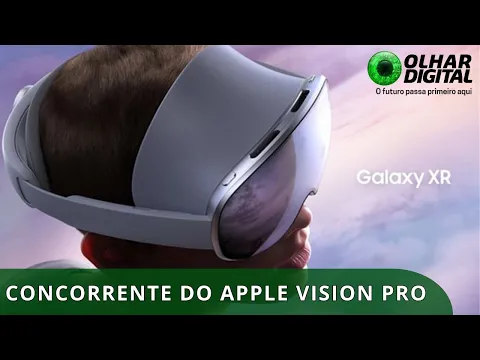

Some technical details associated with the glasses have circulated on specialized websites and in reports about the supply chain, but without formal confirmation from Samsung.
Among them is the possible inclusion of a 12-megapixel camera and a 155 mAh battery, along with a processor dedicated to wearable devices.
These pieces of information, so far, remain in the realm of speculation.
Industry analysts often highlight that cameras in smart glasses tend to serve a dual purpose, both for capturing images and for environmental recognition, feeding AI systems.
The battery life is considered one of the main points of attention, as frequent recharges can limit everyday use.
Samsung has not commented on these numbers nor provided official estimates for battery duration or energy consumption.
Partnerships with Google, Warby Parker, and Gentle Monster
The project involves partnerships with companies from different areas.
Google is responsible for the development of the system and the layer of artificial intelligence, while traditional optical sector brands participate in the design conception.
Warby Parker announced collaboration with Google to develop AI glasses aimed at daily use, with plans to launch a product in 2026.
Gentle Monster has been cited in international reports as a partner involved in the aesthetic aspect of the device.
According to market analysts, the strategy aims to address one of the main historical barriers of smart glasses, the challenge of reconciling advanced technology with an acceptable design for continuous use in public spaces.
Integration with Popular Apps in the Google Ecosystem
Compatibility with well-known applications is regarded as a central element to make the product relevant from the outset.
Information released by the press indicates that services such as map navigation and video consumption are expected to have versions adapted to the format of the glasses.
Samsung has not released an official list of compatible applications.
The market expects basic functionalities such as notifications, calls, and map guidance to be among the first implementations.
Industry observers believe that the product’s acceptance will depend on the practical utility of these integrations in daily life.
Competition with Meta and Apple and Limited Initial Production
Samsung’s entry into this segment occurs in a context of increasing competition.
Meta is already marketing smart glasses in partnership with Ray-Ban, while Apple continues to invest in spatial computing devices and closely monitors the advanced wearables market.
During the communication to investors, Samsung indicated that initial production of the glasses will be limited.
The indication suggests a launch aimed at specific audiences and an initial phase of market testing.
Without information on pricing or launch countries, it is still not possible to gauge the commercial reach of the product.
With the industry trying to define what the next major format of personal computing will be, smart glasses emerge as a relevant bet, but surrounded by uncertainties.
What concrete functions will convince the public to adopt this type of device in their daily lives?







Seja o primeiro a reagir!