





 Portuguese
  English
  Spanish
  5 min of reading
  0 comments



Mark Zuckerberg predicts that smart glasses will replace smartphones as the main digital device, and he bets on the Meta Quest 3S to accelerate this transition with a lower price, artificial intelligence features, and interaction through gestures and voice.
Mark Zuckerberg reiterated that smart glasses are expected to take on the central role currently held by smartphones.
The message was reinforced at Meta Connect, an event where the company introduced the Meta Quest 3S, a mixed reality headset promising to bring this experience to a broader audience.
For the CEO of Meta, the next decade could mark the transition where connected glasses and voice, gesture, and AI interfaces progressively replace the pocket screen.
-
How the terraforming of Mars can transform the planet: artificial aerosols can increase the temperature by up to 35°C in 15 years, creating conditions for liquid water.

-
Scientists drilled nearly 8,000 meters into the ocean floor above the fault that caused the 2011 tsunami in Japan and discovered that a layer of clay 130 million years old was responsible for making the wave much worse than any model had predicted.

-
Thousands of years after causing the largest eruption of the Holocene, one of the world’s largest supervolcanoes is rebuilding itself beneath the sea south of Japan, receiving new magma and alarming scientists with its transformation.

-
China has activated a magnet 700,000 times more powerful than the Earth’s magnetic field that operates for over 200 consecutive hours while consuming little energy, and now the world wants to know what Beijing plans to do with this technology in 2026.


What Was Announced at Meta Connect
On stage at the event, Meta officially launched the Quest 3S as an entry-level model in mixed reality.
The device inherits features from the Quest 3, but with an initial price of US$ 299 and focus on volume.
The company also showcased advancements in augmented reality glasses, an area seen internally as a key piece of this transition.

By linking hardware to AI models, Meta aims to make interaction more natural, without constant distractions from the smartphone screen.
Meta Quest 3S Arrives at US$ 299 and Aims for Mass Adoption
The Quest 3S comes in 128 GB and 256 GB versions, maintaining gesture control, color video passthrough, and compatibility with the Quest ecosystem.
Meta positions the 3S as an entry point for those seeking mixed reality at a lower price, while the Quest 3 remains a premium option.
It’s a tiered strategy: lowering price barriers to stimulate experimentation and, subsequently, retaining users on more advanced devices.
What You Can Already Do with Meta Glasses
In addition to immersive games and apps, the headset integrates communication.
You can send messages and make calls through apps like Messenger and WhatsApp within the Quest itself, with the ability to share first-person views during calls.
The expectation is that everyday tasks, currently performed on smartphones, will begin to occur in immersive interfaces when appropriate, while keeping the user connected to their physical environment.
Heavy Investment and Long-Term Vision
Meta continues to invest billions in virtual and augmented reality, even amid pressured financial results in the Reality Labs division.
Since 2020, accumulated losses have exceeded US$ 60 billion, reflecting a prolonged investment cycle to enable the next computational platform.
Meanwhile, reports from industry media indicate that total spending on XR (VR/AR) is approaching US$ 100 billion over the years, reinforcing strategic commitment.
Orion and the Race for Augmented Reality Glasses
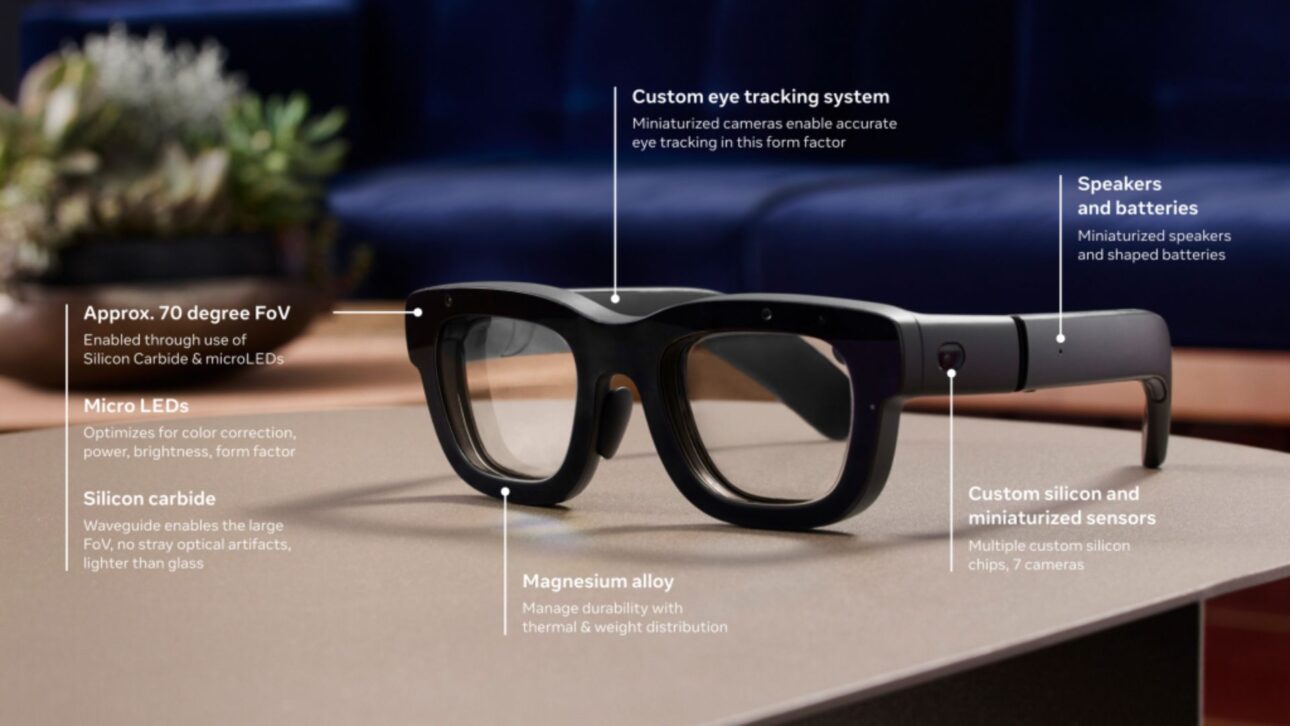
Behind the scenes, Meta is developing the Orion project, augmented reality glasses with micro-LED and control through a neural bracelet based on muscle signals (EMG).
The demonstration of the prototype showcased the potential to overlay graphics in the field of vision and perform tasks with the assistance of AI, although technical complexity and cost keep the product distant from retail for now.
This is the piece that Zuckerberg sees as the natural successor to the smartphone.
AR/VR Market on a Growth Trajectory
Consulting projections indicate consistent growth of the AR/VR market until 2030, with revenues varying in the hundreds of billions of dollars, depending on the methodology.
Although estimates diverge, the consensus is that acceleration will occur with the maturation of hardware, price drops, and integration of generative AI into devices.
This backdrop helps explain the urgency among big tech companies to occupy the space before usage patterns solidify.
Brazil Still Dominated by Smartphones
While Meta’s vision advances, the Brazilian reality shows the resilience of smartphones.
In the first quarter of 2025, Brazil was the only major market in Latin America to grow in sales, with an increase of about 3% and 9.5 million units shipped, according to Canalys.
The installed base remains massive and with a strong presence of Chinese brands.
This scenario helps explain why the total replacement of smartphones is likely to be gradual.
New Brands and Local Appetite
The recent move by Honor, which announced its entry into the country with a line of foldables, mid-range, and high-end devices, reinforces competition in the national retail sector.
Meanwhile, Xiaomi maintains a growth rhythm in shipments.
With aggressive offers and embedded AI features in models, the replacement cycle continues to be active, prolonging the smartphone’s lifespan as the main device for most consumers.

Quest Availability in Brazil and Adoption Barriers
In the Brazilian market, the Quest 3S does not yet have an official launch.
The product is mainly found through importers and retailers bringing units from abroad, while Meta does not include Brazil among the countries served by its store.
This scenario limits adoption, coupled with usual segment issues, such as weight, battery life, comfort, and the need to convince the public that the experience is worth the investment.
Step by Step, Not a Break
Even with the discourse that pocket screens will lose prominence, the transition should occur in layers.
Headsets and smart glasses start as complementary accessories in niches of entertainment, productivity, and communication.
As voice, gesture, and AI features become more reliable, and AR glasses mature, users will begin to migrate specific tasks to immersive interfaces, without immediately abandoning their smartphones.
In light of all this, the question that remains is simple and practical: if glasses become more comfortable, have better battery life, and a more affordable price, would you replace your smartphone as your primary device with an immersive interface on your face?









-

-

-

-

-

33 pessoas reagiram a isso.