





 Portuguese
  English
  Spanish
  3 min of reading
  0 comments


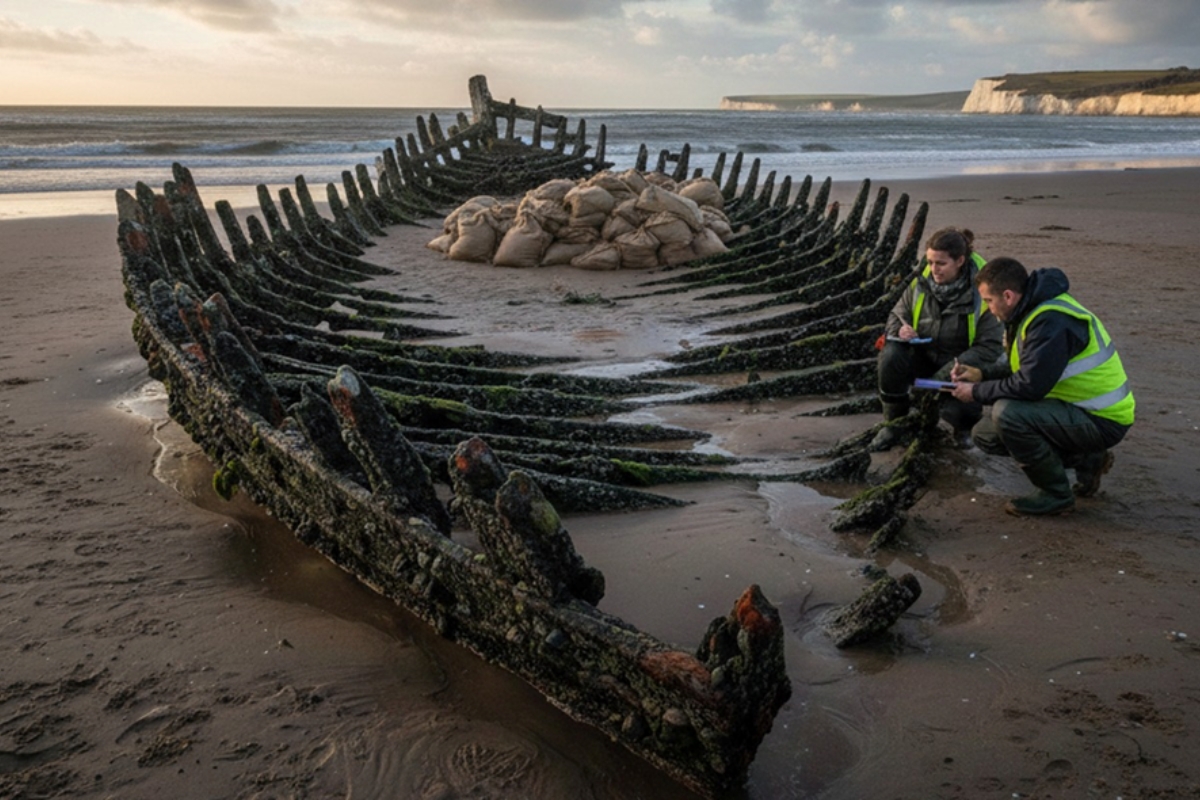
The Chandra Storm Revealed the Wreckage of a Ship with About 400 Years in Studland Bay, Catching the Attention of Researchers and Authorities. The Remains May Be Linked to the Possible Wreck of the Fame from Hoorn, a Historic Vessel Associated with European Maritime Routes of the Past
The fury of nature brought an invaluable archaeological treasure to light in the sands of Dorset, England. After the passing of the Chandra Storm in January 2026, structural timbers from a 17th-century ship were exposed in Studland Bay, mobilizing specialists from the National Trust and Bournemouth University. The discovery, considered a lost link in Dutch naval history, is only visible during low tide and is already under rigorous scientific surveillance.
The Fame from Hoorn and the Wreck of Swash Channel
The main hypothesis of archaeologists is that the wreckage belongs to the Fame from Hoorn, an imposing Dutch merchant ship that ran aground in the area in 1631. The vessel, which measured about 40 meters long, was a high-status ship equipped with up to 40 cannons for defense against pirates on its routes to the Caribbean.
Experts believe that this six-meter section found after the Chandra Storm is a piece that detached from the “Wreck of the Swash Channel”, a famous archaeological site discovered in the 1990s. At the time of the original accident, although all 45 crew members survived, the ship was quickly looted by local inhabitants, and what remained was swallowed by sand, preserved for four centuries.
-
Friends have been building a small “town” for 30 years to grow old together, with compact houses, a common area, nature surrounding it, and a collective life project designed for friendship, coexistence, and simplicity.

-
This small town in Germany created its own currency 24 years ago, today it circulates millions per year, is accepted in over 300 stores, and the German government allowed all of this to happen under one condition.

-
Curitiba is shrinking and is expected to lose 97,000 residents by 2050, while inland cities in Paraná such as Sarandi, Araucária, and Toledo are experiencing accelerated growth that is changing the entire state’s map.

-
Tourists were poisoned on Everest in a million-dollar fraud scheme involving helicopters that diverted over $19 million and shocked international authorities.



The Structure of the Discovery and Preservation
The section revealed by the Chandra Storm impresses with its state of conservation. Composed of at least 15 frames (the “ribs” of the ship) connected by wooden dowels to five planks of the outer hull, the piece demonstrates the robust naval engineering of the time.
- Dimensions: Approximately 6 meters long by 2 meters wide.
- Condition: The outer planks are in excellent condition, despite erosion on the inner frames.
- Technique: The use of wooden nails that remain firm after 400 years is a testament to 17th-century craftsmanship.
Currently, the area is protected by sandbags to prevent accelerated erosion caused by contact with oxygen and saltwater. Bournemouth University is waiting for permits from Historic England to begin controlled excavation and conduct definitive carbon dating.

An “Exceptionally Rare” Heritage Under Protection
Wrecks predating the year 1700 are considered discoveries of worldwide significance. The site is now part of a select group of only 57 wrecks legally protected on the English coast. The guidance for tourists visiting Studland is clear: observe, but never touch or walk on the wood, at the risk of permanently damaging the fragile organic material.
It is expected that, after studies, these pieces will join the collection of the Poole Museum, where figureheads, bronze bells, and kitchen utensils recovered in previous expeditions already rest. The legacy revealed by the Chandra Storm reinforces that, beneath the sands of Studland, history still breathes and awaits the right moment to emerge.
The article was based on information published by Swanage News, which detailed the discovery of the wreckage in Studland Bay after the Chandra Storm










-

-

-

3 pessoas reagiram a isso.