





 Portuguese
  English
  Spanish
  6 min of reading
  0 comments


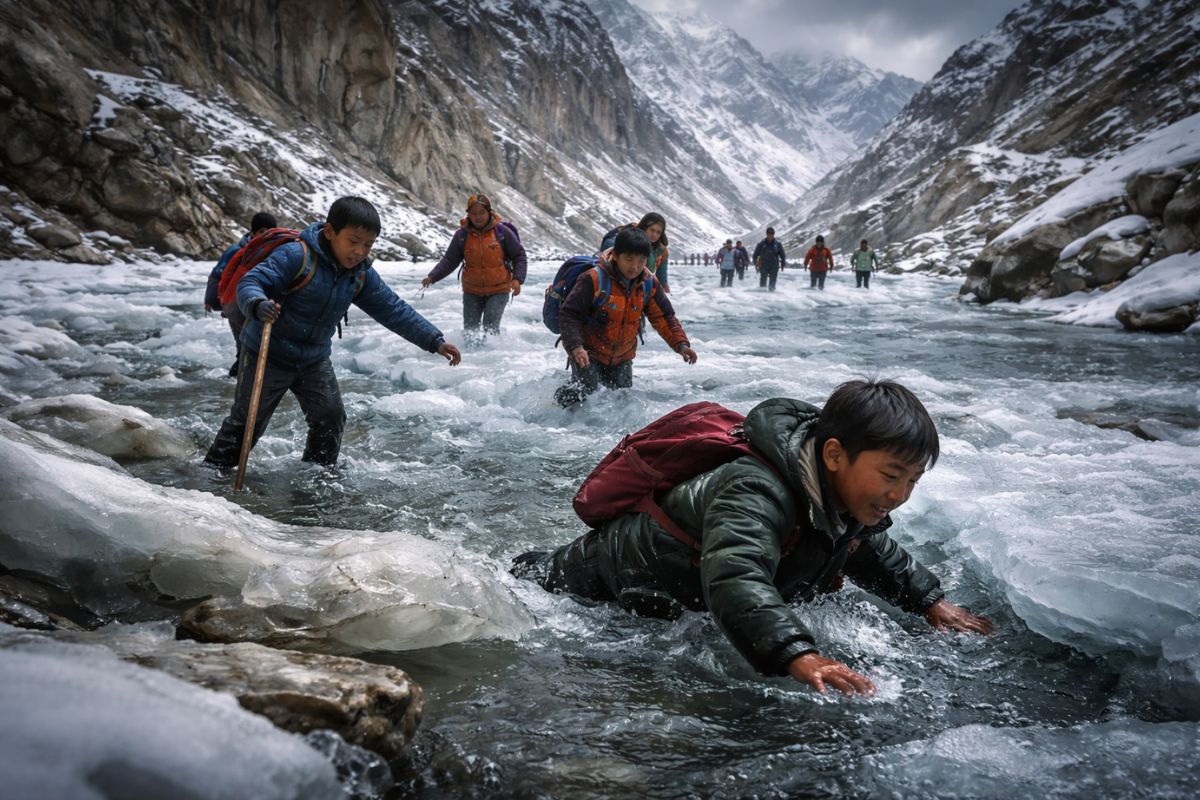
In The Zanskar Valley, Children From Villages Above Four Thousand Meters Cross The Chadar Trail In Winter To Study, Facing Unstable Frozen Rivers, Falls, And Long Walks Without Roads. Amid Poverty, Isolation, And Harsh Climate, Education Depends On Family Courage, External Support, And Still Slow Government Solutions.
The children of Zanskar, in the Indian Himalayas, face a route that combines extreme cold, high altitude, and geographic isolation to reach school during the winter. In many stretches, the crossing takes place over the frozen river, with a real risk of slipping, ice breaks, and currents beneath the surface.
The journey, known as the Chadar Trail, has gained fame as being the most dangerous in the world for school access, although this classification is difficult to prove absolutely. Still, reports from local families, like that of Tsering and Rigzin, make it clear that the risk is not rhetorical: it is part of the annual routine for those who rely on education to break cycles of poverty.
Where The Crossing Begins And Why It Exists

Photo: Tamara Cannon
In winter, high-altitude villages in the Zanskar Valley are practically deserted. The combination of snow, ice, and steep terrain makes regular road travel impossible, including a land trip that has been described as long and rugged between the region and Leh. Without stable transportation, local educational options shrink, and many families come to depend on boarding schools.
-
Friends have been building a small “town” for 30 years to grow old together, with compact houses, a common area, nature surrounding it, and a collective life project designed for friendship, coexistence, and simplicity.

-
This small town in Germany created its own currency 24 years ago, today it circulates millions per year, is accepted in over 300 stores, and the German government allowed all of this to happen under one condition.

-
Curitiba is shrinking and is expected to lose 97,000 residents by 2050, while inland cities in Paraná such as Sarandi, Araucária, and Toledo are experiencing accelerated growth that is changing the entire state’s map.

-
Tourists were poisoned on Everest in a million-dollar fraud scheme involving helicopters that diverted over $19 million and shocked international authorities.

This context explains why the children do not cross for adventure, but out of necessity. When school access is not available in their own village, crossing becomes a condition for continuing their studies. The family’s decision is not between comfort and discomfort; it is between studying and falling behind in a territory where the climate dictates the calendar of daily life.
The landscape itself imposes severe limitations. Some communities live above four thousand meters, in a region marked by even higher peaks, glaciers, and prolonged winters. In this geography, any school-related movement requires collective planning, physical endurance, and support among adults, children, and travel groups.
Who Crosses And How Risk Appears Along The Way

Photo: Tamara Cannon
Local accounts show that the crossing includes grandparents, parents, and guardians carrying children in critical sections, as well as the use of sleds and ropes on descents. In areas like Takmar, there are moments when the ice does not completely freeze and the water rises, creating points of instability along the way. The danger, in this case, shifts in location and intensity from one day to the next.

The memory of Tsering, 76, when he was almost swept away by the current with his grandson on his back, encapsulates the level of exposure faced by families. It is not a unique event in the regional narrative: there is a risk of falls on slopes, slips on ice patches, and crossings in stretches where the river is not entirely safe. For the children, each step depends on the care of those accompanying them.
Beyond the immediate physical risk, there is accumulated wear and tear. Extreme cold, prolonged effort, and constant fear affect concentration, rest, and health. In educational terms, this means that attending school does not start in the classroom: it starts many hours earlier, in a survival logistics that consumes energy that should be available for learning.
How Much It Costs To Maintain Education In A Hard-To-Reach Area

The economic base of many families in Zanskar is subsistence agriculture, with low income and intense seasonal variation. There are cases of families relying on occasional jobs and very small pensions, which limits investment in transportation, lodging, and school supplies. For the children, the cost of education is also a cost of transport, shelter, and stay.
Even where there is public investment in schools, maintenance faces practical barriers: damaged infrastructure, lack of workers, and difficulty retaining professionals in remote locations. The example of the unused school in Shila-Pu, with a compromised structure, shows that having a building does not guarantee continuous educational provision when climate and logistics work against basic operation.

In this scenario, centralizing in boarding schools emerges as a possible solution, but with new challenges. The family must entrust the child to a distant institution, incur indirect expenses, and deal with prolonged separation. The educational equation ceases to be merely pedagogical and becomes territorial, social, and financial at the same time.
What Changes With The New Hostel And What Limits Remain
After nearly a decade of negotiations, the initiative linked to the Lille Fro organization received permission to build an 80-bed hostel, estimated at 400 thousand dollars, with space for students and accommodations for teachers.
The proposal aims to address two simultaneous bottlenecks: accommodating the children and attracting professionals to work in the region.
The project can reduce some of the risk of long crossings at the height of winter and improve school continuity for families in greater vulnerability.
It may also expand access to basic healthcare, as the distance from essential services weighs heavily in hard-to-reach areas. In practice, it is a response to social infrastructure in a territory of adverse geography.
Still, there are objective limits. The short summers hinder construction schedules, and the projected timeline could stretch for years.
Moreover, a hostel does not alone solve structural issues such as rural poverty, turnover of professionals, school maintenance, and reliance on seasonal routes. The improvement tends to be real, but gradual.
Why The Discussion Goes Beyond The Crossing And Reaches The Region’s Future
When a school route depends on seasonal ice, the debate is not just about transportation: it is about territorial inequality.
The children of Zanskar face a barrier that students in urban areas do not face, creating disadvantages from the earliest years of formation. The impact shows up in performance, school retention, and future opportunities.
There is also an intergenerational point. In families with low income and multiple responsibilities, keeping a student in school means reorganizing work, domestic care, and budgeting.
The grandfather’s effort to take the grandson, feed him, do laundry, and accompany the school routine shows that education, there, is a collective work of the entire family, not just an individual obligation of the child.
Finally, Rigzin’s story helps to see what is at stake: the desire to be a pilot does not arise from abstraction but from direct contact with concrete limits. In remote regions, ensuring school safety is the first step for life projects to stop being exceptions. Without stable access, talent and discipline are not enough.
The winter crossing in Zanskar reveals a harsh contrast: while education is treated as a universal right, the real conditions of access still depend on extreme cold, physical risk, and family improvisation.
The advancement of solutions like boarding schools and accommodation for teachers points to a path, but the gap between public policy and the daily routine of children is still large.
If you had to prioritize an immediate measure to reduce risk without interrupting classes, would you choose nearby hostels, seasonal school transportation, reinforcement of resident teachers, or active maintenance of local schools? And, in your city, what invisible barrier still prevents children from studying safely every day?










-

-

6 pessoas reagiram a isso.