





 Portuguese
  English
  Spanish
  4 min of reading
  0 comments


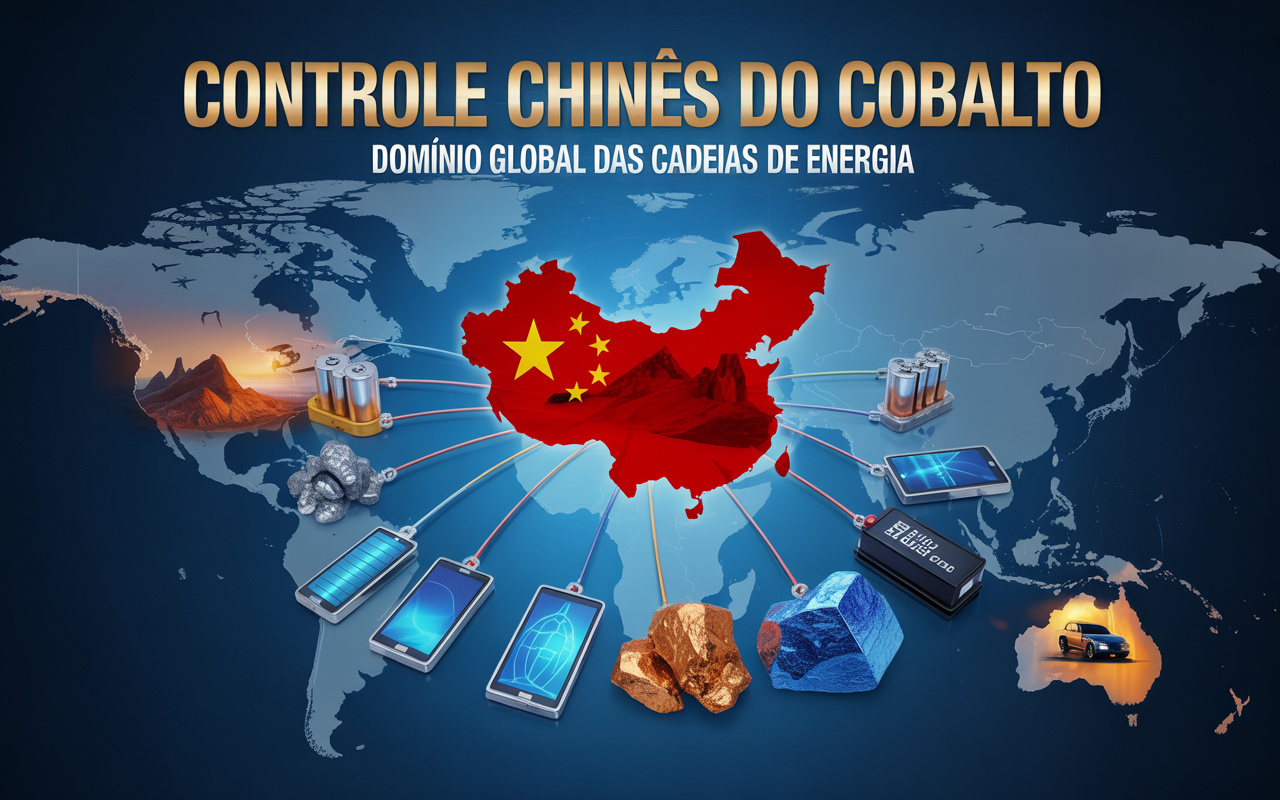
China Concentrates on Refining Cobalt Used in Batteries and Electronics, Expanding Influence Over Strategic Supply Chains Even with Mining Outside the Country.
In the global race for electrification, few inputs are as decisive as cobalt. It doesn’t draw attention like lithium, but it is the component that ensures stability, thermal safety, and lifespan for lithium-ion batteries used in electric cars, energy storage, electronics, and sensitive applications. The central point of this story is less known: whoever controls cobalt refining controls the pace of the energy transition.
That’s where China comes in. Even when the ore is extracted thousands of kilometers away, particularly in the Democratic Republic of the Congo, the critical stage that transforms rock into usable industrial input occurs mostly in facilities linked to Chinese companies. This dominance is not casual; it is the result of an industrial strategy built over decades.
From the African Underground to Asian Refineries
The DRC accounts for about 70% of the world’s cobalt production. However, much of this material leaves the country as concentrate or hydroxide, without significant added value. The next step — refining into cobalt sulfate and other battery-grade intermediates — happens mostly outside Congolese territory.
-
Historic bankruptcy of Centauro shocks the market, and the century-old company puts more than 500,000 products, machines, and complete infrastructure up for online auction.

-
New shoe factory in Ceará is expected to create 400 jobs and strengthen the local economy.

-
No one imagined it, but a mixture of sawdust with a mineral that fights fires surprises scientists with a result that changes the course of fire-resistant construction.
-
From empty land to a high-end house, wooden construction uses a lightweight system, metal structure for the foundation, ventilated ceramic cladding, and special windows to create an efficient and comfortable living space throughout the year.



China has heavily invested to occupy exactly this link. Refineries, chemical plants, and integrated complexes have been built to process cobalt at scale, with competitive costs and direct integration into battery supply chains. The result is a structural concentration: most of the refined cobalt reaching battery factories goes through Chinese companies.
Why Refining Matters More Than Mining
Mining is just the beginning. Refining requires chemical know-how, impurity control, strict standardization, and industrial scale. Without this, cobalt does not meet the safety and performance requirements of modern batteries. For this reason, real power lies not only in the volume extracted, but in the ability to deliver material ready for industrial use. By mastering refining, Chinese companies can:
- prioritize strategic contracts and clients;
- influence prices and deadlines;
- vertically integrate with cathode and battery manufacturers;
- reduce supply risks for their own industry.
This control acts as an invisible switch in global supply chains.
Vertical Integration: From Chemistry to Electric Cars
The Chinese strategy did not stop at refining. The country has built a vertical integration that connects refined cobalt to cathodes, battery cells, and final products. Thus, even when Western automakers buy batteries “outside” of China, a crucial part of the chemical input often has passed through Chinese refineries.
This model reduces costs, accelerates incremental innovation, and creates systemic dependence. For those outside, breaking this dependence requires years of investment, environmental licensing, and industrial learning — a delay that few countries can afford without compromising electrification goals.
Western Reaction: Diversify Without Losing Time
The concentration has raised alarms in Washington, Brussels, and Tokyo. Initiatives to diversify cobalt refining have gained momentum, with incentives for new plants outside China, agreements with producing countries, and requirements for traceability. Still, the industrial gap is large.
Refineries do not appear overnight. They require scale, energy, logistics, and a guaranteed market. In the meantime, China continues to expand capacity and efficiency, reinforcing its position in a market where delays cost competitiveness.
The Role of the DRC and the Dilemma of Added Value
For the DRC, dependence on external refining represents a loss of value and influence. There are efforts to advance stages locally, but challenges in infrastructure, energy, and regulatory stability hinder rapid change. International partnerships arise, but they compete with an already mature and integrated Chinese ecosystem.
The dilemma is clear: retaining value requires time and capital; relinquishing it perpetuates dependence. In the midst of this game, whoever controls refining continues to set the rules.
Impacts Beyond Energy: Electronics and Defense
Cobalt is not only used for electric cars. It is found in smartphones, laptops, stationary storage systems and critical defense applications. Safer and more stable batteries are essential for drones, autonomous vehicles, and equipment in extreme environments. This increases the strategic weight of refining and transforms the issue into a matter of national security for various countries.
If new refining capacities emerge at scale outside China, the market is likely to become more resilient, with less concentrated prices and greater competition. However, until that happens, Chinese influence remains structural. This is not absolute control, but rather a systemic advantage that is difficult to replicate quickly.
Industrial Power is Built in the Middle of the Chain
The story of cobalt shows that, in the contemporary economy, power rarely lies at the beginning of the chain. It lies in the middle — where raw material becomes strategic input. By mastering refining, Chinese companies have expanded their influence over batteries, electronics, and energy, even when the ore originates far from their borders.
As governments seek to diversify and reduce risks, the current reality is unequivocal: whoever controls refining controls the pace. And for now, that pace mostly goes through Chinese refineries.








-

-

2 pessoas reagiram a isso.