






 Portuguese
  Spanish
  4 min of reading
  0 comments


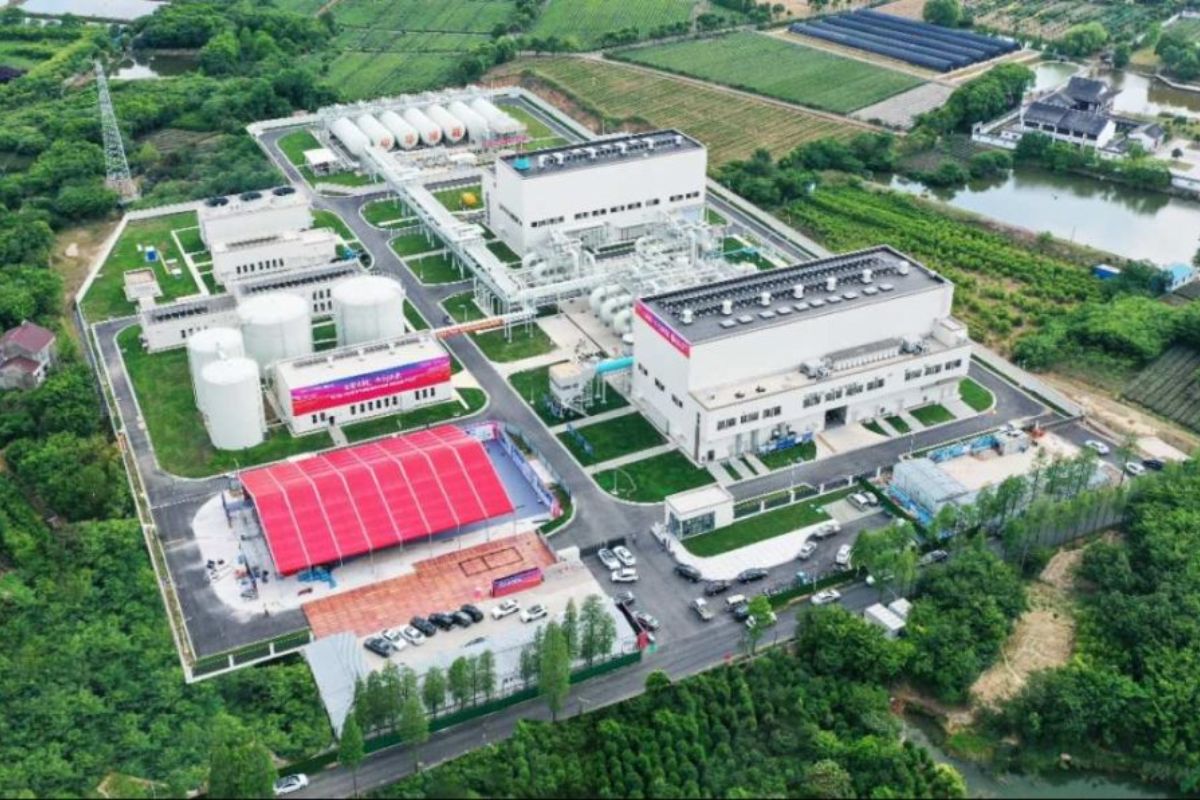
China Puts Into Operation the Guoxin Suyan Huai’an Project, with 71% Efficiency and Capacity to Stabilize the Power Grid for Up to Four Hours Without Combustion or Chemical Batteries
The world’s largest compressed air plant has started operating in Jiangsu province, China, with a straightforward proposal for one of the biggest bottlenecks in the energy transition: storing renewable energy on a large scale and releasing it precisely during peak times. The Guoxin Suyan Huai’an project operates in underground salt caverns, where air is compressed and stored under high pressure to become electricity when the grid needs it.
With 600 MW of installed power and 2.4 GWh of storage capacity, the facility can deliver energy continuously for four hours, precisely during the period when demand rises and generation from intermittent sources tends to fall. And the difference is clear: it is not a lithium battery, does not use combustion, and relies on geology as a reservoir.
What Makes the Largest Compressed Air Plant Different from a “Giant Battery”
The basis of the system is simple to understand and difficult to execute. When there is excess electricity on the grid during times of strong sunlight or intense wind, this energy is used to compress air and store it in high-pressure salt caverns, which function as a hermetic and stable reservoir.
-
Colorectal cancer advances worldwide, but most cases can be prevented.

-
NASA takes another look at the M87* black hole and finds details in the cosmic jet in X-rays that seem to reveal a much more unsettling universe than previously imagined.

-
NASA’s space probe passes just 4,609 km from Mars, receives a boost of 1,600 km/h, and continues towards the asteroid 16 Psyche, a body valued at up to $10,000,000,000,000,000.

-
5,500-year-old DNA found in Stone Age bones reveals that the plague was already haunting prehistoric communities long before the medieval Black Death.



At peak times, the cycle reverses: the compressed air is released, heated, and then drives turbines to generate electricity. The central point here is the utilization of heat because the system stores thermal energy in molten salts and pressurized thermal water, enhancing the process performance.
The highlighted technical result at the base is an energy efficiency of 71%, considered high for this type of technology at scale. And, more importantly, it achieves this without needing to burn gas or other fossil fuels to reheat the air, as was the case in earlier generations of CAES.
How Salt Caverns Became an Underground Energy “Lung”
The use of salt caverns is not a detail; it is a strategy. These formations are impermeable, naturally suitable for pressure storage and are already used in other contexts, such as storing gas.
Repurposing this geological structure for energy creates a pathway with the potential for less invasive surface infrastructure, as part of the “tank” is literally underground.
In practice, the largest compressed air plant operates as an energy lung: it fills up when there is surplus and “exhales” energy when the grid needs reinforcement. This changes the function of storage, which ceases to be merely supplementary and becomes a structural stabilizer of the power grid.
Why the Largest Compressed Air Plant Focuses on Grid Stability Rather Than Just Energy Volume
For decades, the stability of the electrical system relied on coal or gas plants, capable of quickly coming online when consumption spikes.
The Jiangsu project proposes another logic: use renewable surpluses as an energy insurance, reducing dependence on fossil fuel power plants for backup during critical times.
At full capacity, the base indicates that the plant can generate up to 792 GWh per year, a volume associated with supplying around 600,000 households.
From an environmental perspective, the indicated estimates speak of an annual reduction of 250,000 tons of coal and 600,000 tons of carbon dioxide, signaling a direct impact on the transition from thermal to storage.
A Technology Transitioning from “Experimental” to Critical Infrastructure
The base also indicates that the scenario has changed: rather than being treated as an experiment, this technology is now seen as critical infrastructure for electrical systems based on renewables.
Outside of China, there are mentions of growing interest, with an example in Australia: a 200 MW project with up to eight hours of storage being developed as part of a renewable microgrid in Broken Hill.
In North America, the base indicates that there are operational facilities and new projects in advanced stages, aiming for integration with large solar and wind farms.
The implicit message is that the largest compressed air plant does not need to “replace” chemical batteries to be relevant. It enters as a robust component in a portfolio of solutions, especially where favorable geological conditions exist.
The Real Potential: Less Pressure on Critical Minerals and Fewer Thermal Plants at Peak Times
The base outlines concrete pathways in which the largest compressed air plant and similar technologies can contribute:
- Increase the integration of wind and solar with less fear of generation peaks and valleys.
- Reduce the activation of fossil thermal plants as backup during high demand periods.
- Utilize geological infrastructures, such as salt caverns, as energy assets.
- Support more resilient local systems, including in the form of microgrids.
- Reduce pressure on critical minerals by complementing electrochemical batteries.
In the end, the idea tested in Jiangsu is almost straightforward: use the geology itself as an ally to decarbonize the grid, storing energy with air, salt, and thermal management, without relying on combustion.
And you: should Brazil invest in compressed air storage in salt caverns to strengthen the grid and reduce thermal plants during peak times?






Be the first to react!