





 Portuguese
  English
  Spanish
  2 min of reading
  0 comments


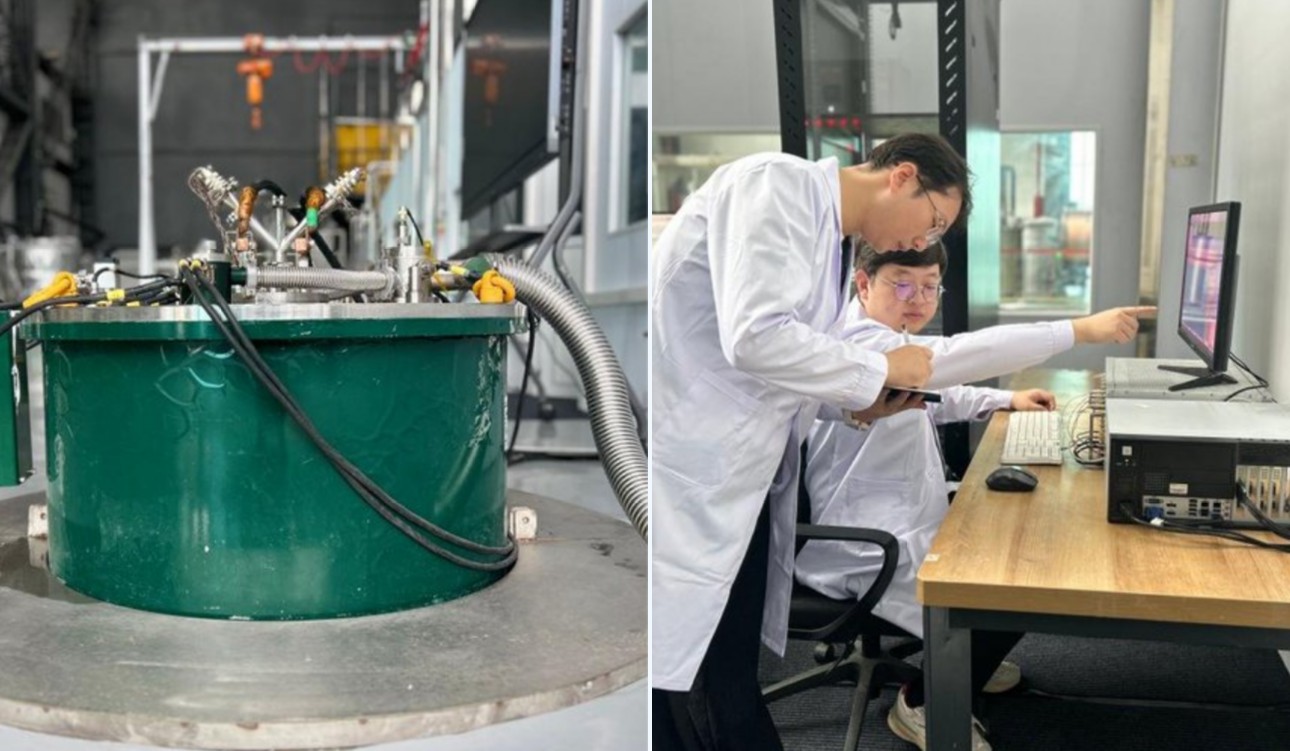
China Achieves Historic Milestone With 351,000 Gauss Superconductor Magnet, A World Record That Generates A Magnetic Field 700,000 Times Greater Than Earth’s
Chinese researchers announced on Sunday an unprecedented achievement in the field of superconductivity: the generation of a constant magnetic field of 351,000 gauss using a fully superconducting magnet.
The feat, accomplished by the Institute of Plasma Physics of the Chinese Academy of Sciences (ASIPP) in Hefei, Anhui, surpassed the previous record of 323,500 gauss and positioned China as the global leader in advanced magnetic technology.
A Milestone In Superconductors Science
The project involved the International Center for Applied Superconductivity in Hefei, the Energy Institute of the National Comprehensive Science Center of Hefei, and Tsinghua University.
-
Motorola launched the Signature with a gold seal from DxOMark, tying with the iPhone 17 Pro in camera performance, Snapdragon 8 Gen 5 that surpassed 3 million in benchmarks, and a zoom that impresses even at night.

-
Satellites reveal beneath the Sahara a giant river buried for thousands of kilometers: study shows that the largest hot desert on the planet was once traversed by a river system comparable to the largest on Earth.

-
Scientists have captured something never seen in space: newly born stars are creating gigantic rings of light a thousand times larger than the distance between the Earth and the Sun, and this changes everything we knew about stellar birth.

-
Geologists find traces of a continent that disappeared 155 million years ago after separating from Australia and reveal that it did not sink, but broke into fragments scattered across Southeast Asia.

For comparison, the Earth’s natural magnetic field is only 0.5 gauss. This means that the new field achieved is over 700,000 times stronger than the geomagnetic field of the Earth.
According to the team, this advancement will boost the commercial application of superconducting scientific instruments, such as nuclear magnetic resonance spectrometers, used in medical imaging and chemical analysis.
Additionally, the results support technologies such as fusion magnets, space electromagnetic propulsion, magnetic levitation, superconducting induction heating, and high-efficiency power transmission.
Researcher Liu Fang from ASIPP emphasized that the magnet uses high and low temperature superconducting coils in a coaxial arrangement, a solution that ensures stability even under extreme conditions.
Overcoming Technical Challenges
The team faced significant barriers to reach this new level.
It was necessary to solve issues of stress concentration, shielding current effects, and multi-field coupling in low temperature and high field environments.
With structural improvements, the scientists enhanced mechanical stability and electromagnetic performance.
In the test, the magnet was energized to 35.1 tesla, maintained stable operation for 30 minutes, and was safely demagnetized. The process demonstrated the reliability and resilience of the new technology under demanding conditions.
Applications In Nuclear Fusion
Superconducting magnets are essential in magnetic confinement fusion devices, responsible for creating the “magnetic cage” that confines plasma at extreme temperatures to enable sustained nuclear fusion reactions.
ASIPP already has a track record of leadership in this field, with advances in the national production of superconducting materials and systems that reduce external dependency.
As a participant in the International Thermonuclear Experimental Reactor (ITER), the institute is responsible for superconductors, correction coils, and magnetic feeders for the world’s largest fusion experiment.
The new record solidifies China’s position in global nuclear fusion research and paves the way for the development of strategic technologies in energy, transportation, and advanced science.







-

Uma pessoa reagiu a isso.