





 Portuguese
  English
  Spanish
  4 min of reading
  2 comments


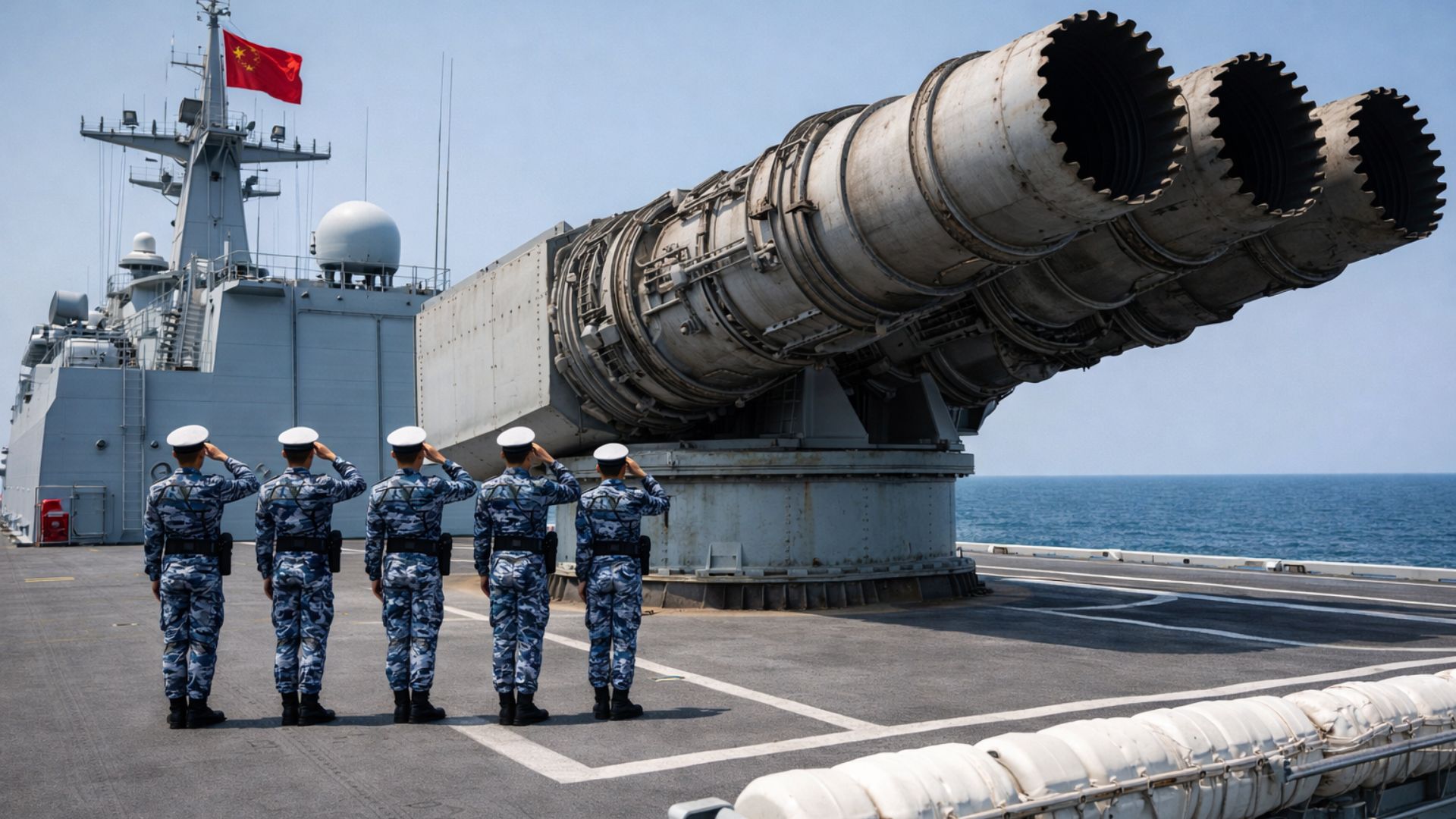


Strategic Dispute Takes On New Dimensions With Reports Of Long-Range Missile, Multiple Warheads, And Emerging Technologies That Challenge Defense Systems And Reignite The Debate On Nuclear Balance Among Powers.
A set of claims regarding new Chinese weapons has circulated online, claiming that Beijing already possesses an “impossible missile” capable of covering about 15,000 kilometers in 30 minutes and carrying up to 10 nuclear warheads, in addition to a supposed “$1 laser” that would destroy high-value electronics.
The most detailed part of the narrative cites the intercontinental missile DF-41, described as mobile and with the capability for multiple independent warheads, a technology that would increase the complexity of any interception attempt.
Although the original text uses hyperbolic terms and presents the technology as already “operational,” experts and public reference databases treat the characteristics of the DF-41 as estimates with varying degrees of uncertainty.
-
Motorola launched the Signature with a gold seal from DxOMark, tying with the iPhone 17 Pro in camera performance, Snapdragon 8 Gen 5 that surpassed 3 million in benchmarks, and a zoom that impresses even at night.

-
Satellites reveal beneath the Sahara a giant river buried for thousands of kilometers: study shows that the largest hot desert on the planet was once traversed by a river system comparable to the largest on Earth.

-
Scientists have captured something never seen in space: newly born stars are creating gigantic rings of light a thousand times larger than the distance between the Earth and the Sun, and this changes everything we knew about stellar birth.

-
Geologists find traces of a continent that disappeared 155 million years ago after separating from Australia and reveal that it did not sink, but broke into fragments scattered across Southeast Asia.

Still, there is consensus that it is one of the key vectors of the Chinese nuclear modernization program, with sufficient range to reach the continental United States and with basing options that complicate tracking.
DF-41 At The Center Of Chinese Nuclear Modernization

The DF-41 is generally described as a Chinese Intercontinental Ballistic Missile, solid-fueled, associated with mobile road platforms and also possible silo versions.
Public studies and surveys from international centers indicate that the estimated range could reach up to 15,000 kilometers, which would place the system among the most extensive of the known Chinese arsenal.
Within this range, technical analyses suggest that the flight time to the continental United States could be around 30 minutes, depending on the trajectory and the exact launch and impact points.
The original text also claims that the DF-41 would carry “up to 10 independent nuclear warheads,” referencing the concept of Multiple Independently Targetable Reentry Vehicles, known as MIRV.
This capability is frequently mentioned in open analyses, although the exact number of warheads is not publicly confirmed and varies according to the source and scenario considered.
Mobility And Silos Increase Strategic Uncertainty

One of the most emphasized points is the system’s mobility.
Unlike fixed missiles in traditional silos, mobile platforms on highways allow for launches from variable positions, complicating early detection by satellites and intelligence systems.
This logic is recurrent in studies on the survival of strategic forces, as dispersion reduces vulnerability to preemptive attacks.
At the same time, recent analyses based on satellite imagery indicate that China has also invested in the construction of new silo fields, enhancing the land component of its nuclear deterrent.
The combination of mobility and fixed infrastructure reinforces the perception that geographic distance has lost some of its role as a factor of strategic protection.
Defense Costs And The Challenge Of Interception
The text claims that countering this type of missile would require investments of billions.
Conceptually, the assertion aligns with a known reality for defense specialists: missile defense systems are expensive, complex, and technologically demanding, especially when they must deal with multiple warheads, decoys, and countermeasures.
When a single vector can release multiple reentry vehicles, defense must track, discriminate, and attempt to intercept several targets almost simultaneously.
Still, the content does not provide specific values, cited programs, or budgetary data that would allow for accurate quantification of these costs.
The Enigma Of The “$1 Laser”

Another part of the narrative mentions a supposed “$1 laser” capable of destroying high-value electronics.
In the analyzed excerpt, there is no identification of system, power, range, manufacturer, or documented tests.
Without these elements, it is impossible to confirm the existence of an operational weapon with such a cost per shot and with the described effects.
Discussions about directed energy weapons exist in military and academic circles, but are usually accompanied by technical data, official statements, or public demonstrations, which are absent in the original text.
What The Debate Reveals About The Global Scenario
By presenting an arsenal described as already operational, the text reflects a real concern regarding the accelerated pace of Chinese military modernization.
International reports and analyses have been highlighting the increase in the number of vectors and the diversification of the country’s strategic capabilities.
In this context, the DF-41 appears as a recurring symbol for combining estimated long range, multiple warhead potential, and greater operational survivability.
The difference between technical potential and fully proven capability, however, is often the point where viral narratives amplify certainties and reduce nuances.
If strategic weapons become more mobile, numerous, and difficult to intercept, how will governments and societies deal with the increasing risks and the future of arms control agreements in a competition scenario among great powers?






15 km en 30 min? Impresionante, va 5 km/h más rápido que mi patinete
30.000 km/h ? Duvido