





 Portuguese
  English
  Spanish
  5 min of reading
  1 comment


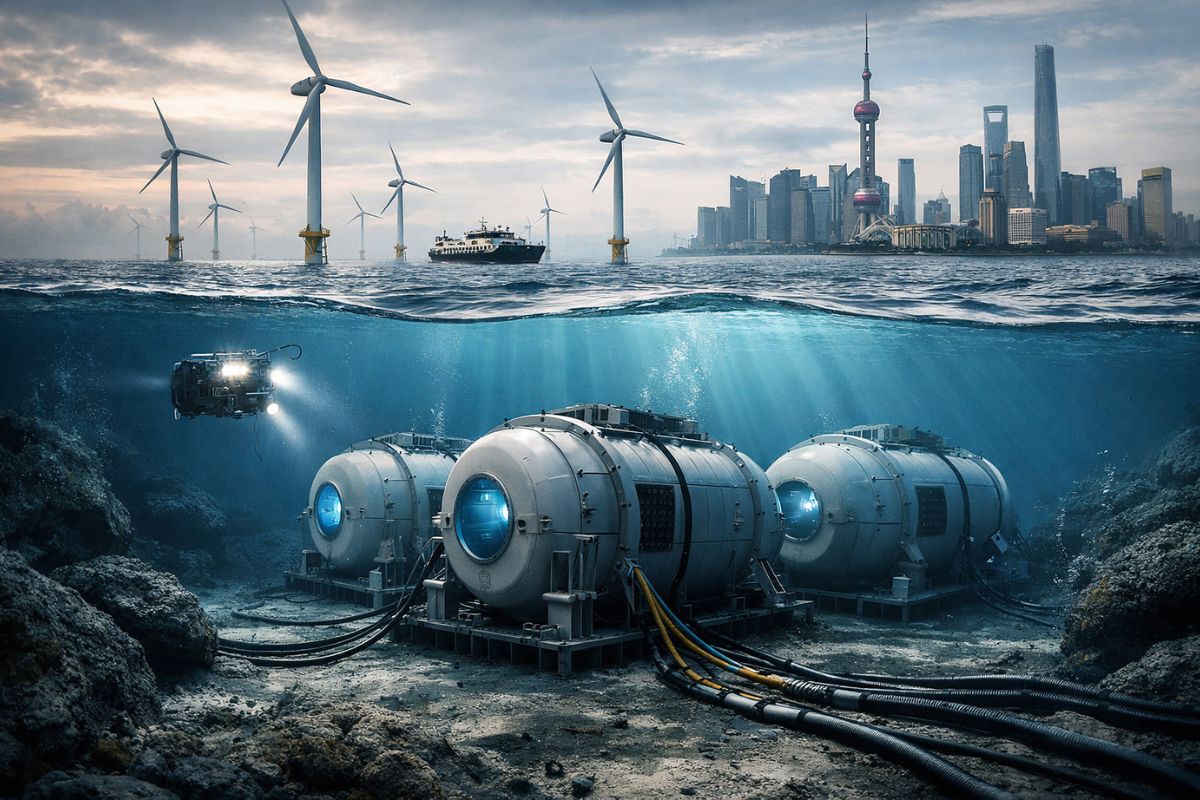


Already Operating in the First Phase, the First Underwater Data Center in Shanghai Places Servers Under the Ocean and Uses Seawater to Exchange Heat in Copper Pipe Circuits, Reducing Cooling Energy by Up to 90% and Being Supplied by Over 95% by Local Offshore Wind.
China inaugurated in 2025 the world’s first underwater data center powered by wind energy, with a total investment of 1.6 billion yuan and the promise of changing the main energy bottleneck of computing: cooling. Instead of rooms full of air conditioning, the proposal is simple and bold: let the ocean do the work.
The initiative comes at a time when China’s IT infrastructure is growing, putting pressure on energy, space, and efficiency. The central question is not just “does it work?”, but also “what changes when the physical foundation of the internet goes below the ocean’s surface?”.
Why Submerging Data Centers Became a Shortcut to Efficiency

Traditional land-based data centers heat up during operation and need to be kept cool to function efficiently. In this equation, the air conditioning system can account for up to 50% of total energy consumption, which makes cooling an immediate target for any project seeking sustainability and scale.
-
Motorola launched the Signature with a gold seal from DxOMark, tying with the iPhone 17 Pro in camera performance, Snapdragon 8 Gen 5 that surpassed 3 million in benchmarks, and a zoom that impresses even at night.

-
Satellites reveal beneath the Sahara a giant river buried for thousands of kilometers: study shows that the largest hot desert on the planet was once traversed by a river system comparable to the largest on Earth.

-
Scientists have captured something never seen in space: newly born stars are creating gigantic rings of light a thousand times larger than the distance between the Earth and the Sun, and this changes everything we knew about stellar birth.

-
Geologists find traces of a continent that disappeared 155 million years ago after separating from Australia and reveal that it did not sink, but broke into fragments scattered across Southeast Asia.

By placing part of the infrastructure below the ocean’s surface, the first underwater data center attempts to address this structural weakness with an environmental change, not just a change of equipment. Instead of “fighting” against heat with cold air, the logic is to transfer heat to a naturally cool and abundant medium, reducing electrical demand which, on land, tends to grow alongside computational capacity.
How Seawater Becomes “Natural Air Conditioning” in Practice
In the first phase, already operational, the servers are submerged and cooling occurs through a thermal exchange circuit in copper pipes. The comparison used in the system’s own design helps to visualize: larger pipes act as arteries, smaller pipes as capillaries, carrying the refrigerant fluid through narrow and controlled paths, close to heat sources.
High-power servers are described as “electric heaters” due to the amount of heat generated. This heat is absorbed by the refrigerant fluid within the smaller pipes, causing a phase change from liquid to gas. Then, the gas rises through the larger pipes to a shell-and-tube heat exchanger, where it exchanges heat with seawater; by releasing this heat, the refrigerant returns to a liquid state and goes back to the smaller pipes, restarting the cycle. The promised result is straightforward: a reduction of up to 90% in energy dedicated to cooling.
Offshore Wind Power and the Electricity Bill Behind the Project
In addition to natural cooling, the project is presented as more environmentally sustainable due to the source of electricity: over 95% of the energy would come from offshore wind turbines. The proposal connects two critical points of data centers, cooling and electricity supply, aiming to reduce both consumption and the energy footprint associated with operations.
There is also a message about industrial scale and cost: the plan mentions turbines about 30 km offshore and, in line with national policies, the movement of wind turbines to deeper waters with the aim of large-scale development. Within this context, there is the statement that, thanks to the country’s industrial capabilities, the cost of offshore wind generation has begun to yield returns in less than 3 years and dropped below 5 cents per kWh. Even without going into details of methodology, the point is clear: reduce costs and stabilize the source to support computational expansion.
Capacity, Phases, and the Efficiency Metric That Aims to Get Close to “Perfect”
The first phase of the first underwater data center was presented with a capacity of 2.3 MW, while the second phase would raise the capacity to 24 MW. This difference in scale is important because it indicates that the initial operation serves as a technical showcase and learning base, while the expansion is where the proposal for real impact is usually measured.
To measure efficiency, a scale of energy use was cited called the PE scale, where 1.0 represents perfection. The first phase is said to have been designed to achieve 1.15, a value described as incredibly close to ideal.
In practice, this type of indicator reinforces the project’s ambition: it is not enough to function; it needs to operate with minimal losses, especially when the demand for computing tends to grow faster than the “easy” energy supply.
Less Land Occupied, More Computing on the Coast, and the Shanghai Effect
Another promise associated with the first underwater data center is to reduce land use, addressing a common problem of land-based facilities: scarcity of terrestrial resources, especially in regions that concentrate economic activity.
In a coastal city like Shanghai, the idea of relocating part of the infrastructure to the marine environment also aligns with urban planning and the pressure for areas for housing, industry, and services.
The project fits into the local movement to strengthen intelligent computing. According to the municipal government, Shanghai already has over 160 facilities connected to computer science, and 19 would adopt greener energy supply solutions.
In this context, the underwater center does not appear in isolation, but as part of a larger strategy: to increase computational capacity, reduce relative operating costs, and demonstrate a pathway to expand without “consuming” even more land space.
The first underwater data center combines three promises that rarely align in large-scale computing projects: cooling with seawater as a natural mechanism, predominantly offshore wind electricity, and reducing pressure on land use.
At the same time, it changes the physical address of critical infrastructure, which naturally raises new questions about operation, maintenance, and expansion to 24 MW.
If this model proves consistent, it could reshape the map of where computing resides: less tethered to expensive land and more connected to renewable sources and environments capable of efficiently absorbing heat.
And you, looking at your city or region: would it make sense to move part of the digital infrastructure to the sea to save energy and space?
Would you trust more in land-based data centers, where everything is “visible”, or in a submerged solution that promises efficiency but requires a different logic of maintenance and control?








This is the colonization of the ocean, treating it as mere real estate. As usual, humans are ignoring the trauma inflicted on the living systems of the sea. Anthropocentrism and hubris are the demise of humanity.