





 Portuguese
  English
  Spanish
 4 min of reading
  9 comments


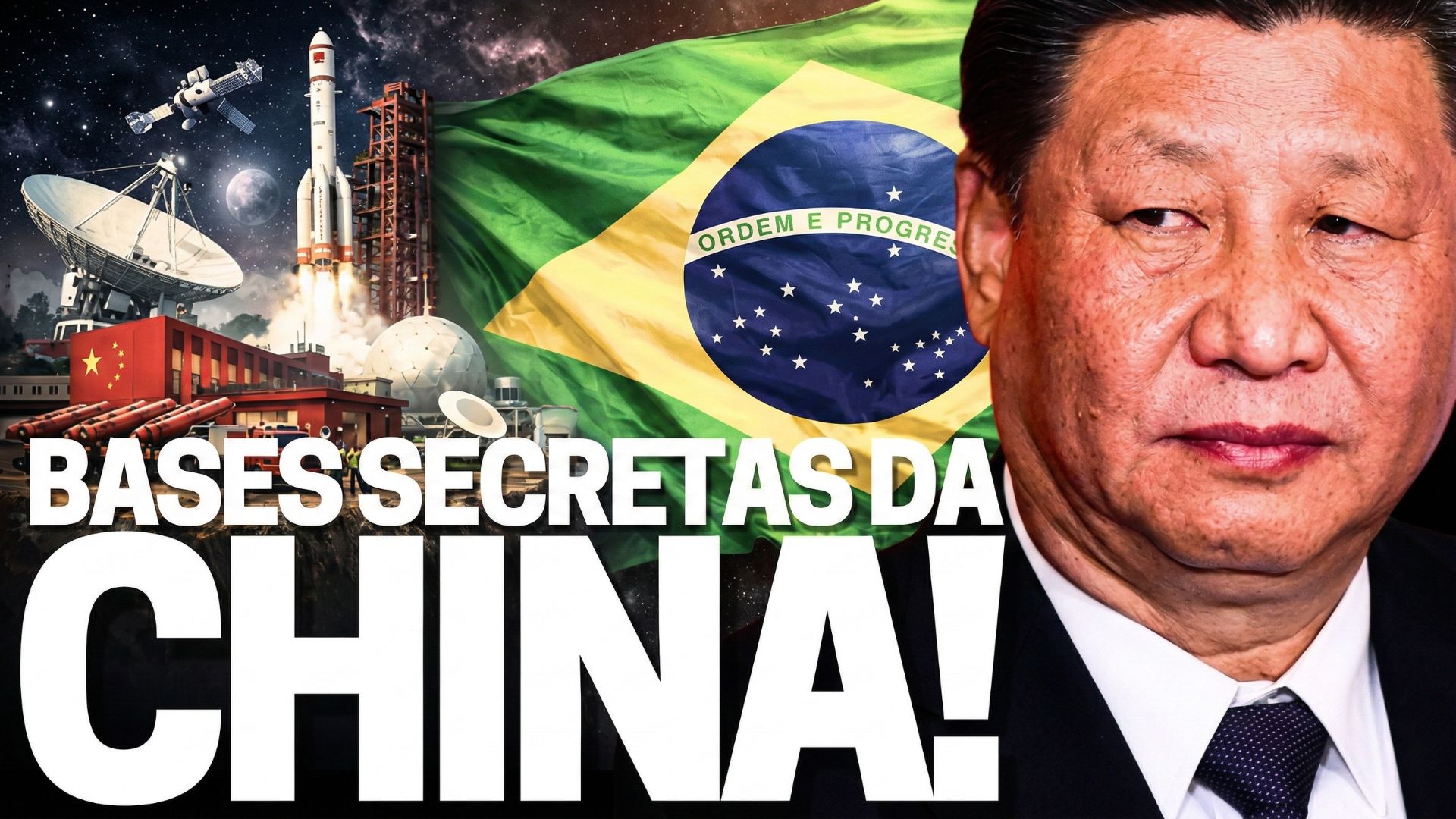


US Congress Report Points to Chinese-Linked Structure in Brazil and Cites Partnerships in the Northeast with Dual-Use Potential Involving Satellite Data and Radio Astronomy, While Describing a Regional Network of Facilities and Warning of Influence Risks from Space Infrastructure.
A report released by a committee of the United States House of Representatives claims that China maintains an installation in Brazil described as “unofficial,” linked to space operations capable of supporting real-time monitoring and potential intelligence collection on the South American continent.
According to the document from the Select Committee on the Chinese Communist Party, the structure mentioned in the country is the Tucano Ground Station, presented as a result of an agreement reached in 2020 between the Brazilian startup Ayla, identified in the report as Ayla Nanosatellites, and the Chinese company Beijing Tianlian Space Technology, from the aerospace sector.
While part of the reaction in Brazil points to the Bahian capital as the address of the station, the American report itself notes that the exact location of the facility is unknown, in addition to situating the project generally in the region associated with the name “Tucano,” in Bahia.
-
Friends have been building a small “town” for 30 years to grow old together, with compact houses, a common area, nature surrounding it, and a collective life project designed for friendship, coexistence, and simplicity.

-
This small town in Germany created its own currency 24 years ago, today it circulates millions per year, is accepted in over 300 stores, and the German government allowed all of this to happen under one condition.

-
Curitiba is shrinking and is expected to lose 97,000 residents by 2050, while inland cities in Paraná such as Sarandi, Araucária, and Toledo are experiencing accelerated growth that is changing the entire state’s map.

-
Tourists were poisoned on Everest in a million-dollar fraud scheme involving helicopters that diverted over $19 million and shocked international authorities.


The investigation was made public on February 26, 2026, and includes references to bases, ground stations, and space-related structures that, in the committee’s assessment, may have civilian utility and also military applications, as they integrate a support network for satellites and asset observation in orbit.
Tucano Station and Space Tracking in Brazil

In the section dedicated to the Tucano Ground Station, the committee describes that the partnership provides for the storage and exchange of operational data between facilities connected by networks of antennas, which would scale communications and the reception of information from satellites for extended periods.
The report also links Beijing Tianlian Space Technology to entities in the Chinese space sector and mentions the possibility that such infrastructure would allow for precise mapping of the positions of space assets, a point that, in the committee’s view, could facilitate planning and monitoring of third-party capabilities.
Presenting the strategic assessment of the case, the text states: “[The base] provides the PRC [People’s Republic of China] with a channel to observe and influence Brazilian military space doctrine while establishing a permanent presence in a region vital to US national security,” says the report.
According to the committee, the same infrastructure supporting commercial or scientific projects can be utilized in a manner compatible with information collection, depending on data control, interoperability agreements, and the limitations—or absence thereof—for inspections and audits.
China-Brazil Laboratory in Paraíba and Radio Astronomy
In addition to the station associated with Bahia, the report mentions the China-Brazil Joint Laboratory of Radio Astronomy Technology in Serra do Uruba, Paraíba, an initiative linked to academic and research cooperation involving Brazilian universities.
The Federal University of Paraíba reported, in an institutional statement from November 2025, that the agreement involves advanced research and the creation of a joint laboratory in radio astronomy, with participation also from the Federal University of Campina Grande, within a multi-year cooperation horizon.
In the debate monitored by US authorities, the concern raised is the linkage of the Chinese partner to the country’s defense industrial complex, which, according to this reading, would increase the risk of dual use of deep space observation systems, depending on the type of technology involved.

Although the publicly described goal for the laboratory is scientific, the international context includes warnings that China has been expanding its space infrastructure outside of the mainland, with a relevant presence in Latin America and the Caribbean, according to an annual report by the US Department of Defense published in December 2025.
Network of Bases in South America and Influence Through Infrastructure
The committee’s document maintains that China has built a network of space facilities in the region, including ground stations and radio telescopes, and claims to have identified at least 11 structures linked to the country in nations such as Argentina, Venezuela, Bolivia, Chile, and Brazil.
The American reading suggests that cooperation and investment agreements in strategic technological sectors could create operational dependency and thus enhance the capacity for political pressure, as they allow local infrastructure to be mobilized for purposes aligned with Beijing’s interests.
In the case of the station associated with Bahia, the report describes the existence of memoranda and arrangements for data exchange, while news in Brazil has linked the operation to the business structure of Ayla Space, which maintains a partnership with Beijing Tianlian Space Technology aimed at satellite data analysis.
The committee also contextualizes that, in conflict scenarios, information about the position and movement of space assets could be strategically valuable, as it would support tracking, monitoring, and eventual planning of actions against satellites, although the text does not detail evidence of direct military employment in Brazil.
The publication of the report intensified attention to the subject precisely because it involves a sector where the boundaries between civil and military use can be tenuous, especially when the same networks of antennas and communications serve multiple clients, missions, and constellations.









The danger isn’t Chinese technology, which is merely a good copy of Russian, European, and American technology, on which all these countries depend due to having subsidiaries in China because of the low production costs that bring more profits to multinationals than to China itself, as seen with companies like Apple and Tesla. Therefore, the greater danger lies in the leftist governments of Latin America that favor economic and political alliances with China and Russia, and even threaten the United States with anti-American policies and the financing of drug trafficking. This is further aggravated in the event of wars like the Cuban Missile Crisis of 1962 during the Cold War, when the former Soviet Union installed several intercontinental ballistic missiles (ICBMs) in Cuba, in addition to current wars where China finances Russia’s war in Ukraine (a European and NATO ally), and Iran finances terrorist groups like Hezbollah and Hamas against US allies in the Middle East.
So obvious since Sputnik in 1957, October 4 by USSR, however China is only a good copy from Russia, Europe and United States technology since 1995 when China Communism opened the economy for the world after Soviet Union end in 1991 with Glasnost & Perestroika, the political and economy open. Therefore China technology is very recent and dependent for Western technology as United States that makes storm in a glass of water by politicians without tech expertise such as UFO hearing….
Sabe oque me deixa triste neste país é ver que tem brasileiro jogando contra seu próprio país, gente sem noção , sem nenhum apego nacional , só interesse em se dar bem com a **** da nação.