





 Portuguese
  English
  Spanish
  3 min of reading
  1 comment


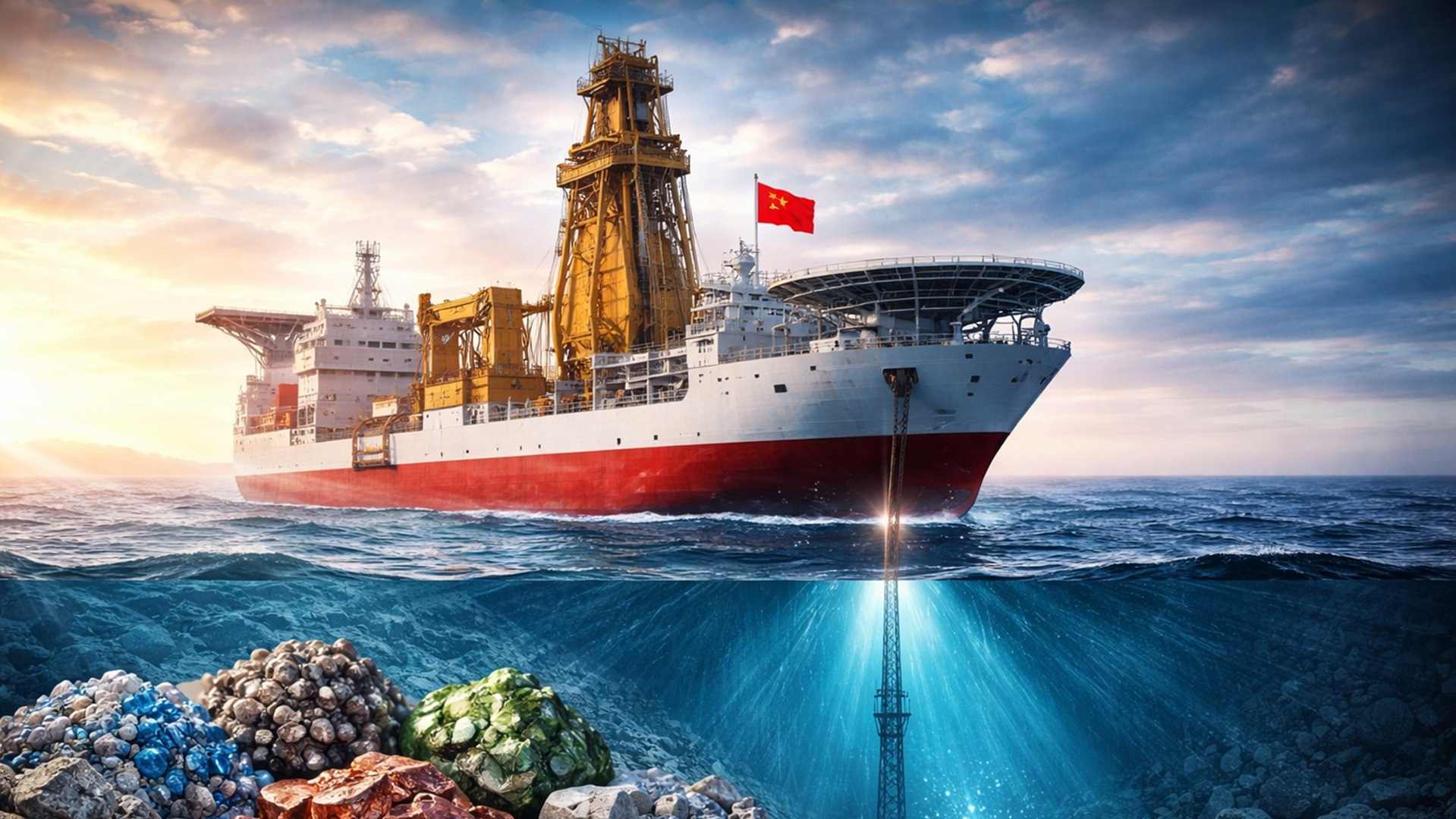


When Launching Its First Drilling Ship Capable of Operating at 10,000 Meters Deep in 2022, China Redirects Its Resource Acquisition Strategy, Prioritizing Deep-Sea Mining to Ensure Access to Critical Minerals and Occupy an Under-Regulated Space in the International Scenario
In 2022, China initiated a new strategic front by launching its first deep-sea drilling ship capable of operating at 10,000 meters deep, prioritizing deep-sea mining to obtain critical minerals and potentially gain an initial advantage in a sector that is still poorly regulated and contested.
Strategic Focus Shift from Space Exploration to the Seabed
The Chinese decision to direct resources to the ocean floor does not signify an abandonment of space exploration but a temporary reorientation of strategic priorities. While other nations continue to focus on the Moon and outer space, China seeks to explore a little-occupied gap.
The country bets that deep-sea mining may offer more immediate returns, concentrating efforts on resources located in the earth’s crust rather than beyond the atmosphere. This choice involves technical, environmental, and regulatory risks, but also the possibility of initial leadership.
-
With a cost per shot close to zero, the DragonFire laser could change naval warfare in 2027 and provide British ships with nearly unlimited defense against drones.

-
A British startup creates tires that generate electricity in electric vehicles when passing over potholes, speed bumps, and cracks.

-
Scientists have created robots made with living cells that have their own nervous system, swim on their own, explore the environment, and self-organize without any genetic engineering, and now they want to do the same with human cells.

-
Students create a solar-powered ambulance that operates without a plug, without fuel, and still keeps medical equipment running in remote areas.


By launching a ship capable of operating at 10,000 meters deep, China demonstrated technological capacity to access commercially unexplored regions of the ocean, paving the way for a new type of race for natural resources.
Critical Minerals Targeted on the Sea Floor
The Chinese project primarily aims at extracting globally high-demand minerals, including nickel, cobalt, lithium, copper, and zinc. These materials are considered essential for various contemporary industrial chains.
China already has a consolidated reputation in terrestrial mining and seeks to expand this position by transferring its expertise to the submarine environment. The initiative may reinforce its role as a strategic supplier of critical raw materials.
According to Chinese assessment, conventional mining on land faces increasing limitations, as many accessible deposits have already been explored over generations, reducing the availability of new economically viable resources.
Increasing Demand for Minerals in Modern Society
The global demand for critical minerals is directly related to the expansion of clean energy technologies. These materials are fundamental for wind, solar, and air generation systems, as well as other strategic industrial applications.
The production of electric vehicles also heavily relies on these minerals, intensifying competition for their control. China, which has been investing in this sector for years, sees deep-sea mining as a way to ensure a stable supply.
The leading Chinese electric vehicle company, BYD, competes directly with Tesla, reinforcing the need for continuous access to essential raw materials to maintain production and global competitiveness.
Regulatory and Environmental Challenges of Deep-Sea Mining
Despite the economic potential, deep-sea mining presents significant challenges. The International Seabed Authority has not yet established clear rules and regulations for mineral exploration in these environments.
The absence of a defined regulatory framework creates legal uncertainties and may hamper international coordination. At the same time, it allows pioneering countries like China to influence future normative structures.
There are also relevant environmental concerns, as seabed exploration may affect millions of marine species and cause impacts that are still not well understood on oceanic ecosystems. This risk generates tensions between economic and environmental objectives.
Possible Geopolitical and Industrial Impacts of the Project
If the Chinese submarine project is successfully executed, other countries may face challenges in achieving technological and strategic parity. China may establish operational standards and influence future practices in the sector.
The initiative goes beyond clean energy production, as it may open new industrial and geopolitical opportunities for the country. Initial dominance in deep-sea mining could translate into a lasting competitive advantage.
By choosing to explore the depths of the ocean, China assumes considerable risks but also bets on a path capable of redefining global access to strategic natural resources, altering the current balance of disputes over critical minerals.








Qualquer similaridade tecnológica com a Petrobrás é coincidência