





 Portuguese
  English
  Spanish
  5 min of reading
  0 comments


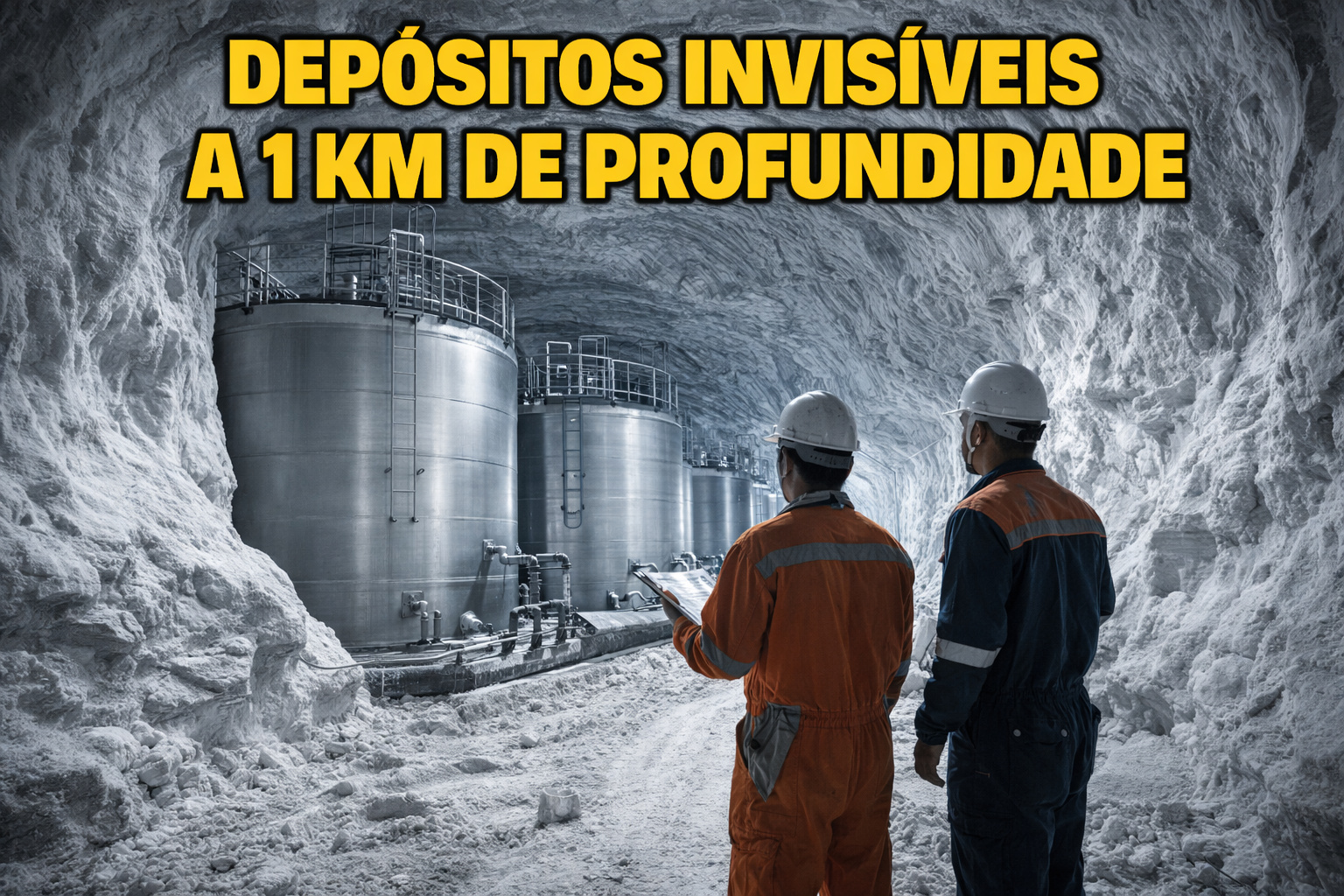
With Deep Salt Caverns Over 1,000 Meters and Subterranean Capacity of Millions of Cubic Meters, China Uses Geological Space to Store Gas and Petrochemicals Strategically and Invisibly
Since the mid-2010s, China has been implementing one of the largest and least known underground energy storage systems in the world: the use of deep salt caverns to store natural gas and petrochemical products, leveraging the huge availability of natural salt deposits and the need to ensure energy security and flexibility in fuel supply.
This model—which combines underground engineering with energy infrastructure—is a key element in China’s gas supply strategy and response to seasonal demand spikes, as well as paving the way for future applications in hydrogen and large-scale electricity storage.
What Are Salt Caverns and Why Are They of Interest to China
Salt caverns are underground spaces excavated in natural salt deposits (halite) that can be leveraged to store large volumes of gas, oil, or even energy in the form of compressed air. The geology of salt provides these spaces with a very efficient natural seal, reducing the risk of leaks and providing a compact and safe alternative to traditional surface storage methods.
-
He started running at 66 years old, broke records at 82, and is now a subject of study for having a metabolic age comparable to that of a 20-year-old, in a case that is intriguing scientists and inspiring the world.

-
Oldest tree on the planet reappears after 130 years of searches: Wattieza, 385 million years old, was 10 meters tall and had no leaves or seeds; Gilboa fossils in New York solved the mystery in 2007.
-
A 48-square-meter house assembled in hours with 4,000 bricks made of recycled plastic that does not absorb moisture, has natural thermal insulation, and costs less than 90,000 reais in a complete kit.

-
Luciano Hang revealed that Havan’s air fleet has already accumulated more than 20,000 landings, 10,000 flight hours, and 6 million kilometers traveled, and he says that without the planes, the company would never have grown so quickly.


China has extensive saline resources in various provinces, including Jiangsu, Hubei, Henan, and others, where salt deposits can be transformed into large-volume caverns through mining and mechanized excavation techniques. These underground spaces—often more than 1,000 meters deep—offer storage volumes that can reach tens of millions of cubic meters when aggregated in connected cavern networks and favorable geological pockets.
Pioneering Gas Storage in Salt Caverns in China
One of the most prominent projects of this type is in Jintan, Jiangsu province, operated by China Oil and Gas Pipeline Network Corp (PipeChina). In 2025, following a significant expansion, this underground natural gas storage facility came into operation with significantly increased capacities, boosting the region’s response to seasonal consumption variations and strengthening the energy supply security of the Yangtze River Delta.
According to reports from official Chinese media, the facility in Jintan saw its daily gas injection capacity increase by 60%, to 13.2 million cubic meters, while peak consumption withdrawal capacity tripled to 18 million cubic meters per day, and emergency response capacity reached 27 million cubic meters per day. These numbers illustrate the strategic importance of the infrastructure in keeping gas flowing, especially during the colder winter months when demand spikes.
History and Evolution of Chinese Underground Technology
The adoption of salt caverns for gas storage in China did not happen overnight. As reported in academic analyses and industry reports, the country had already built several underground natural gas storage facilities by the end of the 2010s, including caverns, oil reservoirs, and aquifer storage, with a total of dozens of facilities amounting to over 1 × 10⁹ m³ of workable gas capacity.
In addition to facilities exclusively for natural gas, innovative energy projects have also explored salt caverns for compressed air energy storage (CAES). One such project, installed in Yingcheng, Hubei province, was connected to the power grid and began commercial operations, using salt caverns around 500 meters deep to store energy in the form of compressed air and release electricity as demand required. This CAES plant was able to produce up to 300 MW of power with a storage capacity of 1,500 MWh, equivalent to the energy consumed by hundreds of thousands of homes during peak scenarios.
Engineering and Operation of Subterranean Salt Caverns
The salt caverns used for storage are not natural in their final form; they are created through controlled excavation and dissolution processes, utilizing the solubility of salt and its ability to form stable spaces when properly designed. The technique involves vertical drilling followed by lateral expansion at deep levels, reaching volumes that can range from hundreds of thousands to millions of cubic meters per chamber, depending on the geological formation. The natural sealing of salt is a technological advantage because:
- It Maintains Stable Pressures for Long Periods, which is crucial for storing gas under compression.
- It Reduces the Need for Complex Artificial Linings, as the salt rock itself serves as a highly resistant containment barrier.
- It Minimizes the Risk of Environmental Leaks, a critical concern in densely populated areas or near underground water reserves.
Additionally, the depth of the caverns (often over 1,000 meters below the surface) helps maintain the gas at ideal temperatures and pressures for rapid injection and extraction, which is crucial for operations that need to respond quickly to daily or seasonal demand fluctuations.
The Strategic Role of Underground Storage
For China, the use of deep salt caverns is not just about storing resources: it is part of an integrated energy security and market stability strategy. The country is the largest importer of natural gas in the world and faces significant challenges in balancing supply and demand across different regions, especially during seasonal consumption peaks. With infrastructures like that of Jintan and CAES facilities like that of Yingcheng, China is able to:
- Increase Emergency Response Capability and Response to Intense Climate Variability;
- Provide a Physical Reserve That Complements Stocks at Coastal Terminals;
- Reduce Price Volatility of Gas in the Domestic Market;
- Expand the Flexibility of the National Distribution Network.
These caverns function not only as passive warehouses but also as active parts of a complex energy management system that operates synchronously with pipelines, climate constraints, and industrial and residential demands.
Challenges and Future Prospects
Despite the advancements, the construction and operation of deep salt caverns still face technical and geological challenges. Structural stability over time, management of variable pressures, and ensuring operational safety require constant monitoring. Recent academic studies highlight that variability in salt formations can affect the final geometry of the caverns, necessitating advanced geotechnical engineering and continuous monitoring to avoid unwanted deformations.
Furthermore, technological interest is expanding to the use of these caverns not only for natural gas but also for hydrogen and large-scale renewable energy storage, which could transform salt caverns into central elements of future energy infrastructure.







-

-

-

-

-

-

48 pessoas reagiram a isso.