





 Portuguese
  English
  Spanish
  4 min of reading
  8 comments


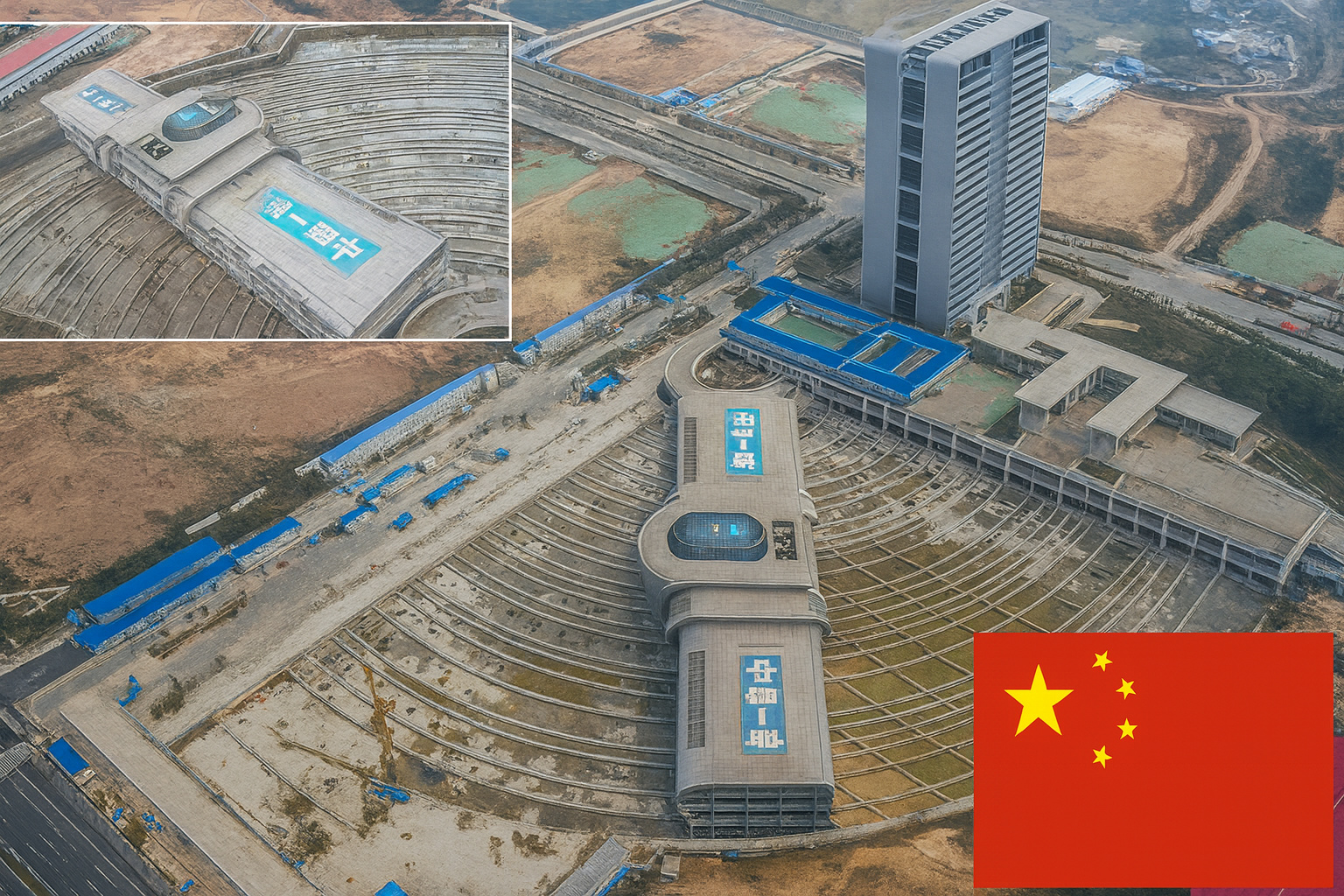


With 532 Hydraulic Jacks and Millimeter Precision, Chinese Engineers Rotated a Bus Terminal in Xiamen by 90°. The Feat Entered the Guinness World Records.
In the city of Xiamen, Fujian province, China, engineers carried out an operation that challenged the limits of modern engineering: moving a 30,000-ton bus terminal in just 40 days. The colossal building, equivalent to the weight of 170 Boeing 737 airplanes, was relocated and rotated by 90° to make room for the expansion of the high-speed rail line that crosses the region.
The project not only avoided the demolition of the terminal, built in 2015, but also saved millions of dollars. Additionally, it earned China unprecedented recognition: the Guinness World Records recorded the feat as the largest rotation ever performed on a building of this size.
How to Move a Concrete Giant
The operation mobilized 532 hydraulic jacks, mounted on specially constructed rolling rails to support the weight. All equipment was controlled by computer, in a system that synchronized each movement with precision of up to 2 millimeters.
-
Friends have been building a small “town” for 30 years to grow old together, with compact houses, a common area, nature surrounding it, and a collective life project designed for friendship, coexistence, and simplicity.

-
This small town in Germany created its own currency 24 years ago, today it circulates millions per year, is accepted in over 300 stores, and the German government allowed all of this to happen under one condition.

-
Curitiba is shrinking and is expected to lose 97,000 residents by 2050, while inland cities in Paraná such as Sarandi, Araucária, and Toledo are experiencing accelerated growth that is changing the entire state’s map.

-
Tourists were poisoned on Everest in a million-dollar fraud scheme involving helicopters that diverted over $19 million and shocked international authorities.


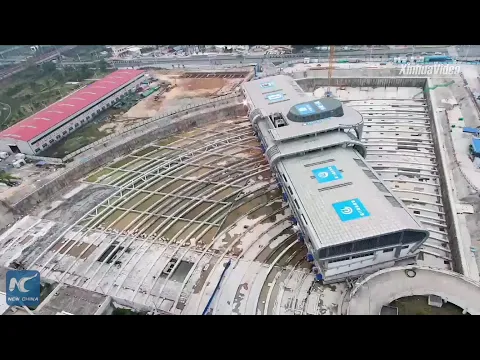

The terminal moved slowly, advancing about 7 to 8 meters per day. After just over a month, it had covered 288 meters, completing the necessary 90° rotation to clear the area for the future rail alignment.
According to the engineers in charge, the biggest challenge was not only the weight but the need to maintain the structural integrity of the building throughout the process. Any mistake could cause irreparable cracks or even the collapse of the structure.
Billion-Dollar Savings
The bus terminal, inaugurated in 2015, had cost approximately US$ 39 million. Demolition and reconstruction at a new location would have been even more expensive and would take years.
In contrast, the relocation operation cost about US$ 7.5 million, less than one-fifth of the amount needed for reconstruction. Besides being cheaper, the process was fast and sustainable, as it avoided tons of debris from a potential demolition.
This cost-benefit equation shows why China opts for bold solutions: engineering is seen as a strategic tool for maintaining the fast pace of urbanization and modernization.
The Guinness World Records Confirms
The grandeur of the operation secured international recognition. The Guinness World Records validated the feat as the largest rotation of a building of this size ever accomplished.
The certification took into account not only the weight of the building but also the complexity of the operation, the distance traveled, and the curvature radius. It’s a milestone that reinforces China’s position as a global leader in urban engineering megaprojects.
Why Move Instead of Demolish?
The decision to move the terminal instead of demolishing it reflects a philosophy that has been gaining traction in China: building without halting urban development.
High-speed rail projects are expanding in several cities, but instead of tearing down entire buildings, engineers are seeking creative solutions to repurpose existing structures.
This approach combines:
- Economic efficiency, with much lower costs;
- Environmental efficiency, avoiding waste of materials;
- Social efficiency, reducing interruption time in transportation services.
China and the Engineering of the Impossible
In recent years, China has established itself as a stage for megaprojects that impress the world. From the largest marine bridge on the planet (Hong Kong-Zhuhai-Macau) to skyscrapers constructed in record time, the country has accumulated examples of highly complex engineering.
The Xiamen case adds to this list, demonstrating that for China, no urban obstacle is definitive. The motto seems to be: if the construction doesn’t fit in the plan, just move whatever is in the way.
The Legacy of the Project
More than a record, the rotation of the Houxi Long Distance Bus Station left valuable lessons:
- Integration of technology and planning: computerized systems were crucial to ensure safety;
- Valuation of public investment: preserving the existing structure saved millions;
- Example of innovation: the project inspired engineers in other countries to think beyond traditional solutions.
Moving a 30,000-ton building in just 40 days may sound like science fiction, but in China, it has become a reality. With advanced technology, millimeter precision, and impeccable planning, the engineers of Xiamen showed that even entire buildings can be moved when progress demands it.
More than a curiosity, the feat symbolizes China’s ability to turn the impossible into routine, ensuring development without losing time — while also setting world records along the way.










O mais importante não falaram como fizeram para levantar?
Discurso de bozonarist@ vira lata de americano
Não é discurso de **** não, isso é a falta de conhecimento dos fizeram o L e não tem conhecimento de geopolítica e história, simples assim.
Chora pelo seu mitow hahaha
Deu pra ver+ de 500 macacos hidráulico e um computador fazendo o trabalho escravo ,essa história de escravidão na China é coisa que americano espalhou evc acreditou,dá um olhada no YouTube e veja quantos vídeos tem sobre o crescimento da China, inclusive canais de brasileiros que moram lá.