





 Portuguese
  English
  Spanish
  5 min of reading
  4 comments


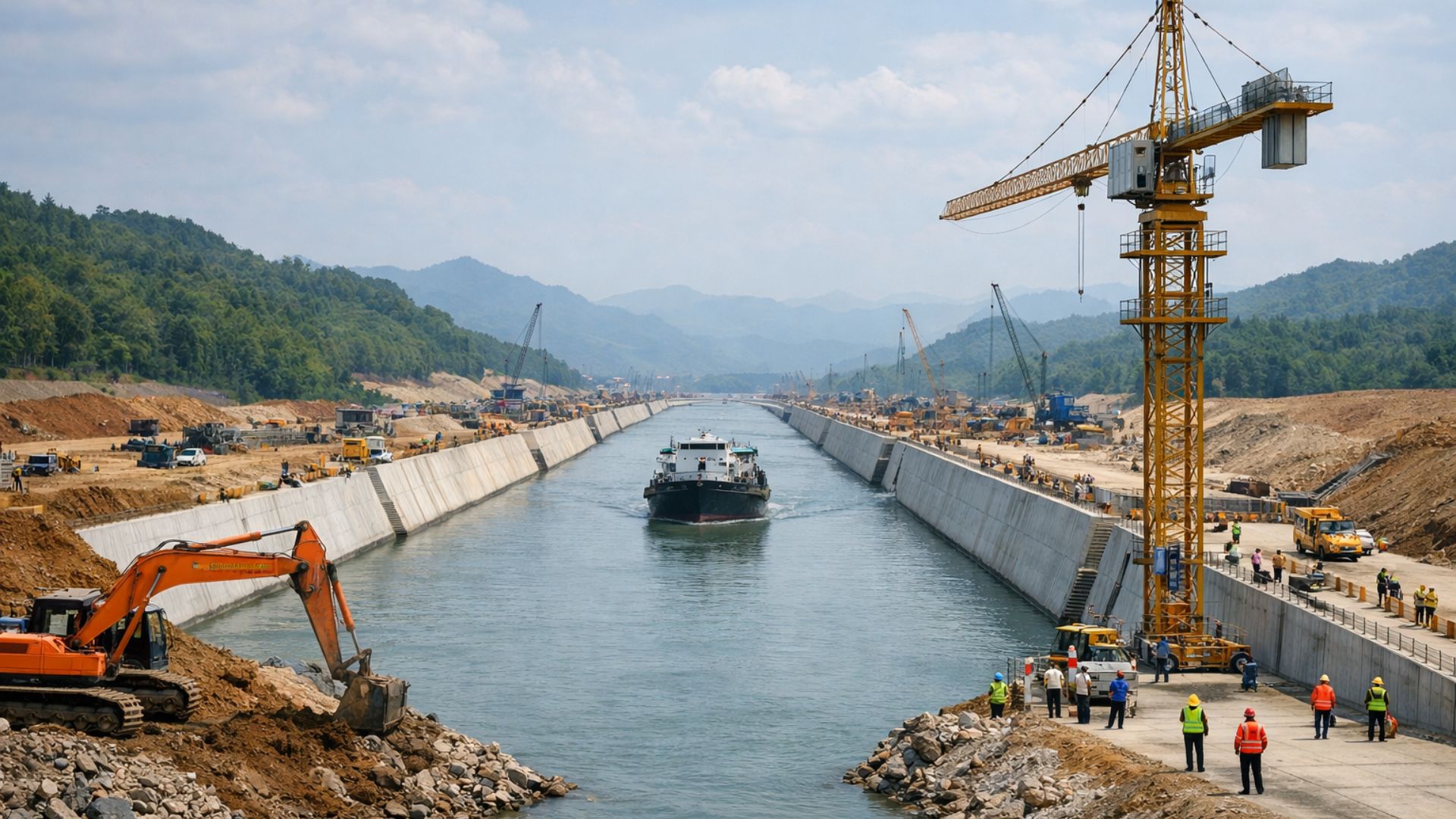


Billion-Dollar Investment in Water Infrastructure Redesigns Logistics in Southern China, Strengthens Trade Integration with Southeast Asia, and Puts New 3,200-Km River Corridor at the Center of National Economic Planning Expected for the 2026-2030 Cycle.
China is considering investing around US$ 32 billion in a set of channels to form a river corridor of approximately 3,200 km, linking inland areas to the south of the country and, by logistical extension, to trade routes associated with Southeast Asia.
The proposal comes at a time of strong economic integration with the region: recent data and reports indicate that Asean remained China’s top trading partner in 2025, with cumulative bilateral trade already close to US$ 1 trillion in partial period measures.
River Corridor Expands Access to the Sea and Reduces Logistics Costs
The core of the plan is the idea of transforming waterways into a hub for drainage and supply, reducing transport costs and travel time for loads that currently rely more on highways, railways, and indirect maritime routes in southern China.
-
The government requests the Federal Revenue Service for a new system to automate the income tax declaration, reducing errors, time, and bureaucracy for millions of Brazilians.

-
Pix in installments, international Pix, and contactless payment without internet: the Central Bank revealed the new features coming to the tool that is already used by almost every adult in Brazil.

-
Mercado Livre has just started selling medications with delivery in up to three hours to your door, and this move could completely change the way Brazilians buy medicines on a daily basis.

-
In Dubai, rising tensions from the war in the Middle East are causing super-rich individuals to leave the Gulf and direct their fortunes to a new financial refuge in Asia.



Instead of a single route, the proposed design involves two distinct projects, with different maturity levels but connected by a common narrative: expanding navigable areas along the north-south axis and linking interior provinces to ports and industrial hubs.
This strategy is supported by Guangxi’s role as a geographical bridge to Southeast Asia because the region borders Vietnam and has access to the Beibu Gulf, an area that concentrates relevant coastal terminals for logistics in southern China.
Pinglu Canal Advances and Is Expected to Operate by 2026
The first project is the Pinglu Canal, estimated at 72.7 billion yuan, an amount frequently converted to about US$ 10.4 billion, and presented as the most advanced component of this water infrastructure package.
According to project descriptions, the canal is expected to connect the Beibu Gulf to the city of Nanning, the capital of the Guangxi autonomous region, creating an inland navigation route capable of bringing production chains closer to access to the sea.
The announced route for the Pinglu spans 134 km and has been designed to accommodate vessels of up to 5,000 tons, figures used by sources comparing its reach to large international canals and traditional logistics routes.

Recent reports also place the inauguration before the end of 2026, although different public communications and coverage have varied when addressing the timeline, which keeps the construction under the oversight of the transport sector and the market.
Xianggui Canal Depends on Approval in the Five-Year Plan
The second project, called the Xianggui Canal, is described as more complex and, so far, without definitive confirmation of execution, despite studies and debates on the viability of its construction and the effects on regional navigation.
The proposal mentioned for the Xianggui involves a connection of about 300 km between the Li and Xiang rivers, which would enhance waterway connectivity and help stitch together navigable sections in a longer corridor.
The estimated cost reported in recent coverage reaches 150 billion yuan, approximately US$ 21.6 billion, a figure that appears as the main factor of hesitation for the central government when assessing the relationship between investment and logistical return.
Even without a final decision, the discussion has gained momentum with the advancement of the Pinglu, as the delivery of a large canal in the south can serve as a practical reference for advocates of the Xianggui, especially among provinces that expect competitive gains.
Interior Pressures for Priority in National Planning

The logic presented by stakeholders in the project focuses on the impact for inland areas seeking to reduce transport bottlenecks, connecting production centers to export and import routes with less dependence on congested land infrastructure.
In this context, the idea of a corridor of about 3,200 km is associated with a network that would cross several provinces, articulating existing and new navigable sections, and bringing industrial and agricultural hubs closer to strategic port regions.
Although the initiative is presented as domestic integration, the commercial backdrop with Southeast Asia weighs in the debate, as Asean appears in recent data as the main destination and source of significant flows amid the reconfiguration of global supply chains.
At the same time, authorities and analysts have been highlighting that China is entering the preparation cycle for the 15th Five-Year Plan (2026-2030), a stage that usually organizes priorities and defines which projects receive national approval, financing, and political coordination.
Plan 2026-2030 Could Define the Fate of the Megaproject
The expectation reported by sources monitoring state planning is that the plan for 2026-2030 will be formally approved in early 2026, during the national legislative process, after months of recommendations and internal debates.

Therefore, the inclusion of the Xianggui in this package is treated as a watershed, as projects listed in five-year plans tend to gain clearer execution mechanisms, while proposals outside the scope may remain in the realms of studies.
In addition to the infrastructure component, the debate occurs against a backdrop of international trade that has shown robust numbers, with China registering high surpluses and reorganizing export destinations, a context that reinforces the search for efficient routes.
Still, the viability of the Xianggui remains conditioned to cost, engineering, and political priority, and the fact that the Pinglu is closer to operation does not eliminate the need for a formal decision regarding the second canal and the final design of the waterway.
With advanced construction on one side and a billion-dollar project still under evaluation on the other, the canal plan highlights the competition for infrastructure investment in China: which corridors enter the list of national priorities and which are left for later?








It’s not even necessary unlike Panama. Just pure greed.
Seems silly if DRONE CONTAINERS will soon be.
I have no good or bad comments. China wins !!!.