





 Portuguese
  English
  Spanish
 4 min of reading
  4 comments




Chinese Automaker Accelerates Industrialization in Brazil, Expands Jobs, Invests in Hybrid Technology, and Consolidates the Country as a Strategic Hub for New Sustainable Mobility
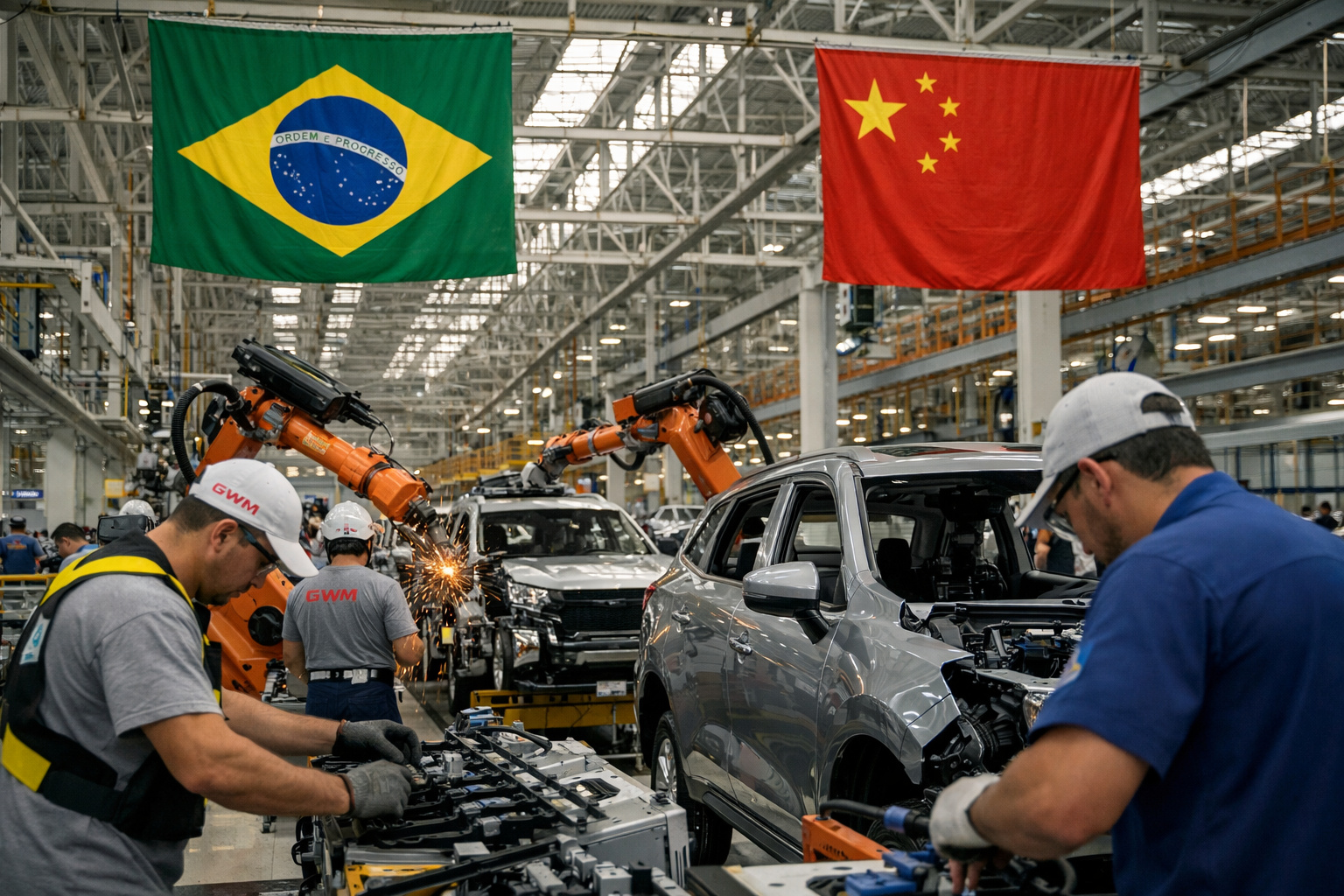
The factory of Chinese GWM in São Paulo begins production with a plan for 60% localization, marking a new chapter in the Brazilian automotive industry. The Great Wall Motors (GWM) officially inaugurated its industrial unit in Iracemápolis, in the interior of São Paulo, focusing on hybrid vehicles, local production, and expanding the national production chain.
In addition, the industrial complex reinforces the company’s strategy to transform Brazil into a regional hub for Latin America. The plant, acquired from Mercedes-Benz in 2021, already employs around 400 workers and has installed capacity to produce up to 50,000 vehicles per year, with potential for gradual expansion in the coming years.
The information was disclosed by specialized automotive sector vehicles and confirmed by GWM, which detailed ambitious goals for localization, job creation, and technological advancement in the country.
-
With 74% of companies facing difficulties in hiring, technicians and engineers in renewable energy are becoming scarce in Brazil and are essential to support the expansion of solar, wind, and green hydrogen projects.

-
Historic bankruptcy of Centauro shocks the market, and the century-old company puts more than 500,000 products, machines, and complete infrastructure up for online auction.

-
New shoe factory in Ceará is expected to create 400 jobs and strengthen the local economy.

-
No one imagined it, but a mixture of sawdust with a mineral that fights fires surprises scientists with a result that changes the course of fire-resistant construction.


Production Begins with Hybrids and Targets Accelerated Expansion of Installed Capacity
Initially, the factory’s annual production is expected to range between 20,000 and 30,000 vehicles, a number that could reach 50,000 units within three years. In the medium term, the automaker projects to achieve 100,000 vehicles per year, keeping pace with the growth in demand for electrified models in Brazil.
The first locally manufactured vehicle will be the Haval H6 hybrid SUV, available in the HEV2, PHEV19, PHEV34, and GT versions. Additionally, the company confirmed that a flex version of the model is planned for 2026, reinforcing its adaptation to the characteristics of the Brazilian market.
Still in 2025, the plant is expected to begin production of the Haval H9, a premium seven-seater SUV powered by diesel, and the Poer P30 medium pickup, also with diesel engine. This way, GWM expands its national portfolio and begins to compete in strategic market segments.
Meanwhile, the factory is already integrated into the federal program MoVer, which encourages green mobility and the production of vehicles with lower environmental impact.
60% Localization Boosts Suppliers, Jobs, and Local Technology


Since the beginning of operations, GWM has been working with parts imported from China. However, the automaker has set a goal to achieve 60% localization of parts within three years, strengthening the local industry and reducing external dependence.
Even in this initial phase, items such as tires, glass, wheels, seats, wiring harnesses, and painting are starting to be produced in Brazil. Additionally, the company is evaluating the adoption of two shifts of production starting in 2026, which should further accelerate the unit’s production capacity.
As a result, the expectation is to generate between 800 and 1,000 direct jobs by the end of 2025, along with thousands of indirect positions throughout the supply chain.
At the same time, GWM announced the creation of a Engineering and Research & Development (R&D) Center in Brazil. The company also plans to launch the GWM Foundation, focused on technological development, professional training, and social actions.
Chinese Automakers Lead Electrified Vehicles and Expand Presence in Brazil
The advancement of GWM comes at a time of strong growth for Chinese automakers in Brazil. According to data from Fenabrave, between January and July 2025, sales of hybrid and electric vehicles grew 46.83% compared to the same period in 2024, while the total market grew only 4.1%.
Moreover, numbers from the Brazilian Electric Vehicles Association (ABVE) show that 63.5% of the 139.2 thousand electrified vehicles sold in the period belong to Chinese brands. BYD leads with 28.10% of the hybrid market and 76.78% of the electric market.
Meanwhile, in addition to GWM’s factory in São Paulo, BYD has partially inaugurated its industrial complex in Camaçari (BA). Other Chinese brands, such as GAC Motors, are also looking to produce locally and develop vehicles powered by ethanol, further increasing sector competitiveness.
GWM Accelerates Sales and Expands Dealer Network in the Country
In the first half of 2025, GWM Brazil registered 15,261 vehicles, a growth of 19.9% compared to the same period in 2024. During the same period, the total light vehicle market only grew 3%, highlighting a performance seven times above the industry average.
The Haval H6 was the best-selling hybrid SUV in Brazil, with 12,675 units sold in the semester. The Tank 300, an off-road model launched in April, recorded 1,218 sales in the period.
Currently, GWM has 104 dealerships in over 50 cities and aims to reach 130 units by December 2025. Furthermore, the GWM Delivery system ensures coverage in 100% of the 5,570 municipalities in Brazil, expanding the brand’s reach.
According to Diego Fernandes, COO of GWM Brazil, this performance reflects a clear strategy. “The growth of GWM is a direct result of the focus on technology, innovation, and customer experience,” he stated.
Do you believe that the expansion of Chinese automakers can transform Brazil into a global hub for hybrid and electric vehicles?








Não entendi essa bandeira chinesa aí. Tem milhares de empresas estrangeiras no Brasil e nem por isso colocam a bandeira de seus países. Isso é colonialismo e ao regime comunista opressor.
Essa bandeira não representa a China, a bandeira verdadeira as 4 estrelinhas não estão no mesmo sentido da estrela maior, e sim com suas pontas voltadas para o centro da maior. Esse é o mesmo erro que a organização das Olimpiadas de 2016 cometeram.
Será que o preço vai baixar?
Receio isso o que fizeram em jacarei quem comprou tigo 1e 3dancaran **** os caras largaram a fábrica e pararam isso e o começo nao tem postura chinês eles sao **** amigos e dane se vc então nao acredito neles