





 Portuguese
  English
  Spanish
  3 min of reading
  0 comments


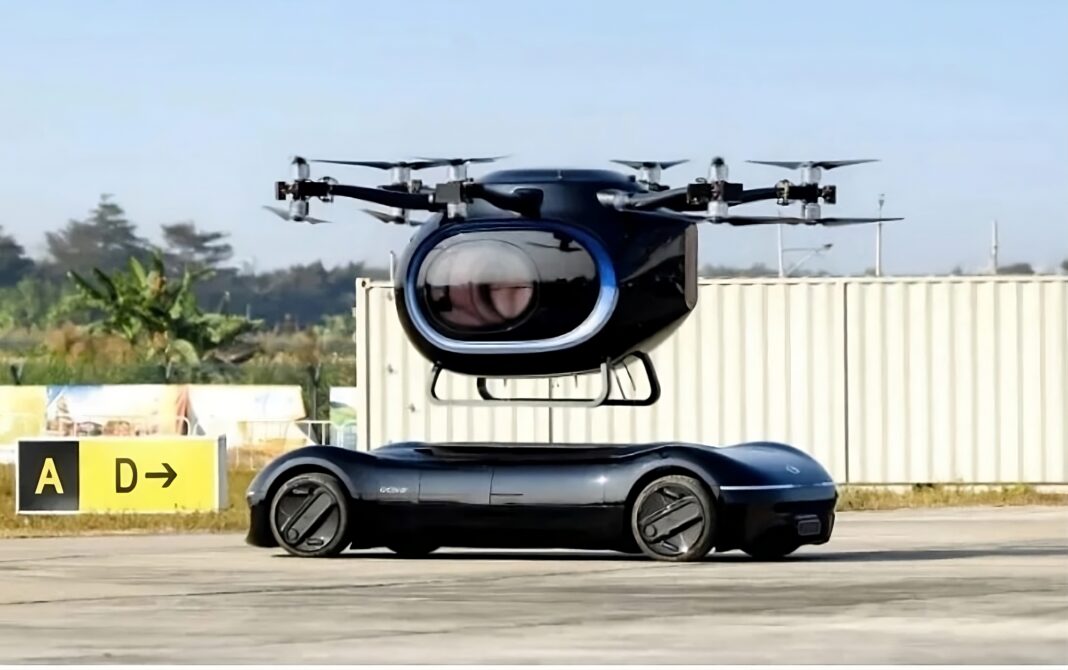
Chinese Company Impressed the Public by Demonstrating a Revolutionary Flying Car That Could Change the Future of Transportation
Imagine a future where flying cars are no longer a concept from science fiction, but a reality that can transform the way we move around cities. At the 15th China International Aviation and Aerospace Exhibition, held on November 12, the manufacturer GAC took an important step in this direction by unveiling its flying car, the GOVE.
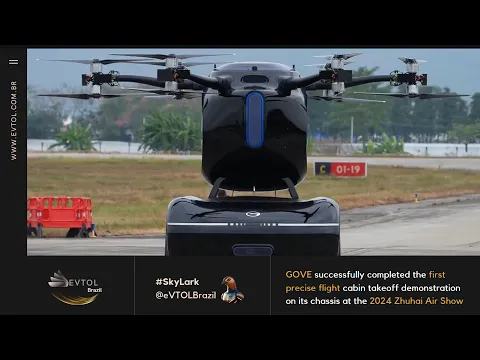
In addition to the presentation, the company announced the operation of the GOVE’s flight cabin, which detaches from the chassis to glide and fly.
This flying car had already demonstrated its capabilities at previous events. In March, it flew over the Central Business District of Guangzhou in a low-altitude urban environment.
-
A French brand placed a car on four huge red balloons to prove that its suspension made the vehicle “float,” and the surreal scene became one of the most iconic and unusual images in automotive history.

-
Jeep Avenger begins production in Brazil, debuting as the brand’s new entry-level SUV and inaugurating an unprecedented phase by becoming the first national Jeep manufactured outside of Goiana, as part of a R$ 3 billion plan.

-
Costing R$ 12,490, the new Shineray Urban Lite 150 “cheap one” arrives in Brazil with a CVT transmission, digital dashboard, and LED lights, making it more affordable than the Biz and targeting those who want to abandon the bus.
-
Ducati brings to Brazil the Superleggera V4 Centenario: 228 hp that become 247 with a track kit, carbon fiber and carbon-ceramic brakes, estimated price between R$ 1.5 and 2 million, deliveries only in 2027.


And in September, GAC obtained special certification from the Civil Aviation Administration of Central and Southern China, allowing low-altitude flights, a milestone that places the GOVE ahead in safety and regulation.
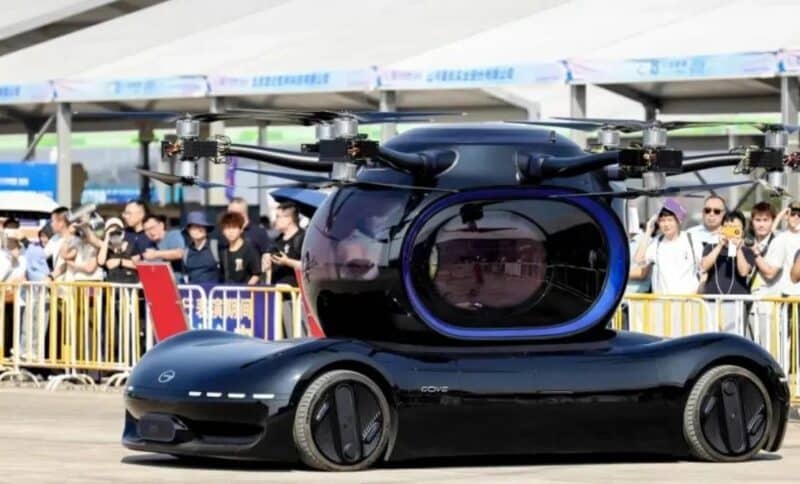
Innovative and Multifunctional Design of the GOVE
The GOVE is an electric eVTOL (electric Vertical Take-Off and Landing) vehicle that adopts an innovative decoupling system, in which the flight cabin separates from the chassis to perform three functions: ground driving, flying, and air-ground docking. This design, according to GAC, was inspired by the concept of “halo” – representing the light of the future and symbolizing the endless possibilities of a new era of mobility.
The chassis of the GOVE is not just a base for the cabin; it functions as a mobile charging station. After flight, the cabin reconnects to the chassis, which automatically finds a nearby charging station and recharges the cabin’s battery for the next use. This feature is innovative and essential to ensure that the car is always ready for a new takeoff.
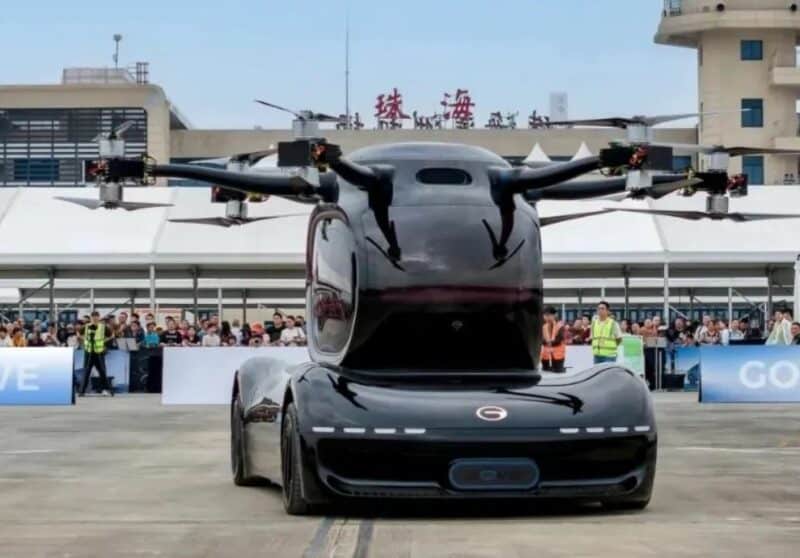
High-Performance Flight Cabin
The GOVE’s cabin is equipped with a 6-axis configuration and 12 propellers, enabling high lift and stability during flight. The power is distributed so that each axis supports more than one-third of the maximum takeoff weight, which enhances safety and provides a smooth flight.
To make the GOVE viable for the general public, GAC is working to meet specific safety standards for civil aviation and has already conducted more than 400 flight checks. The company also plans to launch pilot operations of flying cars in two or three cities in the Greater Bay Area of Guangdong-Hong Kong-Macau by 2027.

The urban air mobility market in China has immense potential, with a growth estimate of 1.5 trillion yuan by 2025, potentially reaching 3.5 trillion by 2035. Automakers like Xpeng, Chery, and Geely are entering this market, seeking alternatives to the congested traffic of large cities.
The GOVE presents a fascinating vision of a future where traveling through the sky will be as common as driving on the streets. For those living in bustling urban centers, the GOVE promises increased speed and a revolutionary travel experience. It’s another step towards a tomorrow where mobility is not limited to the ground.










Seja o primeiro a reagir!