





 Portuguese
  English
  Spanish
  4 min of reading
  0 comments


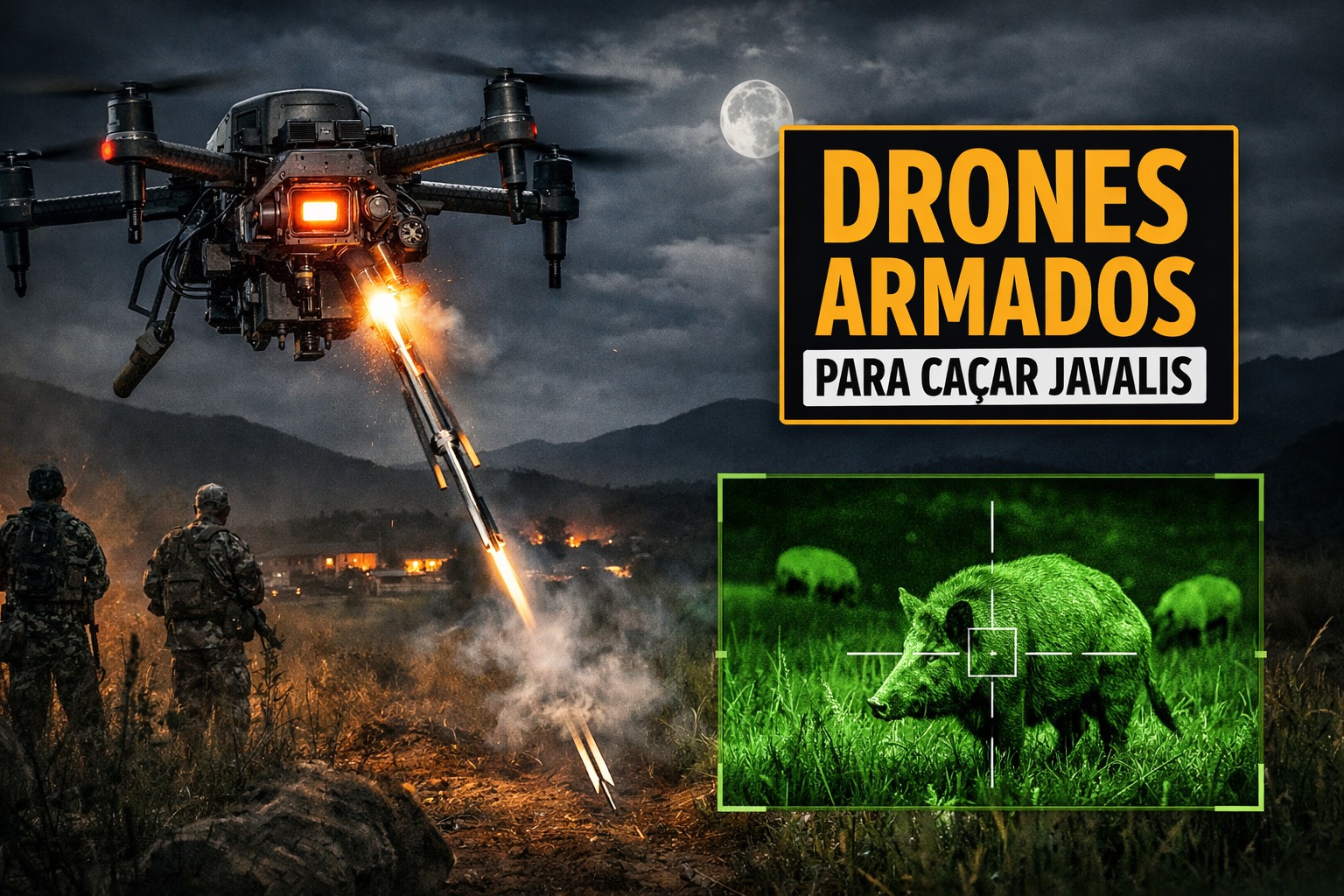
The Legalization of Hunting in 2023 Boosted Armed Drones in China, Creating a Legal Gray Area That Intensified Rural Conflicts, Environmental Crimes, Public Safety Risks, and Increasing Pressure for Specific Regulations
Modified drones for hunting wild boars began to operate in a legal gray area in China, following the legalization of hunting in 2023, escalating rural conflicts, environmental crimes, and putting pressure on authorities for stricter rules.
Expansion of Use After Regulatory Change
The legalization of wild boar hunting in 2023 aimed to protect rural crops after successive agricultural losses and accidents involving animals that began to invade urban areas.
With this decision, drones equipped with thermal cameras and metal projectiles emerged as an efficient tool for locating and targeting wild boars at night.
-
While the world looks at oil, the war with Iran is already disrupting helium supply from Qatar, affecting car and iPhone chips, threatening AI expansion, and putting pressure on aluminum packaging at the highest value in four years.

-
Global warming will expose a treasure hidden under the ice of Antarctica and may spark an international dispute over gold and valuable minerals.

-
A street vendor from Praia Grande built a robot made of scrap from scooters and washing machines that pulls his popcorn cart on the beach, emits sounds, and interacts with customers, becoming an attraction on the coast of São Paulo.

-
The specifications of the Xiaomi 18 Pro Max have been leaked, and the highlight is a dual 200 MP camera with a new 22-nanometer technology that promises to consume less energy and capture details in shadows and bright areas using LOFIC HDR.


Initially, the technology was restricted to hunting teams approved and supervised by the government, aimed at reducing conflicts between humans and wild boars in affected regions.
In recent years, 26 provincial-level regions reported injuries caused by wild boars, including episodes where the animals roamed city streets.
Local governments spent millions of yuan compensating farmers for crop losses, reinforcing the pressure for quick and effective solutions.
History of Population Control
China banned wild boar hunting for the first time in 2000, considering that the species had significant beneficial, economic, or scientific value.
Despite the protection, the population grew rapidly and became out of control, increasing agricultural damage and conflicts with rural communities.
In 2023, the central government removed the wild boar from the list of protected species, officially reopening the possibility for controlled hunting.
In February 2024, more than 100 hunting teams were sent across the country to manage the population growth.
In Shaanxi province, forest authorities invited drone pilots to hunt 200 wild boars between May and October this year.
A reward of 1,500 yuan per carcass was offered, an amount equivalent to US$ 210, according to local authorities.
Technical Characteristics of Hunting Drones
Hunting drones cost approximately 40,000 yuan and are equipped with thermal imaging systems for nighttime operations.
Many devices are modified to carry metal arrows about 60 centimeters long, launched vertically at the target.
After locking onto the target, the arrows can hit it from a height of up to 40 meters, even in low visibility conditions.
Authorities reported that the method causes less damage to crops than traditional hunting with dogs.
Abuses and Associated Crimes
Since late 2024, cases of misuse of drones have emerged in various regions of China.
The incidents include attacks on protected wildlife and also on livestock belonging to local farmers.
In October, an individual was hunting wild boars when, amid heavy nighttime fog, he accidentally killed a horse.
The responsible party compensated the animal’s owner after a judicial agreement was reached between the parties.
In another case, two individuals shot and stole free-range goats, being detained on charges of theft.
In many cases, proceedings stall because the drone operators cannot be identified.
Cases Involving Protected Species
In the central province of Hunan, in September of this year, metal arrows were found being used to hunt muntjac deer, a protected species.
In the same state, in November, police discovered that three criminals used net-launching drones.
They captured 31 protected animals, including common kestrels, herons, and Chinese hares, according to the investigation.
The cases raised concerns about the ease of adapting the technology for illegal activities.
Influence of Social Media on Drone Hunting
The popularization of drone hunting was driven by the circulation of videos on social media, especially on Douyin.
The technique gained rapid visibility, encouraging unauthorized users to replicate the method.
A survey by Sixth Tone showed that aerial launching devices for drones cost only 100 yuan on platforms like Taobao.
Metal arrow tips and shafts are sold for prices ranging from 10 to 100 yuan, increasing access.
In October, a suspect arrested in Jiangxi stated he had been inspired by short videos before modifying his drone.
Public Safety Risks
A member of an official hunting team alerted local media about the risks posed by these modified devices.
According to him, if they target wild boars today, they could easily injure a person tomorrow, due to the precision of the equipment.
The statement highlighted concerns about serious accidents and criminal use in populated areas.
Legal Gaps and Legal Debates
Legal experts have begun pressuring regulators for clearer intervention regarding the use of these devices.
The Criminal Code of China stipulates that hunting can be deemed illegal when using prohibited tools or methods.
The Wildlife Protection Law, last revised in 2022, only lists traditional weapons as prohibited.
Drones and arrow tips are not explicitly mentioned, creating a significant regulatory gap.
So far, only Liuyang, in Hunan, has explicitly banned drone-launching darts or arrows.
Proposals for Drone Hunting Regulation
Han Xiao, a lawyer at the Kangda law firm, told Beijing News that it is difficult to impose a general ban on drone modifications.
According to him, adaptations also serve legitimate uses, such as agriculture and mapping, making objective definition challenging.
The legal challenge lies in delineating what constitutes modification for illegal activity and establishing clear penalties.
Han suggested that all drones should have tamper-proof flight data recorders, allowing for tracking illegal incidents.
The proposal aims to facilitate the identification of responsible parties and provide evidence after occurrences involving illegal hunting or theft.
With information from Sixthtone.









-

-

-

-

20 pessoas reagiram a isso.