





 Portuguese
  English
  Spanish
  5 min of reading
  0 comments


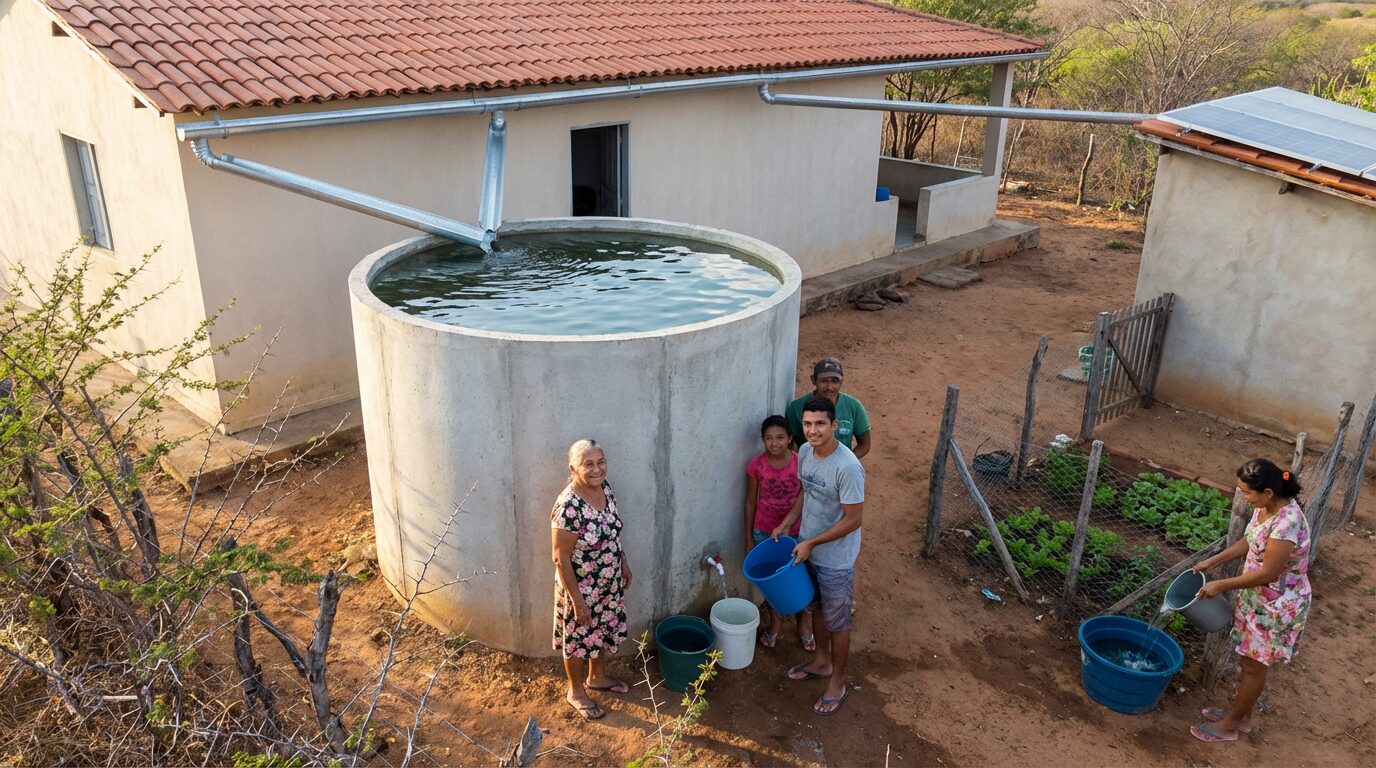
Cisterns Spread Across The Semi-Arid Secure Rainwater Near Home And Change The Local Economy
Network Of Organizations And Public Policies Boost Living With Drought And Reduce Dependence On Benefits
The expansion of plate cisterns in the Brazilian Semi-Arid has consolidated a historic turnaround against thirst and water insecurity. Led by civil society organizations, with subsequent support from the Lula and Dilma governments, the social technology came off the drawing board and achieved regional scale. According to the Ministry of Development and Social Assistance, Family, and Fight Against Hunger (MDS), by 2024, 1,111,695 drinking cisterns and 215,570 water storage technologies for production and livestock watering had already been installed.
The impact was broad, with reports of a significant decrease in diseases and greater autonomy in communities. In two decades, infant mortality dropped from 140 to 16 per thousand live births, a result associated with access to safe water and improved sanitary conditions. Families also left behind the exhausting routine of fetching water far from home, a task that fell primarily on rural women.
The economic and social transformation reorganized the landscape of opportunities. Areas that were previously stigmatized as unviable became attractive to wind and solar companies, irrigation projects, and mining companies seeking rare earths and strategic minerals. However, this progress comes with regulatory and social participation challenges to ensure that the benefits do not become concentrated.
-
Friends have been building a small “town” for 30 years to grow old together, with compact houses, a common area, nature surrounding it, and a collective life project designed for friendship, coexistence, and simplicity.

-
This small town in Germany created its own currency 24 years ago, today it circulates millions per year, is accepted in over 300 stores, and the German government allowed all of this to happen under one condition.

-
Curitiba is shrinking and is expected to lose 97,000 residents by 2050, while inland cities in Paraná such as Sarandi, Araucária, and Toledo are experiencing accelerated growth that is changing the entire state’s map.

-
Tourists were poisoned on Everest in a million-dollar fraud scheme involving helicopters that diverted over $19 million and shocked international authorities.

One statistic summarizes the shift in family income and production. According to the Valor Econômico newspaper, based on an academic study published by the outlet, 30% of Bolsa Família beneficiaries renounced the benefit after receiving drinking and producing cisterns, as they were now able to produce food and better sustain their households.
How Living With The Semi-Arid Replaced The Old Fight Against Drought

The strategy of Living With The Semi-Arid surpassed the old paradigm of emergency works and water trucks. The focus shifted to collecting and storing rainwater in simple, durable, and community-managed structures, with contextualized education, local communication, and intelligent management of the Caatinga. This technical and social package valued popular knowledge and applied science.
More than 3,000 entities and a multitude of agricultural technicians monitored each project, weaving a decentralized network of implementation and maintenance. Organizations like ASA Brazil coordinate training, mobilization, and governance, while large-scale public policies have driven diffusion, albeit with tensions with the traditional “fight against drought” model.
Numbers That Explain The Social And Productive Leap With Rainwater Collection
The official data from MDS, in 2024, confirm the scale of the process, with 1,111,695 cisterns for drinking water and 215,570 technologies aimed at production and livestock. These decentralized reservoirs function as a domestic water insurance, ensuring continuous use even during dry periods.
The immediate result is a reduction in costs and time spent obtaining water, freeing hours for work and study. In practice, access to water enables vegetable gardens, raising small animals, and food processing, which increases income and broadens family food diversity.
In the public health arena, communities report fewer diarrhea cases and diseases related to contaminated water. The decrease in infant mortality, from 140 to 16 per thousand over twenty years, illustrates how simple infrastructure suited to the territory can generate lasting effects.
In the local labor market, family production gains momentum, stimulating fairs and short marketing circuits. This movement helps reduce dependence on permanent assistance and explains why, according to Valor Econômico, three in ten beneficiaries decided to give up Bolsa Família after the arrival of the cisterns.
Beyond the direct economic effect, the cistern policy strengthens climate resilience, anticipating extreme events. Instead of waiting for rain, the community takes advantage of every millimeter of precipitation to store and use it efficiently.
Impacts On Health, Migration, And The Work Of Women
With water close to home, the daily physical effort and risks involved in transporting it over long distances decrease. Women, historically burdened with this task, regain time for education, political participation, and income generation.
Regular access also helps stabilize family permanence in rural areas, reducing seasonal migrations and exposure to precarious jobs. Water security creates conditions for planning production and investing in improvements.
In health, better quality water reduces infections and hospitalizations, easing the public system. With less pressure on emergency services during droughts, local governments can plan better and expand preventive actions.
Challenges And Next Steps To Maintain Water And Production In Times Of Extreme Climate
Despite the advancements, the expansion and maintenance of cisterns require stable financing, continuous training, and transparency in management. The growing presence of wind, solar, and mining enterprises reinforces the need for environmental and social safeguards, ensuring access to water and community rights.
Consolidating agroecology adapted to the Semi-Arid, investing in local technical training, and ensuring the participation of ASA Brazil and over 3,000 organizations in governance are central steps. The Brazilian experience is already a reference for climate adaptation in the territory, but it requires constant updating in the face of new pressures and global warming.
Figures from Brazilian culture like Luiz Gonzaga, Cândido Portinari, Raquel de Queiróz, Graciliano Ramos, and João Cabral de Melo Neto immortalized drought in songs, paintings, and books. The cistern policy proves that it is possible to rewrite this story, replacing chronic suffering with simple, cost-effective solutions rooted in the territory.
We Want To Hear From You. Are plate cisterns the best answer to drought in the Semi-Arid, or is there a need to integrate other solutions, such as community desalination and reuse? Leave your comment and tell us if the arrival of rainwater to your doorstep should come with new rules for wind, solar, and mining projects, or if the market can already balance these interests.










-

2 pessoas reagiram a isso.