





 Portuguese
  English
  Spanish
  3 min of reading
  1 comment


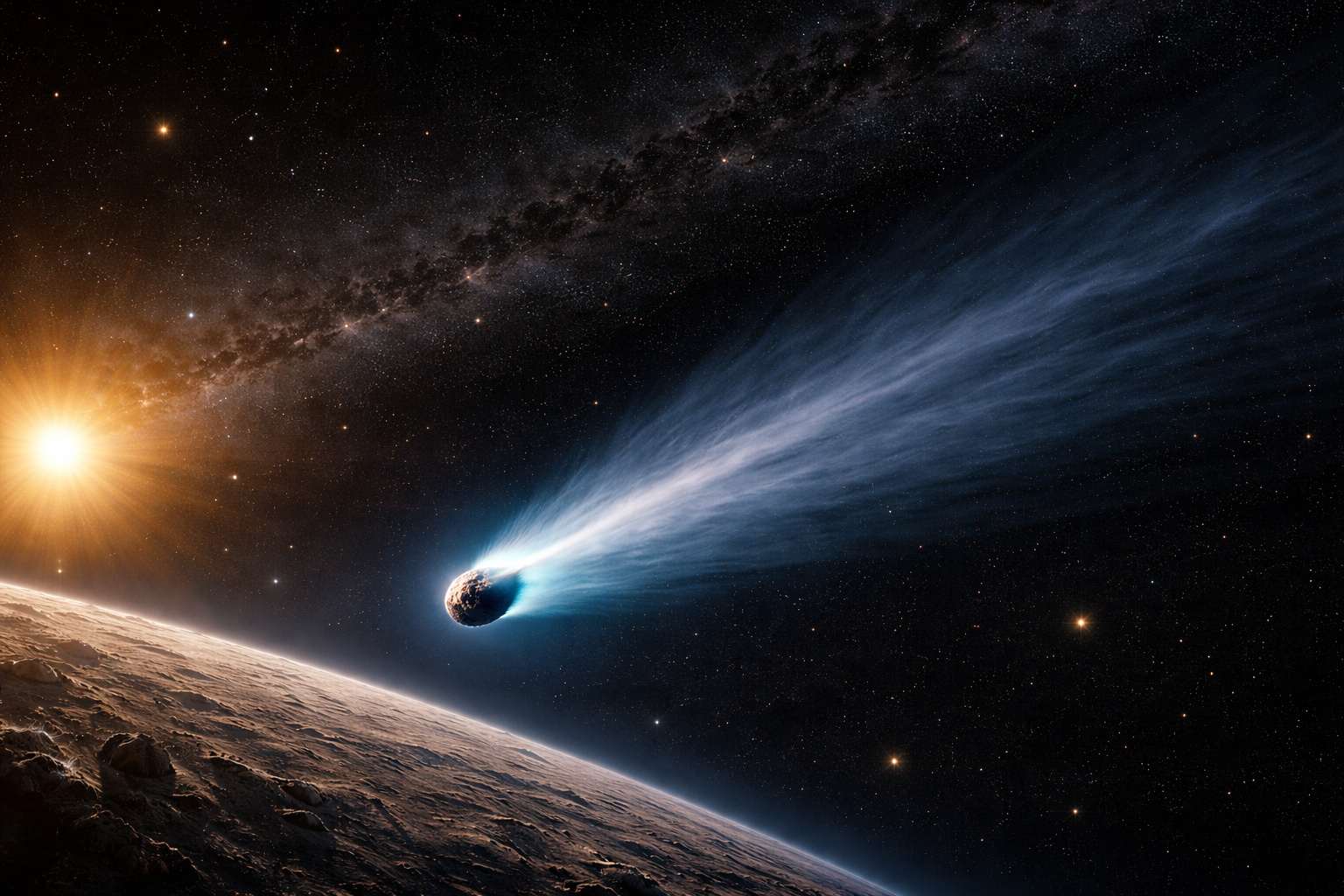


Extreme Change In Rotation Of 41P/Tuttle-Giacobini-Kresák In 2017 Surprises Astronomers And May Help Explain The Destruction Of Comets
In 2017, an unusual astronomical phenomenon caught the attention of the international scientific community. The comet 41P/Tuttle-Giacobini-Kresák drastically slowed its rotation as it approached the Sun, almost stopped completely, and then resumed movement in the opposite direction.

The astronomer David Jewitt, from the University of California, Los Angeles, identified the behavior while analyzing images from the Hubble Space Telescope. He initially published the study on the arXiv platform and later submitted it to the journal The Astronomical Journal, solidifying the record as one of the most unusual ever documented in the Solar System.
Technical Investigation Confirms Extreme Change In Rotation
In March 2017, the Neil Gehrels Swift Observatory recorded that the comet completed a rotation every 20 hours. However, between March and May of that year, the period jumped to 46 hours. This variation surprised researchers, as changes usually occur in minutes, not dozens of hours.
-
Motorola launched the Signature with a gold seal from DxOMark, tying with the iPhone 17 Pro in camera performance, Snapdragon 8 Gen 5 that surpassed 3 million in benchmarks, and a zoom that impresses even at night.

-
Satellites reveal beneath the Sahara a giant river buried for thousands of kilometers: study shows that the largest hot desert on the planet was once traversed by a river system comparable to the largest on Earth.

-
Scientists have captured something never seen in space: newly born stars are creating gigantic rings of light a thousand times larger than the distance between the Earth and the Sun, and this changes everything we knew about stellar birth.

-
Geologists find traces of a continent that disappeared 155 million years ago after separating from Australia and reveal that it did not sink, but broke into fragments scattered across Southeast Asia.

After May 2017, the comet became temporarily invisible from Earth because it passed very close to the Sun. When it reappeared in December of the same year, new Hubble images showed another relevant piece of information: the rotation period dropped to 14 hours.
Based on these measurements, Jewitt concluded that the comet likely reduced its rotation to zero and then resumed spinning in the opposite direction. The astronomer Dennis Bodewits, who also monitored the phenomenon, stated that he had never seen such a large and rapid change.
Physical Mechanism Explains Sudden Braking
Comets are formed from ice and rock remnants from the origin of the Solar System. As they approach the Sun, the heat causes the sublimation of ice and releases gas and dust. This material forms the coma, the cloud surrounding the nucleus.
Additionally, jets of gas can emerge unevenly and act as small natural thrusters. This mechanism directly altered the rotation of 41P/Tuttle-Giacobini-Kresák, as the jets generated enough force to drastically modify its spin period.
Astronomer Jane Luu, from the University of Oslo, explained that scientists had already considered this possibility theoretically. However, it was the first time someone observed a comet performing this inversion in real-time.
Scientific Impacts And Hypothesis About The Lifetimes Of Comets
The case of 41P helps researchers understand why the Solar System has fewer small comets than expected. One hypothesis suggests that gas jets accelerate rotation to the point where the body fragments due to centrifugal force.
According to Jewitt, the evidence indicates that comets may not live for very long, as physical processes contribute to their gradual destruction. Accelerated rotation may represent one of the main factors in this wear.
New Approach Expected For 2028
The comet 41P/Tuttle-Giacobini-Kresák will again approach the Sun in early 2028. Astronomers intend to observe new episodes of instability, especially with the start of operations at the Vera C. Rubin Observatory in Chile, which will enhance the monitoring of small bodies in the Solar System.
In light of this rare phenomenon recorded in 2017, an inevitable question arises: will other comets also be able to reverse their rotation in the coming years or will 41P remain a unique case in the Solar System?








Tudo no universo pode acontecer. Então não fique adimerado.