





 Portuguese
  English
  Spanish
  4 min of reading
  0 comments


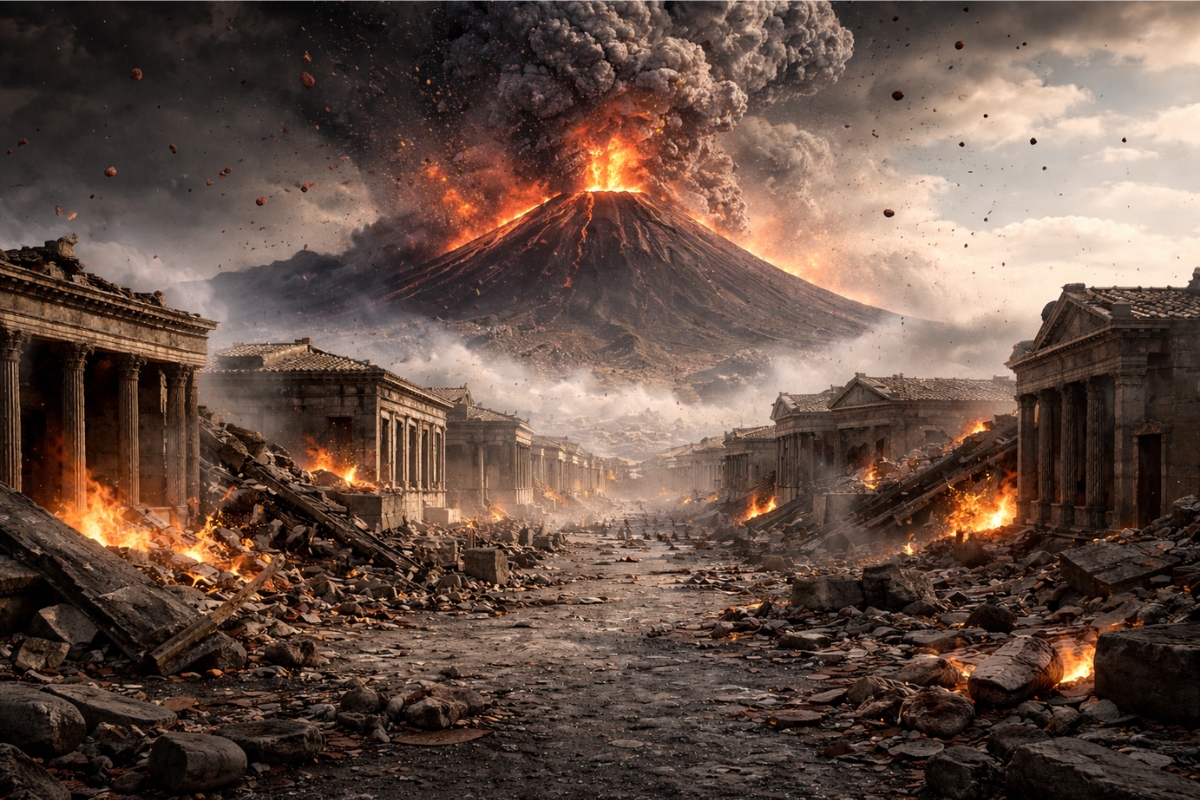
In Pompeii, the Vesuvius Volcano Erupted in 79 With Layers of Up to 7 Meters of Ash to Bury a City of Up to 20 Thousand Inhabitants, Preserving Structures and Routines of the Roman World and Changing Archaeology Forever
The history of Pompeii still impresses today with the contrast between total destruction and almost intact preservation. An active, populous, and organized city simply disappeared in a few hours after the fury of Vesuvius.
What seemed impossible happened in southern Italy. Houses, temples, streets, and even people were frozen in time, covered by tons of ash and volcanic stones.
Centuries later, this burial would become the main reason for the archaeological importance of the site, considered unique in the world for offering a complete view of life in an ancient Roman city.
-
Friends have been building a small “town” for 30 years to grow old together, with compact houses, a common area, nature surrounding it, and a collective life project designed for friendship, coexistence, and simplicity.

-
This small town in Germany created its own currency 24 years ago, today it circulates millions per year, is accepted in over 300 stores, and the German government allowed all of this to happen under one condition.

-
Curitiba is shrinking and is expected to lose 97,000 residents by 2050, while inland cities in Paraná such as Sarandi, Araucária, and Toledo are experiencing accelerated growth that is changing the entire state’s map.

-
Tourists were poisoned on Everest in a million-dollar fraud scheme involving helicopters that diverted over $19 million and shocked international authorities.


The Eruption of Vesuvius That Destroyed Pompeii in Just a Few Hours
Around noon on August 24 of the year 79, the Vesuvius volcano erupted violently. Fragments of ash, stones, and volcanic debris began to fall on Pompeii continuously.
In just a few hours, the city was covered by a layer of approximately 3 meters of volcanic material. The weight was enough to cause the collapse of roofs and structures.
Pyroclastic flows and new rainfalls of ash followed throughout the day. As a result, the accumulated volume reached about 6 to 7 meters, completely burying the city.
Buried Population and Entire City Destroyed

At the time of the eruption, estimates suggest that between 10,000 and 20,000 people lived in Pompeii. Many were crushed by the collapses or died from asphyxiation caused by the gases and ash.
The city ceased to exist abruptly. Public buildings, residences, businesses, and streets were buried under thick layers of volcanic material.
The impact was immediate and total. Pompeii had no time to recover, evacuate, or reorganize.
Centuries Hidden Until Rediscovered in Italy
After the disaster, Pompeii remained hidden for hundreds of years. The city was protected from human actions and climate changes for about 17 centuries.
The ruins were first identified in the late 16th century by architect Domenico Fontana. However, archaeological work only officially began in 1748.
In 1763, an inscription with the expression Rei publicae Pompeianorum definitively confirmed that this location was the ancient Pompeii.


What Was Found in the Excavations of Pompeii
Today, Pompeii has about 44 hectares excavated. The site appears frozen in time, with public and private buildings still visible.
It is possible to find structures such as the Capitolium, the Basilica, temples, forum, amphitheater, villas, houses, public baths, as well as tools and instruments from Roman daily life.
Human remains have also been located. People who attempted to take refuge or escape the eruption had their forms preserved after being enveloped and calcified by the ash.
Graffiti, Elections, and Details of Roman Daily Life
Among the most curious finds are documents such as papyrus and wax tablets with inscriptions. The city’s walls also reveal a large quantity of graffiti.
According to experts, at the time of the eruption, an election was about to take place in Pompeii. This explains the presence of political slogans scattered throughout the city.
There are also personal messages and even defamatory inscriptions, offering a direct and human portrait of Roman society at the time.
Why Pompeii is Considered Unique in the World
The sudden burial protected Pompeii from looting, vandalism, and the passage of time for centuries. This factor preserved rare details of ancient life.
According to UNESCO, Pompeii is the only archaeological site that provides a complete picture of an ancient Roman city.
In 1997, Pompeii, Herculaneum, and Torre Annunziata were recognized as a World Heritage Site, reinforcing the historical and cultural value of the region destroyed by Vesuvius.
The case of Pompeii draws attention because it transforms a tragedy into one of the greatest sources of knowledge about the ancient world, revealing how an entire city lived, worked, and died in a single day.
Did you enjoy learning these impressive details about Pompeii? What else catches your attention in this city frozen in time? Leave your opinion in the comments.
The historical and archaeological information presented in this article is based on data from the Encyclopaedia Britannica, an international reference in history and sciences, especially in content related to Mount Vesuvius and the destruction of Pompeii.










-

Uma pessoa reagiu a isso.