





 Portuguese
  English
  Spanish
  3 min of reading
  0 comments


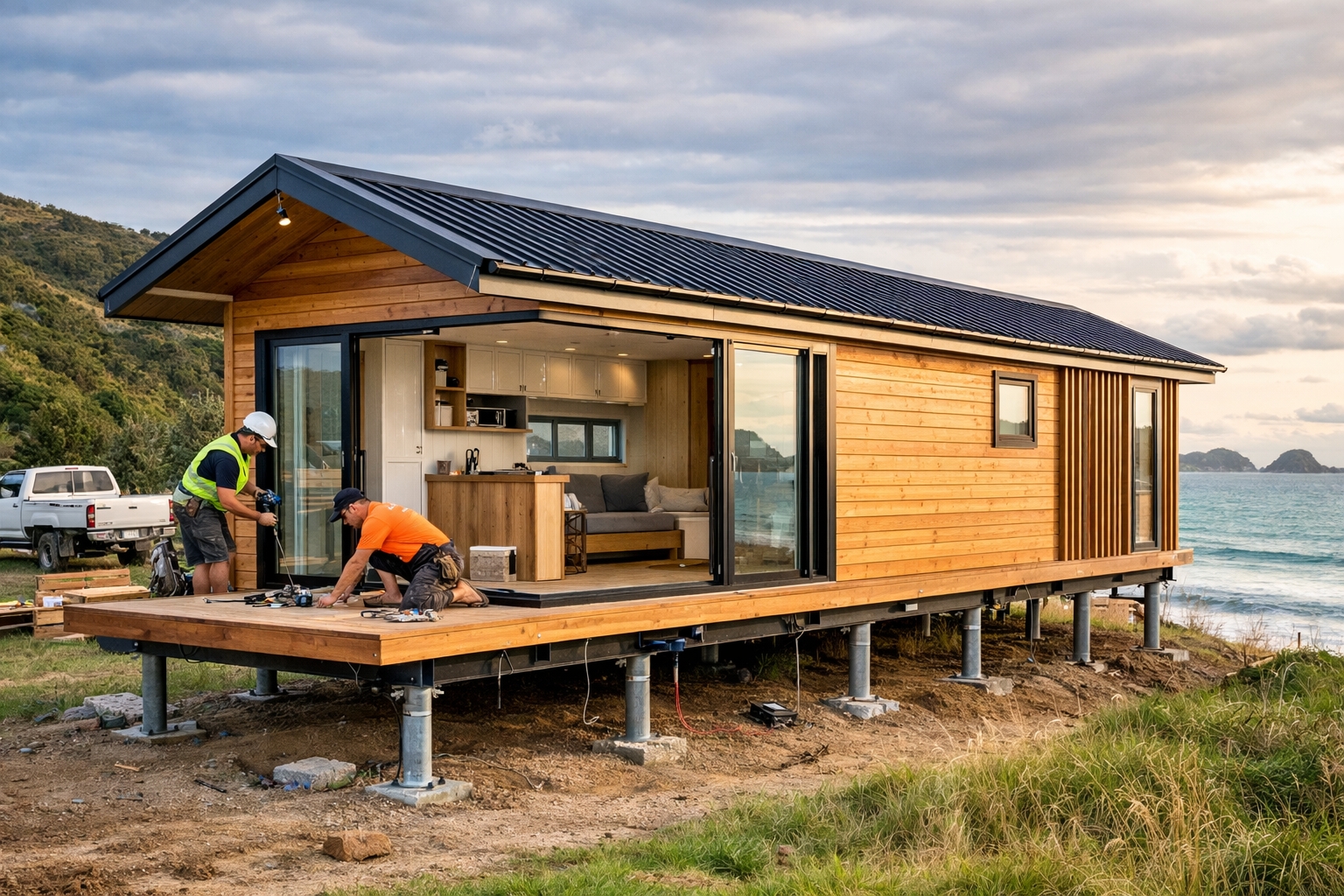
In New Zealand, the South Base Tiny Homes Company Developed a 12 Meter Small House Permanently Installed in a Coastal Area Delivering Apartment Comfort in a Compact Space.
Reducing the size of a house often means sacrificing space, comfort, and circulation. For years, this has been the major dilemma of compact housing. But a project installed on the coast of New Zealand is drawing attention for a different reason. Instead of looking improvised, the small house delivers a sense of spaciousness and unusual structural organization for this type of construction.
What seemed impossible has become a topic of debate among construction professionals and those interested in efficient housing. After all, how far can engineering go when space is limited?

Fixed Structure Expands Possibilities in the Construction of Small Houses
Unlike many compact models on wheels, this house was not designed to be towed. It is 12 meters long and 4 meters wide and was installed permanently.
-
Friends have been building a small “town” for 30 years to grow old together, with compact houses, a common area, nature surrounding it, and a collective life project designed for friendship, coexistence, and simplicity.

-
This small town in Germany created its own currency 24 years ago, today it circulates millions per year, is accepted in over 300 stores, and the German government allowed all of this to happen under one condition.

-
Curitiba is shrinking and is expected to lose 97,000 residents by 2050, while inland cities in Paraná such as Sarandi, Araucária, and Toledo are experiencing accelerated growth that is changing the entire state’s map.

-
Tourists were poisoned on Everest in a million-dollar fraud scheme involving helicopters that diverted over $19 million and shocked international authorities.


This decision changes everything from a construction standpoint.
By not needing to meet transportation limitations, the project could better explore width and structural stability. The result is an interior that resembles a small apartment more than a mobile home.
In practice, this opens up a discussion about a new path in compact construction.
Layout Engineering Eliminates Cramped Mezzanines and Improves Circulation
One of the biggest challenges of small houses is the use of low mezzanines to accommodate bedrooms. Often, the resident cannot even stand up.
In this case, the project adopted a single-story layout. No steep stairs. No low ceiling over the bed.
The bedroom has a ceiling height sufficient for comfortable circulation and includes a queen bed and spacious wardrobes.
This simple solution addresses one of the main critical points of reduced housing and demonstrates how structural planning can completely change the user experience.
Spacious Central Living Room Redefines Space Concept in Compact Housing

The center of the house is occupied by a living room considered large by the standards of compact constructions.
The space includes a sofa, additional chairs, television, ceiling fan, and mini-split air conditioning system.
Double glass doors enhance the entry of natural light and create a sense of visual depth. This architectural detail directly affects the perception of size.
It is a clear example of how lighting and internal distribution impact more than just square footage.
Complete Kitchen Shows That Compact Construction Doesn’t Need to Be Limited
Next to the living room is the kitchen with a counter for two people. The space includes an oven, propane cooktop, refrigerator with freezer, farmhouse-style sink, and a significant amount of cabinets.
Nothing was overly simplified.
Instead of improvised solutions, the project maintained conventional appliances within a compact structure. This demonstrates that well-applied engineering can integrate functionality without drastically increasing the built area.
Suite-Style Bathroom Reinforces Concept of Permanent Housing

The bathroom is positioned next to the bedroom, functioning as a suite. It features a glass shower, sink with cabinet, and conventional flush toilet.
This detail is important.
A large number of small houses rely on reduced or multifunctional solutions. Here, the layout brings the project closer to the traditional standard of fixed residence.
The model is based on the Abel line from South Base Tiny Homes, with an initial value of NZD 230,000, approximately US$ 137,000. There is no disclosure of the exact price for this specific unit.
More than the price, what stands out is the applied concept.
The construction shows that the future of small houses may not lie solely in extreme reduction, but in structural intelligence and strategic use of space.

This case raises an interesting question for the construction sector: Will the next step in residential engineering be to make smaller houses more efficient, rather than simply making them larger?










-

-

-

3 pessoas reagiram a isso.