





 Portuguese
  English
  Spanish
  5 min of reading
  7 comments


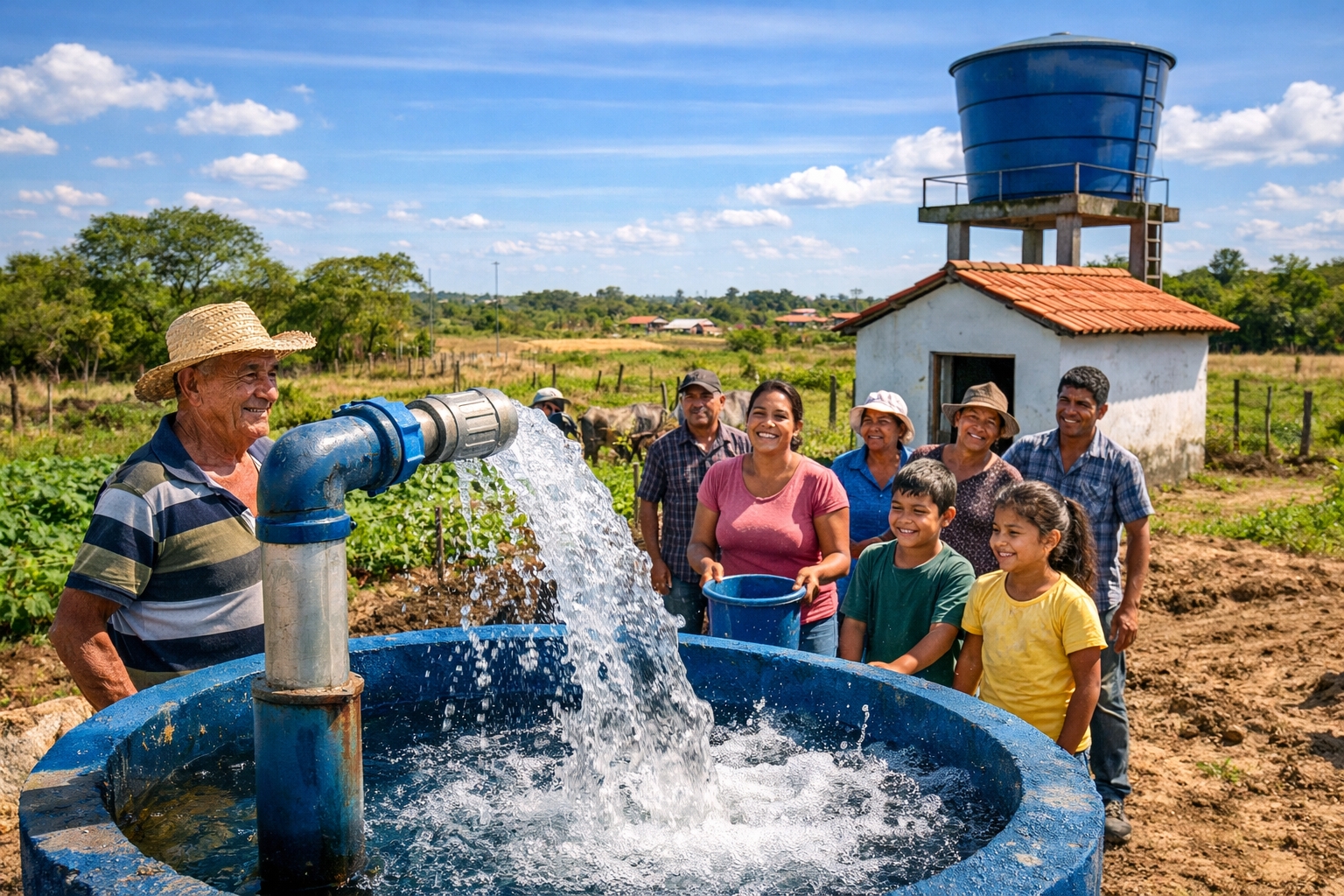


Construction of Artesian Well Promises to Transform Water Access in the Community of Humildes, Strengthen Family Farming, Reduce Inequalities in Rural Areas, and Bring Brazil Closer to Universal Access to Safe Water Goals.
The struggle for water in rural Brazil goes far beyond a simple desire; it is a basic need that still faces deep barriers today. In the district of Humildes, in Feira de Santana (BA), communities such as Borda da Mata, Fazenda Escoval, and Rosário face this challenge every day, especially families connected to family farming, who depend on water both for daily consumption and for planting, raising animals, and maintaining a minimum income in the field.
The proposal for construction of an artesian well there arises as a historic step, which can not only alleviate daily routines but represent a new beginning for those who have suffered for years waiting for quality and regular water, far from surface sources and emergency solutions.
Water in Rural Brazil: A Portrait of Inequality
Despite Brazil housing about 12% of the planet’s surface freshwater and having large water reserves, the reality of access to water is still unequal, especially in rural areas.
-
The lack of welders, electricians, and operators becomes a structural threat in 2025, with the construction industry and manufacturing already suffering from delays, cost pressures, and labor shortages in Brazil.
-
Brazil and Paraguay are just 46 meters away from a historic union on the bioceanic bridge that promises to revolutionize trade between the Atlantic and the Pacific.
-
With 55 km over the sea, a cost of US$ 20 billion, and enough steel to build 60 Eiffel Towers, China’s largest project has connected Hong Kong, Zhuhai, and Macau in a colossal bridge that defies the logic of engineering.

-
A trick with joint compound transforms a Styrofoam ceiling into a plaster-like ceiling: leveled panels, wires and mesh at the joints, sand, paint, and change the environment while spending little today.


Studies indicate that while urban areas enjoy ample supply, in rural zones the coverage is much lower, with a large part of the population still facing irregular access, often insufficient or of questionable quality.
This reflects a structural injustice in the country: despite the human right to water being recognized by the UN since 2010, implementation is still uneven, particularly penalizing isolated, poor communities with less political visibility.
In the Brazilian case, recent estimates show that millions of people still live without regular access to safe drinking water, especially in the North and Northeast, where many rural communities have few alternatives to escape water scarcity.
Construction of Artesian Well Promises to Be a Watershed Moment for Those Living in Communities Far from Urban Centers
The construction of an artesian well can be more than an infrastructure project; it promises to be a watershed moment for those living far from large centers.
Groundwater sourced from artesian wells is usually more stable throughout the seasons and less subject to surface contamination, making it a reliable source for human consumption and productive activities.
In practice, a well-designed well brings direct benefits:
- Ensured water in quantity and quality, reducing dependence on water trucks and exposed sources.
- Support for family farming activities, with water available to irrigate gardens, feed animals, and maintain small crops.
- Improvement in families’ quality of life, which will now have regular access to water suitable for drinking, cooking, and hygiene.
Scientific studies from other regions in Brazil show that artesian wells can be fundamental, especially in dry zones or those weakened by prolonged dry spells, often becoming the primary source of water in rural communities of the Northeast.
From Request to Reality: The Process of Constructing the Artesian Well in Practice
The request for this type of solution in Humildes arose from within the communities. Residents of Borda da Mata, Fazenda Escoval, and Rosário spoke with the local councilor, who took this need to the City Council.
The proposal calls for a technical study to understand whether geological conditions, costs, and social impact justify the drilling and installation. This step is essential; without it, no actual drilling begins.
This study involves analyzing the soil, assessing the depth and flow of the groundwater, and predicting installation costs for pumps, reservoirs, and distribution systems. If the results are positive and the municipality secures funding, the project can be put out to bid and executed.
Afterward, it is always necessary to define how the water will be managed by the community, which preserves conscious use and ensures that the benefit reaches the greatest number of families.
Water and Family Farming: A Relationship of Survival
Many people living in rural areas like those in Humildes do not rely solely on water in their daily lives; it is the foundation of economic survival. Knowing that water is close and stable can be the difference between maintaining a small crop or losing harvests during dry periods.
Public policies that support family farming, such as financial incentives, technical assistance, and access to resources like rural credit, gain even more strength when water ceases to be a constant concern and becomes a real guarantee in the field.
Beyond the Artesian Well: Growing with Dignity
Certainly, the construction of an artesian well in Humildes does not solve all the challenges in the field, but it is a concrete step to face a water access crisis that still affects millions of Brazilians.
Well-thought-out water infrastructure changes habits, protects health, and strengthens the value of rural work. Read more about why access to water is a basic human right according to the UN and global development goals.
Construction of Artesian Well Promises a New Chapter for the Community of Humildes
If realized, the construction of an artesian well in Humildes promises to become a symbol of dignity and achievement for Borda da Mata, Fazenda Escoval, and Rosário; more than just a pipe in the ground, it is a starting point for more social justice in the field.
The impact goes beyond water: it strengthens family farming, improves health, reduces inequalities, and reinforces that well-thought-out public policies transform realities.
Did you enjoy this content? Leave a comment telling how water makes a difference in your life or share this post so that more people understand the importance of this topic!









Eita…… mais do mesmo …. esta “politica” já existe há trocentos anos ……L1 L2 D1 D2…….. T….B1….L3…. se tivesse mesmo sucesso nos governos sociais o nordeste seria um oceano de poços!!!!!!!
Será editado ?
Nada novo !!!! Esta “politica” de implantação de poços já existe a trocentos anos ….e se tivesse realmente sido aplicada pelos governos “sociais” o norte nordeste seria um oceano ….. apenas mais do mesmo
Enquanto isso os parlamentares ficam jogando fora bilhões em emendas.