





 Portuguese
  English
  Spanish
  3 min of reading
  0 comments


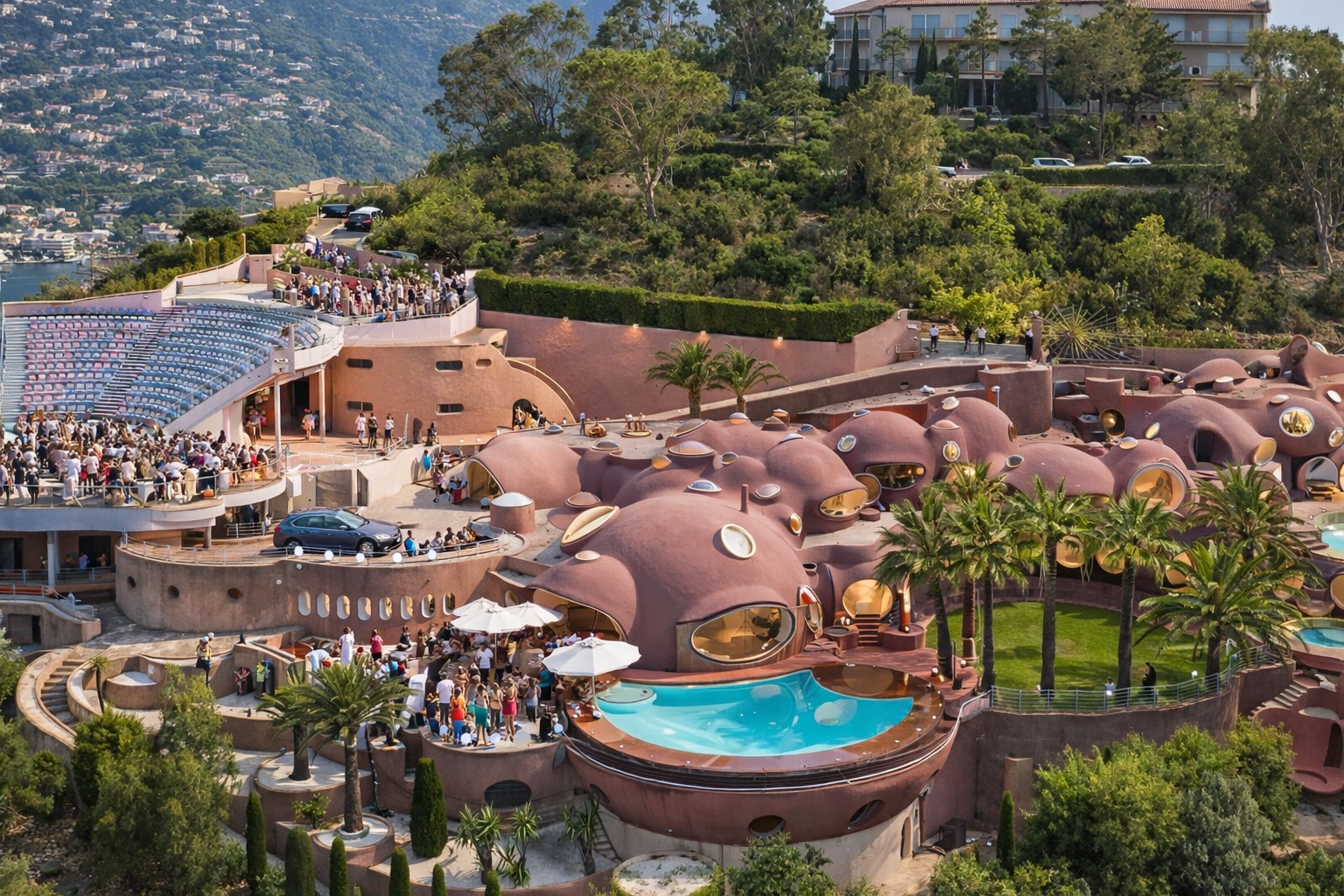
Built In France, The Bubble Palace Brings Together 28 Interconnected Circular Structures, Pools And An Amphitheater In A Project That Combines Organic Architecture, Constructive Innovation And Impact On The International Luxury Market
A house without a single straight line. It may sound like an exaggeration, but it isn’t. In the south of France, the Bubble Palace challenges the standard of traditional engineering by exclusively betting on circular shapes.
There are 28 spherical structures connected as if they were giant bubbles resting on the landscape of the French Riviera. The result draws attention not only for its aesthetics but for the technical complexity that few projects in the world have dared to tackle.
The location has become a stage for million-dollar parties and fashion events that move significant sums. But what truly impresses lies behind the curves.
-
Friends have been building a small “town” for 30 years to grow old together, with compact houses, a common area, nature surrounding it, and a collective life project designed for friendship, coexistence, and simplicity.

-
This small town in Germany created its own currency 24 years ago, today it circulates millions per year, is accepted in over 300 stores, and the German government allowed all of this to happen under one condition.

-
Curitiba is shrinking and is expected to lose 97,000 residents by 2050, while inland cities in Paraná such as Sarandi, Araucária, and Toledo are experiencing accelerated growth that is changing the entire state’s map.

-
Tourists were poisoned on Everest in a million-dollar fraud scheme involving helicopters that diverted over $19 million and shocked international authorities.

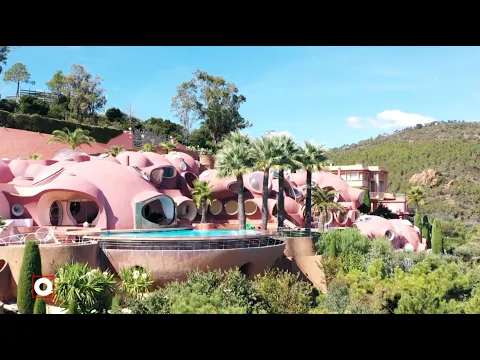

The Architectural Challenge Of Constructing A Mansion Without Straight Lines In A Sector Accustomed To Concrete And Rigid Angles
The construction breaks with the classic model of residential engineering. Instead of straight pillars and flat walls, the project opts for continuous curved surfaces.
According to experts, working solely with circular shapes requires differentiated structural calculations and solutions outside the conventional standards of civil construction. Each sphere needs to connect to another while maintaining stability, insulation, and aesthetic integration.
There is no official number disclosed regarding the total investment, but estimates suggest that projects of this level of structural complexity usually demand contributions capable of redefining the luxury standard of an entire region.
What seemed like mere eccentricity has become an architectural reference.
The Constructive Secret Behind The 28 Bubbles That Transformed Concrete Into Habitable Art
The major advantage lies in adapting engineering to curves. Spherical structures distribute loads differently than conventional buildings.
Instead of concentrating weight at specific points, the rounded shape spreads force across the surface. This reduces structural tensions and allows for, therefore, spacious environments without the need for traditional columns in the center of the spaces.
In addition to the 28 interconnected bubbles, the complex includes pools integrated into the organic design and an amphitheater that extends the residential function for large-scale entertainment.

Thus, the set functions almost like a private microcity shaped by unusual geometries.
From Experimental Work To Global Showcase Of The Luxury Industry And International Events
Over the years, the Bubble Palace has ceased to be just a distinctive residence. The property has started hosting parties and fashion events for the international elite.
This movement has put the project on the luxury market’s radar. Major brands have seen it as a setting that reinforces innovation, exclusivity, and visual impact.
Economically, events of this scale move chains that range from hospitality to audiovisual production. The mansion has transformed into a strategic asset for the region, reinforcing the French Riviera as a high-end hub.
The competition for iconic spaces for fashion launches and private gatherings intensifies the competition among luxury properties in Europe.
What This Organic Architecture Signals For The Future Of High-End Residential Engineering
The success of the Bubble Palace raises an important question: Does traditional architecture still dictate the rules of the high-end market?
Projects with a strong identity and unconventional constructive solutions are gaining ground in a scenario where exclusivity is as valuable as square footage. According to experts, the demand for residences that also serve as a stage for experiences is expected to grow.
By betting on bold geometries and total integration between art and engineering, the French complex shows that structural innovation can become a competitive advantage.
This is not just about aesthetics. It is about market positioning.
In the end, the Bubble Palace draws attention because it proves that engineering and boldness can walk hand in hand, transforming a house into an international symbol of luxury, constructive technology, and economic power.
And you, would you have the courage to live in a house without straight lines or do you think the classic still rules? Leave your opinion in the comments.










-

-

-

-

10 pessoas reagiram a isso.