





 Portuguese
  English
  Spanish
  5 min of reading
  0 comments


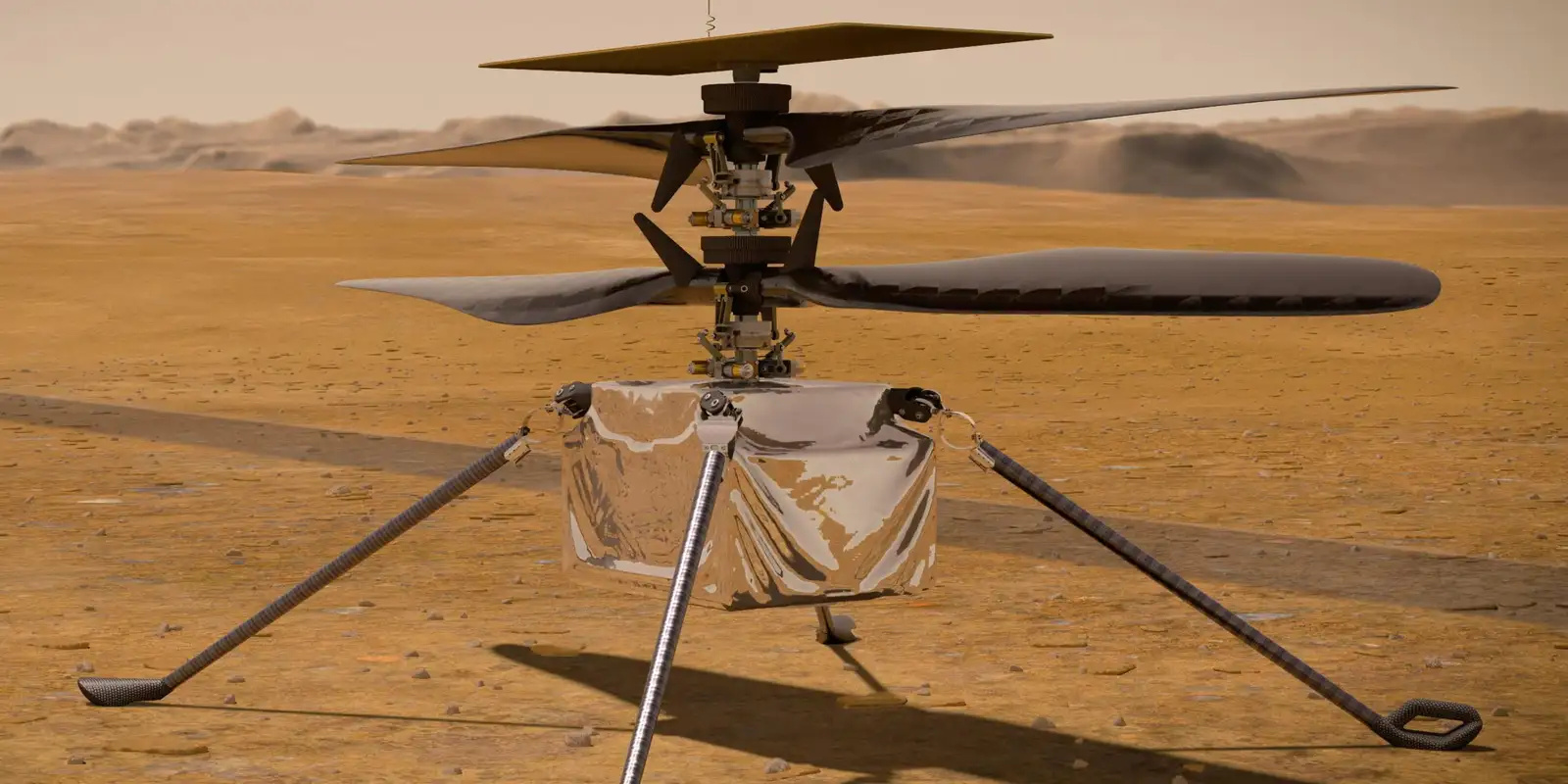
With Only 1.8 Kg, The Ingenuity Helicopter Completed 72 Flights On Mars And Launched The Era Of Interplanetary Aviation In A Thin Atmosphere.
On April 19, 2021, in Jezero Crater on Mars, NASA achieved something that just a few years earlier seemed impossible: it made a helicopter fly on another planet. The challenge was accomplished by Ingenuity, a small technology demonstrator that traveled attached to the Perseverance rover and had a seemingly simple mission on paper, but extremely complex in practice: to prove that controlled flight was possible in the Martian atmosphere.
The information was officially confirmed by NASA and extensively documented by the U.S. space agency throughout the mission. What began as a 30-day experiment with a plan for only five flights turned into an operation that lasted nearly three Earth years. Ingenuity completed 72 flights, traveled over 17 kilometers, and reached altitudes greater than 24 meters before concluding its mission in 2024 after damage to one of the rotor blades.
This was not just a symbolic test. It was the opening of a new technological frontier.
-
Motorola launched the Signature with a gold seal from DxOMark, tying with the iPhone 17 Pro in camera performance, Snapdragon 8 Gen 5 that surpassed 3 million in benchmarks, and a zoom that impresses even at night.

-
Satellites reveal beneath the Sahara a giant river buried for thousands of kilometers: study shows that the largest hot desert on the planet was once traversed by a river system comparable to the largest on Earth.

-
Scientists have captured something never seen in space: newly born stars are creating gigantic rings of light a thousand times larger than the distance between the Earth and the Sun, and this changes everything we knew about stellar birth.

-
Geologists find traces of a continent that disappeared 155 million years ago after separating from Australia and reveal that it did not sink, but broke into fragments scattered across Southeast Asia.

The Martian Atmosphere: The Greatest Physical Obstacle To Flight
Flying on Earth already requires precise control of lift, thrust, and stability. On Mars, the challenge is exponentially greater.
The Martian atmosphere has about 1% of the density of Earth’s atmosphere at sea level. This means the air is extremely thin. Since helicopters rely on air movement to generate lift, Ingenuity needed to compensate for this physical limitation with radically adapted engineering.
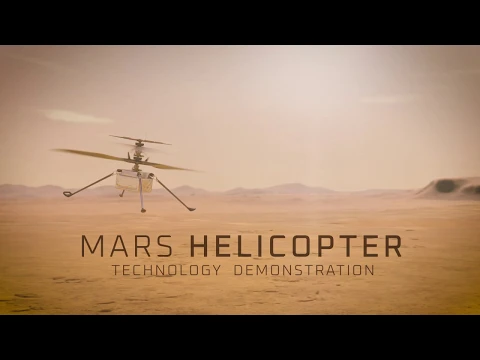

To overcome this challenge, the Jet Propulsion Laboratory (JPL) team at NASA developed large-diameter rotors, approximately 1.2 meters from tip to tip. The blades spun at around 2,400 revolutions per minute, nearly five times faster than conventional helicopters on Earth.
This high rotation was essential to generate enough lift in an environment where there is practically no air to “push.”
Additionally, Martian gravity is about 38% of Earth’s gravity. This factor helped somewhat, but did not eliminate the extreme aerodynamic challenge.
Ultra-Light Structure And Fully Autonomous System
Ingenuity weighed only 1.8 kg on Earth. Its structure used carbon fiber composite materials and ultra-light components designed to maximize strength and reduce mass.
Another critical point was flight control. Since the time delay in communication between Earth and Mars can vary between 4 and 24 minutes, the helicopter could not be remotely piloted in real time. It needed to fly on its own.
Ingenuity operated with an autonomous navigation system, utilizing inertial sensors, downward-facing navigation cameras, and embedded algorithms for stabilization and trajectory correction.
The entire flight sequence was pre-programmed on Earth and sent to the helicopter. From there, it executed the mission completely independently.
This autonomy represented an important technological leap, as it lays the foundation for future interplanetary drones capable of exploring areas inaccessible to rovers.
Solar Energy And Survival In A Hostile Environment
The helicopter had no direct power connection to the Perseverance rover. It depended solely on a small solar panel installed above the rotors.
This panel charged six internal batteries responsible for powering the electronic systems and, primarily, the internal heaters.

At night on Mars, temperatures can drop below -80°C. Without heating, the electronic systems would simply freeze.
A large portion of the energy collected during the day was used solely for the thermal survival of the equipment during the night.
This extreme energy management demonstrated that compact systems can operate in hostile planetary environments with limited autonomy, provided there is precise planning.
From A 5-Flight Experiment To 72 Operational Missions
Originally, Ingenuity was classified as a “technology demonstrator.” Its primary mission initially planned for only five flights over 30 Martian days.
The first flight lasted about 39 seconds and reached approximately 3 meters in height. It was enough to go down in history.
After the initial success, NASA decided to extend the mission. The helicopter then began to function as an air scout for the Perseverance rover.
It flew over the terrain ahead of the rover, mapping safer routes and identifying obstacles such as dunes and rocks.
Over the course of nearly three years, Ingenuity accumulated:
- 72 confirmed flights
- Over 17 kilometers traveled
- Altitudes exceeding 24 meters
- Horizontal speeds of up to 36 km/h
The data was officially released by NASA during periodic mission reports. In January 2024, during a landing, one of the rotor blades suffered structural damage, ending its flight capacity. Still, the helicopter remained functional as a weather station for some time.
The mission was officially considered a complete success.
Technological Impact And The Future Of Interplanetary Aviation
Ingenuity was not just an isolated experiment. It paved the way for new concepts in planetary exploration.
NASA has already announced plans for larger helicopters in future missions, including preliminary studies for the use of aircraft on Titan, Saturn’s moon. The Dragonfly project, also from NASA, is an example of this new generation of extraterrestrial aerial exploration.
The main technical lesson from Ingenuity is clear: motorized flight is viable even in extremely thin atmospheres, as long as the design is adjusted to local physical conditions.
This realization profoundly alters the planning of future missions on Mars. Drones may access canyons, craters, and geological formations that rovers could never reach.
Furthermore, aerial systems can enhance the capacity for scientific data collection, reducing time and operational risks.
A New Stage Of Human Engineering
The first flight on Mars has been compared to the Wright brothers’ first flight in 1903.
Both were brief. Both seemed small at the time they happened. But both changed history.
Ingenuity demonstrated that human engineering is capable of adapting known physical principles to completely different environments from Earth.
It did not transport cargo. It did not carry astronauts. It did not construct bases. But it proved something fundamental: we can fly on another planet.
And this completely changes what is possible in the coming decades. Interplanetary aviation has ceased to be theory. It has become a documented, recorded, and replicable reality. The history of space exploration has taken flight.








Seja o primeiro a reagir!