





 Portuguese
  English
  Spanish
  4 min of reading
  20 comments


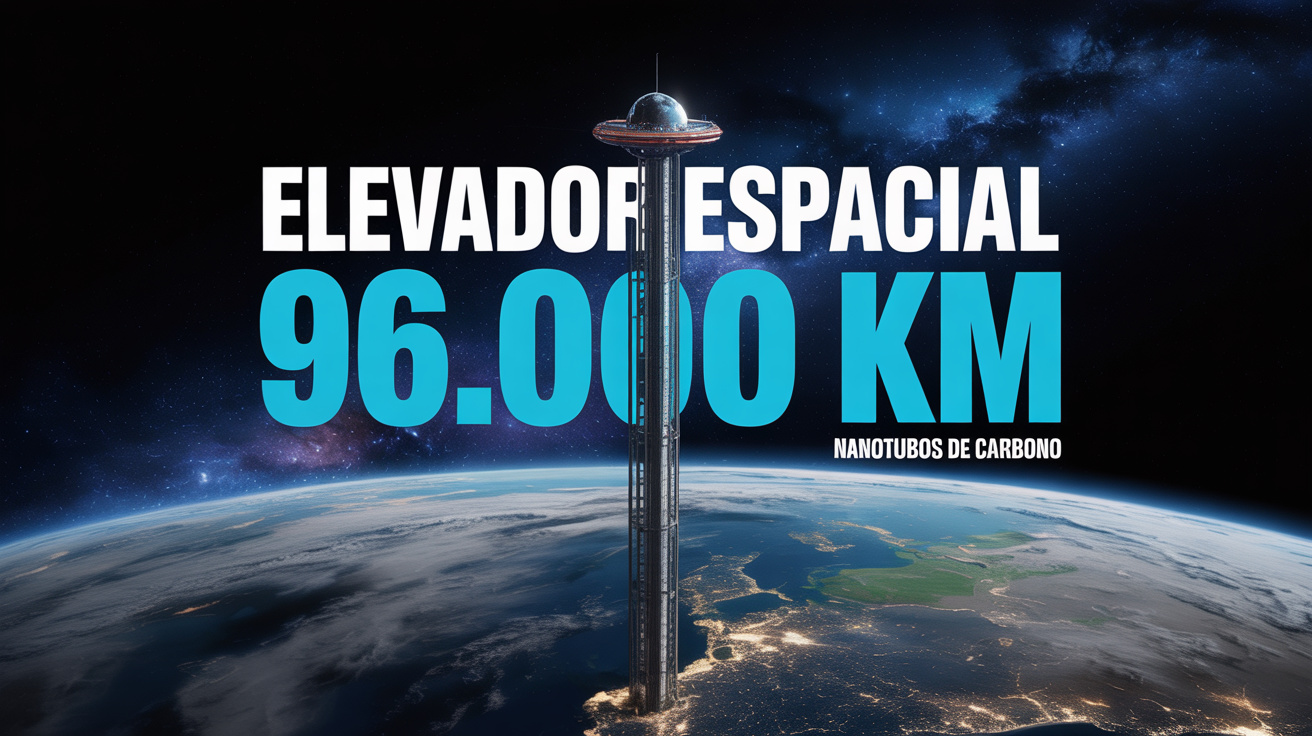


Japan Studies 96,000 Km Space Elevator With Carbon Nanotubes To Connect Earth To Orbit And Reduce Launch Costs.
The idea of a space elevator for decades has been treated as science fiction. However, since the 2000s, the concept has begun to be studied more seriously by academic groups and by one of Japan’s largest construction companies, Obayashi Corporation. The company made public a conceptual plan to build, by 2050, a space elevator capable of connecting the Earth’s surface to geostationary orbit through a cable approximately 96,000 kilometers long.
The project envisions the use of carbon nanotubes as the main structural material, due to their very high mechanical strength in relation to weight. The central objective would be to transform access to space, replacing conventional rocket launches with a continuous vertical transportation system.
Although it is still in the materials study and research phase, the Japanese plan is considered one of the most ambitious proposals ever presented in aerospace engineering.
-
Motorola launched the Signature with a gold seal from DxOMark, tying with the iPhone 17 Pro in camera performance, Snapdragon 8 Gen 5 that surpassed 3 million in benchmarks, and a zoom that impresses even at night.

-
Satellites reveal beneath the Sahara a giant river buried for thousands of kilometers: study shows that the largest hot desert on the planet was once traversed by a river system comparable to the largest on Earth.

-
Scientists have captured something never seen in space: newly born stars are creating gigantic rings of light a thousand times larger than the distance between the Earth and the Sun, and this changes everything we knew about stellar birth.

-
Geologists find traces of a continent that disappeared 155 million years ago after separating from Australia and reveal that it did not sink, but broke into fragments scattered across Southeast Asia.

The Scientific Origin Of The Space Elevator Concept
The concept did not originate in Japan. The idea was originally proposed in 1895 by Russian scientist Konstantin Tsiolkovsky, who imagined a tower connecting Earth to space inspired by the Eiffel Tower. However, only in the 20th century, with the advancement of orbital physics, the model began to be technically discussed.
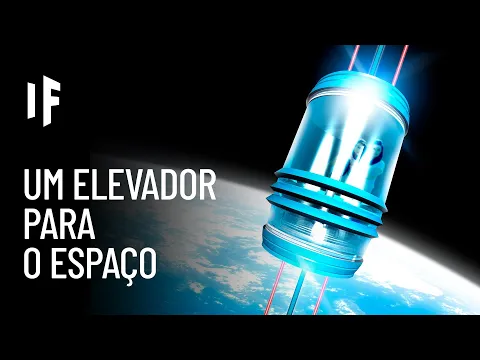

The principle is based on geostationary orbit, which is located approximately 35,786 kilometers above sea level. At this altitude, an object orbits the Earth at the same rotational speed of the planet, remaining seemingly fixed over a specific point on the surface.
For the system to function, the cable would need to exceed this altitude and reach approximately 96,000 kilometers, creating enough tension to keep the structure stable through centrifugal force.
The big challenge has always been the material. No known traditional material had strong enough resistance to support its own weight over tens of thousands of kilometers.
Carbon Nanotubes And The Structural Challenge
Carbon nanotubes are microscopic structures formed by carbon atoms arranged in a cylindrical shape. In the lab, they exhibit tensile strength far greater than steel, with significantly lower density.

It is precisely this combination that makes the material theoretically suitable for a space cable.
The main obstacle is not theoretical strength, but production on a macroscopic scale. There is still no technology capable of manufacturing continuous carbon nanotubes in lengths of tens of thousands of kilometers while maintaining ideal structural properties.
Obayashi Corporation acknowledges that feasibility depends on significant advances in materials science. The company has already conducted concept studies and publicly stated a construction goal by 2050, provided that structural technology is developed.
Japanese researchers have also conducted tests in orbit with small experimental cables using the Japanese Kibo module on the International Space Station to study material behavior in the space environment.
How Rocketless Transport Would Work
In the proposed model, vehicles called “climbers” would ascend the cable carrying cargo and possibly passengers. Energy could be transmitted via laser from the surface or provided by onboard electric systems.
The system would eliminate the need for chemical propulsion for each launch, drastically reducing the cost per kilogram sent into orbit.
Today, launching a kilogram into space still costs thousands of dollars, depending on the vehicle and mission. A space elevator could significantly reduce this cost if the operation were continuous and safe.
In addition to the cost, the system would reduce emissions associated with rocket fuel burning.
Risks And Technological Obstacles
Despite its transformative potential, the challenges are monumental. In addition to the production of the cable, there are risks related to micrometeorite impacts, space debris, solar storms, and structural vibrations.

The dynamic stability of such an extensive structure requires complex modeling of gravitational and centrifugal forces.
Another factor is geopolitical security. A structure of this magnitude would have global strategic importance, requiring international protection protocols.
Experts consider the project theoretically possible, but dependent on scientific advances that have yet to be solidified.
Potential Impact On The Space Economy
If viable, the space elevator could profoundly alter the orbital economy. Satellites, habitable modules, and space infrastructure could be transported more predictably and at a lower cost.
The reduction of economic barriers would increase access to space for smaller countries and companies. Space mining projects, orbital tourism, and industrial stations could become more frequent.
By investing in conceptual studies, Japan positions itself as a key player in a long-term technological race.
Between Futuristic Vision And Real Research
The Japanese plan is not a promise of immediate execution but a conceptual project based on recognized physical principles. The declared goal of 2050 reflects a horizon of decades, not years.
The fact that a major construction company has presented a public timeline demonstrates that the concept has moved from the exclusive realm of fiction into the agenda of experimental engineering.
Challenging gravity through a 96,000-kilometer cable is one of the greatest tests ever imagined for materials science. Success will depend less on the idea and more on humanity’s ability to transform microscopic strength into macroscopic infrastructure.
If this occurs, space transportation could cease to be an explosive and intermittent event, becoming a continuous flow between Earth and orbit.
The Japanese proposal is not just an extreme architectural project. It is an attempt to redefine how humanity reaches space.








Qual superpoder é mais poderoso: Manipulação da Gravidade ou Manipulação do magnetismo?
mesmo se der ****, eu quero ver o Japão construindo isso kkkkk
A Terra vai ter um “****” gigante 😏
E o peso que o terreno onde for construído terá que sustentar ninguém fala nada não?
Seria imensamente maior do que hoje o mesmo terreno hipoteticamente suporta para empurrar uma um foguete para cima como reação a força de propulsão