





 Portuguese
  English
  Spanish
  4 min of reading
  0 comments


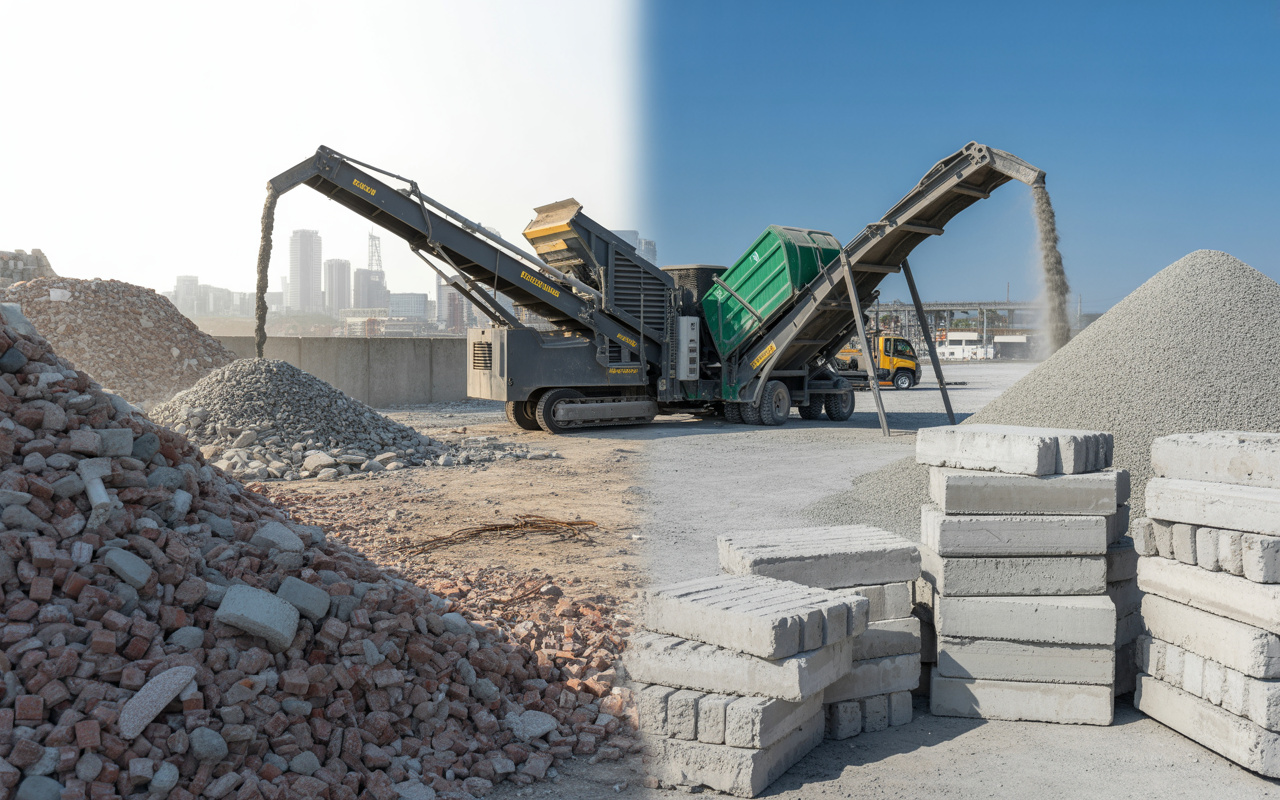
Millions of Tons of Debris Stop Being Waste, Go Through Controlled Recycling and Become Blocks, Pavements, and Urban Infrastructure in Brazil and Europe.
In São Paulo, Curitiba and Madrid, a structured process initiated in the early 2000s has been changing the fate of one of the largest urban liabilities on the planet: construction waste. Consolidated data from IBGE, ABRELPE and the European Environment Agency show that Brazil generates more than 80 million tons of debris per year, while the European Union exceeds 450 million tons annually.
For decades, this material was treated merely as waste. Today, it is crushed, classified, and reused as a base for paving, partition blocks, road sub-base, and non-structural concrete, thanks to municipal public policies, technical standards, and specialized plants operated by municipalities and private companies, with institutional support from CONAMA, ABNT, CETESB, the Institute of Technological Research (IPT) and European universities.
What Is Construction Waste and Why Did It Become a Global Urban Problem
Construction waste, known by the acronym RCC, includes broken concrete, bricks, mortar, ceramics, tiles, excavation soil, and demolition debris. The CONAMA Resolution No. 307, published in 2002, made it clear that this type of waste can account for up to 60% of all urban solid waste in large Brazilian cities.
-
The lack of welders, electricians, and operators becomes a structural threat in 2025, with the construction industry and manufacturing already suffering from delays, cost pressures, and labor shortages in Brazil.
-
Brazil and Paraguay are just 46 meters away from a historic union on the bioceanic bridge that promises to revolutionize trade between the Atlantic and the Pacific.

-
With 55 km over the sea, a cost of US$ 20 billion, and enough steel to build 60 Eiffel Towers, China’s largest project has connected Hong Kong, Zhuhai, and Macau in a colossal bridge that defies the logic of engineering.

-
A trick with joint compound transforms a Styrofoam ceiling into a plaster-like ceiling: leveled panels, wires and mesh at the joints, sand, paint, and change the environment while spending little today.


Without proper control, debris began to occupy irregular areas, riverbanks, and vacant lots, worsening flooding, siltation, and urban cleaning costs. The turning point started when technical studies proved that more than 90% of this material can be reused, as long as it undergoes proper sorting and processing.
How Debris Is Transformed Into New Building Material
The reuse begins right at the construction site. Brazilian legislation has begun to require the minimum separation between mineral waste, recyclables, and rejects, reducing contamination and increasing the quality of recycled material.
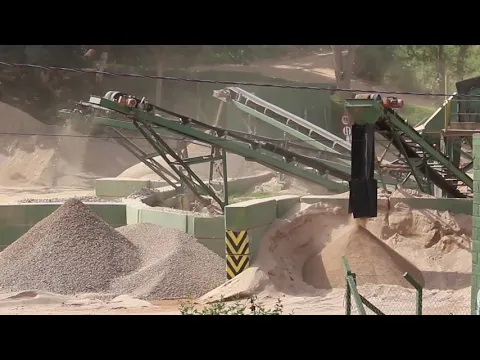
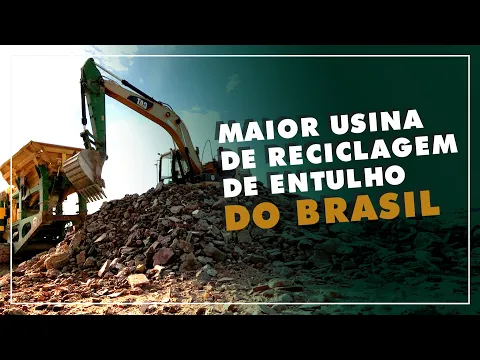
At recycling plants, debris goes through primary and secondary crushing systems. After being fragmented, the material undergoes screening, magnetic separation to remove steel, and granulometric classification. The result is recycled aggregates with controlled technical characteristics.
Studies by the IPT show that these aggregates demonstrate sufficient mechanical resistance for use in urban paving, sidewalks, partition blocks, and non-structural concrete, complying with Brazilian technical standards when applied correctly.
Where This Model Already Functions in Brazil
In São Paulo, since 2011, the city hall has operated and accredited public and private RCC recycling plants. Information from the municipal administration indicates that more than 6 million tons of debris have already been reused in roadway works, reducing costs for transporting natural gravel and disposing of waste in landfills.
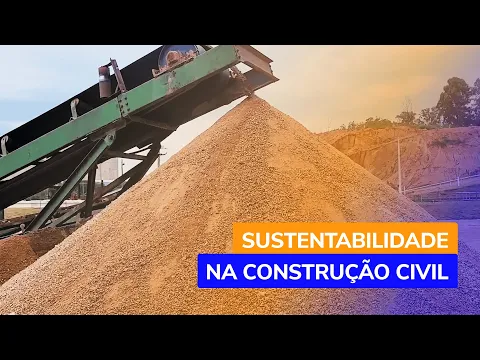
In Curitiba, the mandatory policy for using recycled aggregate in smaller public works was implemented starting in 2014. According to the Municipal Public Works Department, the measure reduced costs for base and sub-base paving on urban roads by up to 40%.
The European Experience: When Recycling Became a Rule
In Spain, the recycling of construction waste gained momentum after the European Directive 2008/98/EC, which set mandatory reuse targets. Cities like Madrid and Barcelona already recycle over 70% of the debris generated, using the material in urban roads, parks, and public infrastructure.
Research from the Polytechnic University of Madrid indicates that pavements made with recycled aggregate perform equivalently to conventional material on low and medium-traffic roads, dispelling the argument that recycled debris would be technically inferior.
Environmental and Economic Impact of Debris Recycling
Each ton of reused debris reduces the need for natural gravel extraction, decreases the energy consumption of quarries, and cuts emissions associated with material transportation. According to ABRELPE, recycling RCC can reduce indirect emissions by up to 30% associated with the construction chain.
This impact is significant in a sector that accounts for about 38% of global carbon emissions, according to data from UN Habitat.
Despite the proven technical viability, debris recycling still faces barriers. There is a lack of consistent monitoring, part of the private market is still skeptical about recycled material, and many medium-sized cities do not have adequate plants.
Experts from the IPT and USP point out that the main obstacle is not technological, but rather cultural, regulatory, and economic, involving urban planning and public incentives.
The Future: Cities Built With Their Own Waste
Pilot projects in Brazil and Europe point to a new urban paradigm. Debris stops being an environmental liability and becomes a strategic raw material, feeding a circular economy model in which the city itself provides the materials for its maintenance and expansion.
With stricter standards, environmental certifications, and pressure for sustainability, the chances grow that the cities of the future will literally be built on the waste of the past.









Seja o primeiro a reagir!