





 Portuguese
  English
  Spanish
  4 min of reading
  2 comments


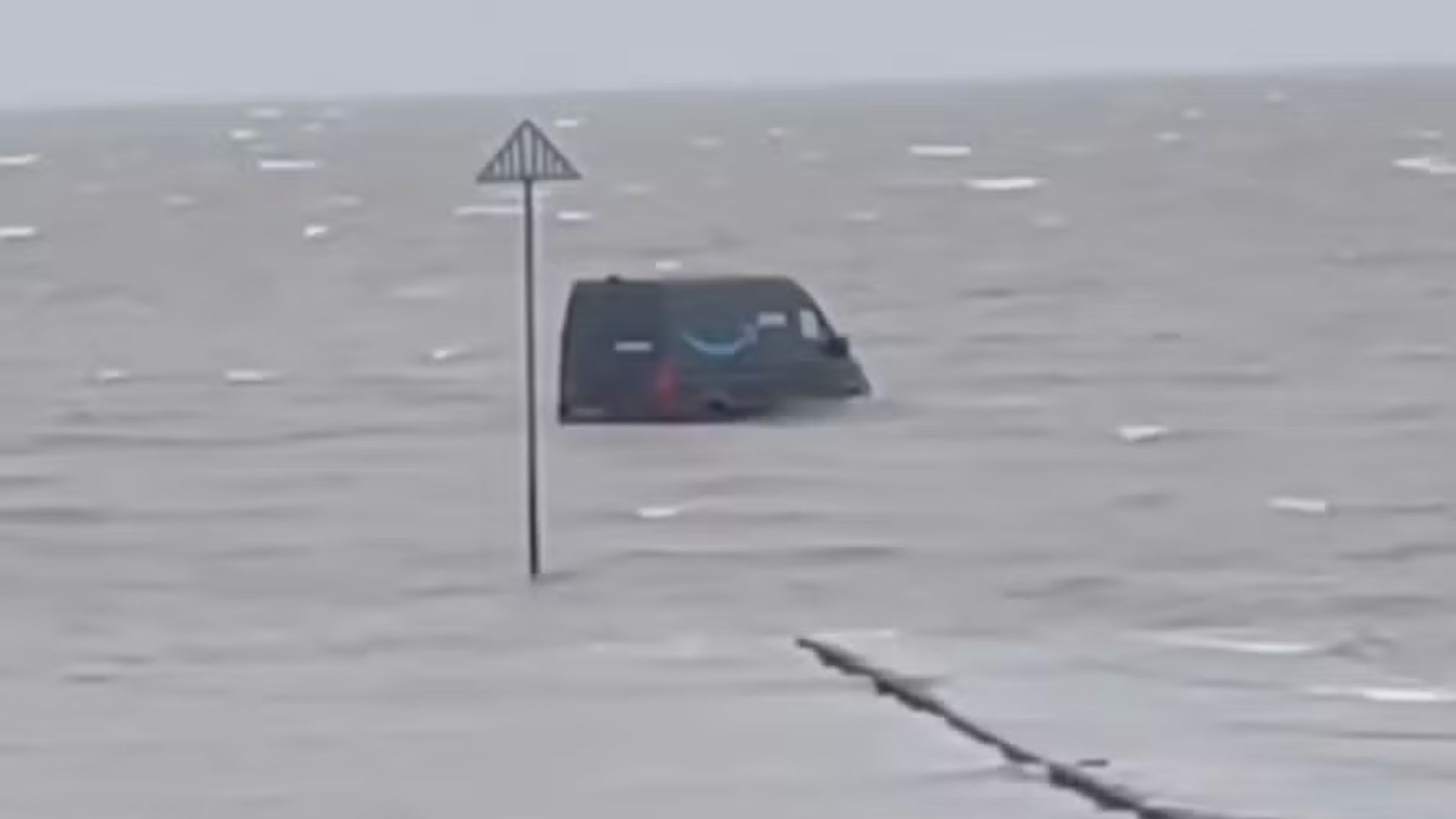


Incident Exposes Risks of Blindly Trusting Digital Navigation When Crossing One of the Most Dangerous Routes in England, Used Only on Foot and Under Specific Conditions
A delivery driver from Amazon faced an extreme situation on the coast of the United Kingdom after following GPS instructions and ending up with the van submerged during high tide. The incident occurred on Sunday (15/2), when the driver was trying to access Foulness Island, an area belonging to the British Ministry of Defence used for weapon testing and military exercises.
However, by trusting the route indicated by the navigation system, the driver entered The Broomway, a path that has existed for about 600 years, known for being one of the most dangerous stretches in England. As a direct consequence of the rapid rise of the tide, the vehicle got stuck in the middle of the river, forcing the driver to abandon the van to preserve his own life.
The information was reported by British press outlets, including BBC News, which detailed the route’s history of risk and the recurring warnings from authorities about the improper use of the location.
-
Friends have been building a small “town” for 30 years to grow old together, with compact houses, a common area, nature surrounding it, and a collective life project designed for friendship, coexistence, and simplicity.

-
This small town in Germany created its own currency 24 years ago, today it circulates millions per year, is accepted in over 300 stores, and the German government allowed all of this to happen under one condition.

-
Curitiba is shrinking and is expected to lose 97,000 residents by 2050, while inland cities in Paraná such as Sarandi, Araucária, and Toledo are experiencing accelerated growth that is changing the entire state’s map.

-
Tourists were poisoned on Everest in a million-dollar fraud scheme involving helicopters that diverted over $19 million and shocked international authorities.


Broomway: A Treacherous Medieval Route Closed to Vehicles

The Broomway is an ancient tidal route that connects the mainland to Foulness Island, crossing extensive mudflats and areas that are completely submerged during high tide. Although it has existed for approximately six centuries, the path was never designed for vehicle traffic and should only be traversed on foot, always with the accompaniment of an experienced guide who knows the dynamics of the tides and terrain.
The incident occurred in the region of Great Wakering, in the county of Essex, a coastal area where water levels can rise quickly and unpredictably. Still, digital navigation apps may indicate the Broomway as a viable route, posing a significant risk to drivers who are unaware of the local characteristics.
According to historical records cited by the BBC, the last known death on the Broomway occurred in 1919. Since then, the location has maintained its reputation as an extremely dangerous passage, especially for those attempting to cross it without technical knowledge or at the wrong tide time.
Coast Guard Warning and Military Restrictions

Following the incident, the British Coast Guard emphasized that the Broomway “is not a route for vehicles” and that its use should be restricted to foot crossings, always with specialized guides. Authorities also highlighted that the area is on property of the Ministry of Defence, with access allowed only when the firing ranges are not active and when the security barriers are open.
According to the official statement, it is an “extremely dangerous” area where navigation errors can result in fatal consequences. Hours after the driver was rescued, the Amazon van was lifted from the location, already significantly damaged by the combination of saltwater and mud.
This type of occurrence, according to security experts, highlights the limits of navigation technology when applied to rural, coastal, or historical areas. Although GPS is a powerful tool, it does not always differentiate between permanent roads and temporary routes or paths subject to tides.
Amazon’s Internal Investigation and Lessons from the Incident
In a statement sent to the newspaper The Telegraph, a spokesperson for Amazon stated that the case is being investigated internally. According to the company, the goal is to determine the circumstances of the incident and assess the safety protocols and routing guidance used by delivery drivers.
Although no one was injured, the episode reignited the debate about the excessive dependence on automated systems in logistics operations. Experts emphasize that even in a high-tech scenario, human analysis, reading warning signs, and knowledge of local conditions remain essential.
In the end, the case of the Broomway leaves a clear lesson for drivers and logistics companies: not every route suggested by an app is safe, and blindly trusting GPS can turn a routine delivery into a high-risk situation.
If this happened in the United Kingdom, would the GPS take the driver right to the doorstep at home — or straight to a shortcut that only exists on the map?









NO BRASIL?
DIRETO PRA FAVELAS E SAI MORTO
Se é proibida, como está no GPS?