





 Portuguese
  English
  Spanish
  4 min of reading
  1 comment


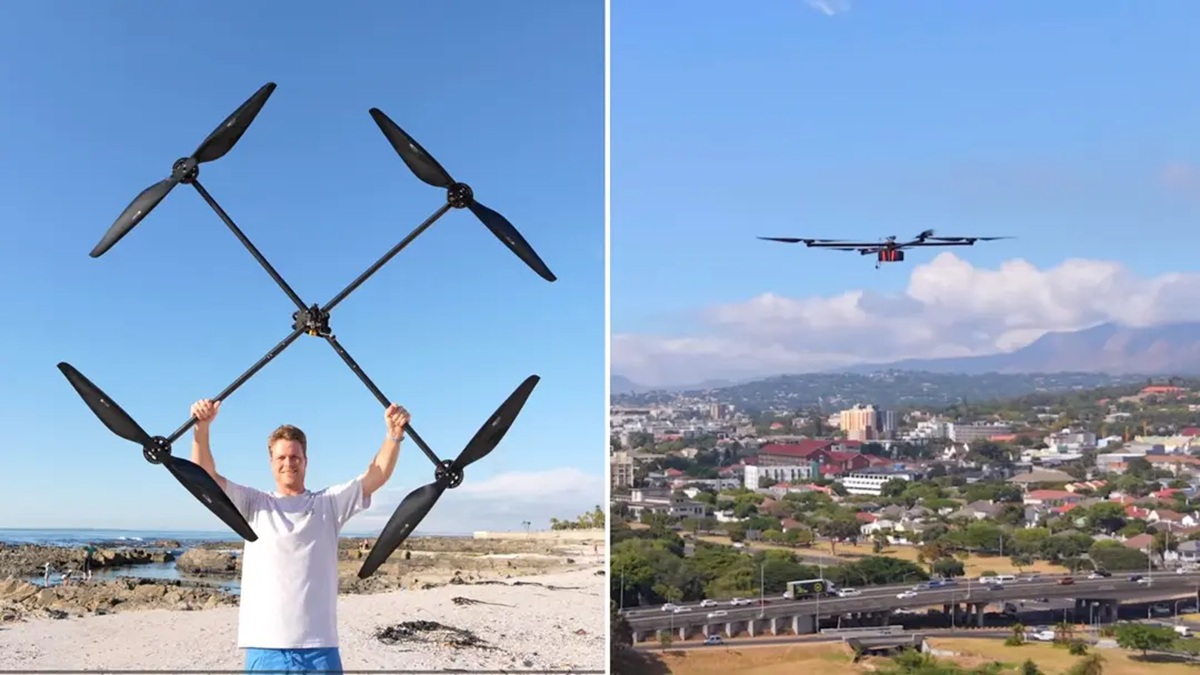


Drone Developed by Luke Maximo Bell Exceeds 3 Hours and 30 Minutes of Flight Time on a Single Charge, Uses 40-Inch Propellers, 320 Wh/kg Batteries and Reduces Consumption from 400 to 250 Watts in Forward Motion, Surpassing Known Autonomy References.
A custom-built drone stayed in the air for over 3.5 hours on a single battery charge during a recent flight conducted by Luke Maximo Bell, demonstrating how energy optimization, weight reduction, and engineering focused on endurance significantly extend operational time.
The flight was led by engineer and drone specialist Luke Maximo Bell, known for setting a world speed record with his Peregrine quadcopters in 2022. This time, he directed the project to maximize endurance, prioritizing autonomy over speed.
The result was an aircraft designed exclusively to stay airborne for as long as possible without recharging. Every technical decision was guided by this central goal.
-
Motorola launched the Signature with a gold seal from DxOMark, tying with the iPhone 17 Pro in camera performance, Snapdragon 8 Gen 5 that surpassed 3 million in benchmarks, and a zoom that impresses even at night.

-
Satellites reveal beneath the Sahara a giant river buried for thousands of kilometers: study shows that the largest hot desert on the planet was once traversed by a river system comparable to the largest on Earth.

-
Scientists have captured something never seen in space: newly born stars are creating gigantic rings of light a thousand times larger than the distance between the Earth and the Sun, and this changes everything we knew about stellar birth.

-
Geologists find traces of a continent that disappeared 155 million years ago after separating from Australia and reveal that it did not sink, but broke into fragments scattered across Southeast Asia.

Drone Prioritizes Engineering Focused Exclusively on Maximum Endurance in Flight
The drone was developed with an absolute focus on durability and energy efficiency. Bell chose 40-inch carbon fiber propellers from T-Motor, model G40, which operate at low rotation speeds.
The propellers spin slowly on low KV motors, reducing energy consumption. Antigravity MN105 V2 motors rated at 90 KV were used, selected for being the lightest capable of turning such large propellers without significant weight increase.
Larger propellers, operating at lower speeds, generate lift more efficiently. This allows the drone to hover while consuming less energy, a determining factor in extending total flight time.
Power is supplied by semi-solid NMC lithium polymer batteries from Tattu, with a density of approximately 320 watt-hours per kilogram. This value represents about double the density of standard lithium polymer cells.
To further increase efficiency, Bell removed 180 grams of packaging from each battery. He also replaced heavy connectors with lighter versions. In total, he reduced 360 grams, a weight close to the total mass of the carbon fiber structure.
Energy Consumption Varies Between 400 Watts in Stationary Flight and 250 Watts in Forward Motion
During stationary flight, the drone consumes approximately 400 watts. When gradually moving forward, the airflow improves lift and consumption drops to around 250 watts.
This efficiency gain played a crucial role in extending autonomy. The combination of lower consumption during movement with high energy density directly contributed to exceeding 3 hours and 30 minutes of continuous flight.
With 2 hours and 14 minutes of operation, the equipment had already surpassed the stationary flight reference from SiFly, maintaining significant battery capacity available. The forward flight further enhanced the overall system efficiency.
The landing occurred with the battery voltage at 2.95 volts, a level chosen to prevent damage to the cells.
Structure with 800-Millimeter Arms Optimizes Interference and Total Weight
The length of the arms was defined after computational fluid dynamics simulations conducted on AirShaper. Multiple configurations were tested until the ideal length of 800 millimeters, equivalent to 31.5 inches, was selected.
Very short arms cause interference between the propeller wakes. Excessively long arms increase structural weight and reduce efficiency. The chosen measure represented the best balance between performance and mass.
The structure uses carbon fiber tubes combined with 3D-printed arms, supports, and landing gear. The assembly maintains structural lightness with enough strength for prolonged flights.
The wiring was also optimized. Each motor requires about 11 meters of wire. Bell selected 18 AWG wire after calculating the relationship between electrical resistance and additional copper weight.
Thicker wires reduce losses due to resistance but increase mass. The final configuration sought maximum energy efficiency with structural balance.
Simplified Electronics Increase Reliability and Reduce Points of Failure
To minimize failures, Bell adopted simplified electronics. Power control is handled by a Holybro Nano Drive 4 in 1 electronic speed controller.
Flight control is managed by a TBS Lucid H7 with INAV firmware. Positioning uses a Matek GPS module. Live video transmission is done through a DJI O4 Air unit.
Initially used lightweight components failed during tests. They were replaced with proven effective parts to enhance system reliability.
Bench tests measured thrust-to-power ratios under different loads. It was found that efficiency decreases as thrust increases, a piece of information that guided weight control to maintain adequate margins.
The initial flights exhibited oscillations and broken components. Each adjustment contributed to the progressive improvement of the project.
After successive refinements, the drone achieved continuous flight exceeding 3 hours and 30 minutes, even under windy conditions. The endurance record is not yet official but clearly surpasses currently known reference standards, consolidating the performance achieved in this project.








Parabéns ao engenheiro. Continue se aprimorando.